…there’s one life…no return and no deposit

It’s the only Broadway musical to have won a Tony Award for Best Revival of a Musical twice and the only show to win a Best Production Tony Award for each of its Broadway productions (1983, 2004, 2010), but its beginnings were far from auspicious to say the least.

Having produced the 1974 Tony nominated revival of Gypsy, for Broadway director, Arthur Laurents, executive producers Fritz Holt and Barry Brown approached their old “teammate” with a new venture, a musical based on a French farce about the son of a St. Tropez nightclub owner and his gay lover, who brings his fiancée’s ultraconservative parents home for dinner. This was 1983 at the height of the burgeoning AIDS epidemic and homophobia was in full surge.  No fan of camp entertainment himself, Laurents figured Holt and Brown would never find the financial backing and only agreed to sign on because they were his friends.

His enthusiasm brightened however, upon meeting the show’s playwright, Harvey Fierstein and its composer/lyricist, Jerry Herman.  Although a script had yet to be completed, Fierstein did have a plot plan for the production, which would bear the name of the original play (and film), La Cage aux Folles, and Herman had already written the song that would serve as the finale for the musical’s first act, and it was a show-stopper.

As the composer/lyricist for such enduring classics as Mame and Hello Dolly! Jerry Herman had long been a Broadway legend, albeit one without a hit for nearly two decades.  Having concentrated on darker-themed productions he was keen to return to form with an optimistic, mainstream, song-and-dance musical that an average, everyday audience would enjoy.  Of course in 1983 nothing said “mainstream and everyday” quite like a gay nightclub owner and his drag queen wife, and Herman is said to have suffered a panic attack before the pre-Broadway Boston unveiling of “La Cage”. For its part, the Boston audience (here in the one-time home of the censorious Watch and Ward Society), gave the show a standing ovation and Jerry Herman would go on to win the Tony Award for Best Musical Score.

While the role of Georges, the St. Tropez nightclub owner and master of ceremonies, was played by (“Bat Masterson” himself) Gene Barry, the pivotal role of Albin, the star drag performer of La Cage aux Folles (and Georges wife) was played by George Hearn.  A long-time Broadway and West End leading man (who’s been married five times), it is Hearn who was most responsible for breathing life into one of Broadway’s most endearing characters.

Written by Herman and sung by Hearn, today’s selection is that show-stopping first act finale, concerning an individual who has been compelled to take a stand in the name of human dignity.

LISTEN TO TODAY’S SELECTION – Wednesday 4 April

I Am What I Am

 I am what I am

I am my own special creation

So come take a look

Give me the hook or the ovation

It’s my world that I want to take a little pride in

My world, and it’s not a place I have to hide in

Life’s not worth a damn

‘Til you can say, “Hey world, I am what I am”

 I am what I am

I don’t want praise, I don’t want pity

I bang my own drum

Some think it’s noise, I think it’s pretty

And so what, if I love each feather and each spangle

Why not try to see things from a different angle?

Your life is a sham ‘til you can shout out loud

I am what I am!

I am what I am

And what I am needs no excuses

I deal my own deck

Sometimes the ace, sometimes the deuces

There’s one life, and there’s no return and no deposit

One life, so it’s time to open up your closet

Life’s not worth a damn ’til you can say

“Hey world, I am what I am!”
…Is it wrong to wish on space hardware?

Perhaps it’s partly as a result of his pluck and determination, but Billy Bragg is one of those artists who grow on you. I became marginally aware of him in the early ‘80s after hearing Kirsty MacColl’s version of today’s selection, but never had occasion to listen to the man himself until the late ‘90s, having purchased the album, Mermaid Avenue.

The actual Mermaid Avenue is the Coney Island street where Woody Guthrie lived (the album cover includes a picture of his house) and Guthrie’s daughter, Nora had asked Bragg to set some of her father’s unrecorded lyrics (and he had many) to music after seeing him perform a Woody Guthrie tribute concert in Central Park.

Bragg asked if he could recruit Wilco (out of Chicago) to serve as his band and the result was a surprising success; so much so that a Volume II was later released. Unsurprisingly, the word “surprising” is used regularly when discussing Stephen William Bragg

Born in Barking, Essex in 1957, he first formed a punk band (called Riff Raff) in the late ‘70, playing pub gigs in the evenings with days spent working in a record store.  But after a number of years and a number of unsuccessful demo tapes, he became disillusioned with his music and joined the British Army as a recruit for the Queen’s Royal Irish Hussars.  Three months in and Bragg saw the light.  Having completed basic training, he managed to buy his way out of the army.

The theory behind such an option is that it’s in no one’s best interest to have a malcontent within the ranks of a professional army, although the more training one has received the higher the cost.  In Bragg’s case it was £175 (in 1981) and he returned to London, initially as a busker and then as a solo act in clubs and pubs around town.

In due course he began to circulate a new demo tape, once again without success.  But this time Billy Bragg wasn’t going to leave it at that and after pretending to be a television repairman, managed to get into the A&R (Artists and Repertoire) offices of aptly named, Charisma Records. Even though Charisma was near bankruptcy (and soon acquired by Virgin Records) Bragg convinced enough of the right people that his music would make a good record and in 1983 the album Life’s a Riot With Spy vs. Spy was released.

He didn’t stop there, however, upon hearing an influential disc jockey at BBC Radio 1 mention on-air that he was hungry, Bragg rushed to the studio with a takeaway biryani and the thankful DJ played a song from his album.  Regrettably the album was unconventionally cut to play at 45 rpm and the DJ played it at the wrong speed.

All was well in the end, however and after repeated play at the correct speed, Life’s a Riot With Spy vs. Spy hit the UK charts, reaching Number 30. Today’s selection comes from that debut album but in typical Billy Bragg fashion, yet another story comes attached.

The idea for “A New England” (not to be confused with “our” New England) came about when Bragg sighted two satellites flying side by side and considered it to be rather romantic. Eventually the notion changed direction, especially after he borrowed the melody from Thin Lizzy’s “Cowboy Song.” You may also recognize a touch of Paul Simon (who Bragg cites as a major influence) as the song’s opening two lines were taken verbatim from Simon and Garfunkel’s “Leaves that are Green.”

None of this “sampling” mattered to Kirsty MacColl who was already a BBC “Top of the Pops” regular.  Nevertheless, she did think that today’s (original) version was too short, so Bragg wrote an additional verse just for her (the additional lyrics are bracketed below) and MacColl’s cover reached Number 7 on the UK charts (her highest charting ever) in 1984.

Upon learning of her death (she was struck while pushing her son out of the way of an oncoming speed boat in Cozumel), Bragg included the additional verse in his next performance and has done so, as a tribute, ever since.

LISTEN TO TODAY’S SELECTION – Tuesday 3 April

A New England

 I was twenty-one years when I wrote this song

I’m twenty-two now, but I won’t be for long

People ask when will you grow up to be a man

But all the girls I loved at school

Are already pushing prams

I loved you then as I love you still

Though I put you on a pedestal,

They put you on the pill

I don’t feel bad about letting you go

I just feel sad about letting you know

 I don’t want to change the world

I’m not looking for a new England

I’m just looking for another girl

I don’t want to change the world

I’m not looking for a new England

I’m just looking for another girl

I loved the words you wrote to me

But that was bloody yesterday

I can’t survive on what you send

Every time you need a friend

 I saw two shooting stars last night

I wished on them but they were only satellites

Is it wrong to wish on space hardware?

I wish, I wish, I wish you’d care

 I don’t want to change the world

I’m not looking for a new England

I’m just looking for another girl

(Looking for another girl)

(Looking for another girl)

(Looking for another girl)

 {My dreams were full of strange ideas

My mind was set despite the fears

But other things got in the way

I never asked that boy (girl) to stay

 Once upon a time at home

I sat beside the telephone

Waiting for someone to pull me through

When at last it didn’t ring, I knew it wasn’t you.

 I don’t want to change the world

I’m not looking for a new England

I’m just looking for another girl

(Are you looking for another girl)}

…I walked across that burning bridge

“Short, sharp shock.” I always assumed the term was coined by British Home Secretary, Willie Whitelaw who, as part of the Thatcher government, used it to describe the quick, severe punishment meted out to young offenders in hopes of scaring them straight.  But as any attentive Gilbert and Sullivan enthusiast will tell you, it stems back at least as far as The Mikado:

To sit in solemn silence in a dull, dark dock,

In a pestilential prison with a life-long lock

Awaiting the sensation of a short, sharp shock

From a cheap and chippy chopper on a big, black block

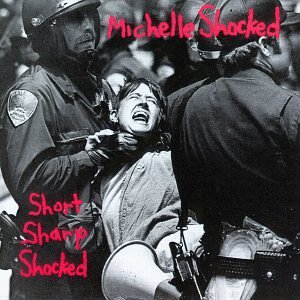
Painful, but quick. Fast forward a century to a 22 year-old singer/songwriter from Dallas, Texas named Michelle Karen Johnston, who decided to change her stage name right after the 1984 Democratic National Convention in San Francisco, where she was forcibly arrested (in a big way) for protesting against major corporations that contribute money to both Democratic and Republican campaigns.

Thereafter known as Michelle Shocked (a contraction of “Miss Shell Shocked”), she later explained that the name refers to the thousand-yard stare symptomatic of shell-shock victims (as they once called those suffering from battle fatigue before it was known as PTSD).  “These people from outward appearances had survived the war quite well,” said Shocked, “when in fact their minds were blown.”

Michelle Shocked first gained popularity in Britain with her 1986 debut album The Texas Campfire Tapes, which perhaps is where she derived the name for her second album in 1988, Short Sharp Shocked.  Today’s pleasantly diverting, slightly incongruous selection is a featured track.

The album cover (which was later closely cropped on re-issue) features a photo taken of the 22 year old Michelle Karen Johnston during the 1984 Democratic National Convention. Explanation, perhaps, for what could possibly compel one to ever come up with such a peculiar new appellation as a performer.

 LISTEN TO TODAY’S SELECTION – Monday 2 April

Anchorage

 I took time out to write to my old friend

I walked across that burning bridge

Mailed my letter off to Dallas

But her reply came from Anchorage, Alaska

 [She said]

“Hey girl, it’s about time you wrote

It’s been over two years you know, my old friend

Take me back to the days of the foreign telegrams

And the all-night rock and rollin’… hey Shell

We was wild then

 Hey Shell, you know it’s kind of funny

Texas always seemed so big

But you know you’re in the largest state in the union

When you’re anchored down in Anchorage

 Hey Girl, I think the last time I saw you

Was on me and Leroy’s wedding day

What was the name of that love song they played?

I forgot how it goes

I don’t recall how it goes

Anchorage

Anchored down in Anchorage

 Leroy got a better job so we moved

Kevin lost a tooth now he’s started school

I got a brand new eight month old baby girl

I sound like a housewife

Hey Shell, I think I’m a housewife

Hey Girl, what’s it like to be in New York?

New York City – imagine that!

Tell me, what’s it like to be a skateboard punk rocker?

Leroy says “Send a picture”

Leroy says “Hello”

Leroy says “Oh, keep on rocking, girl”

“yeah, keep on rocking”

Hey Shell, you know it’s kind of funny

Texas always seemed so big

But you know you’re in the largest state in the union

When you’re anchored down in Anchorage

Oh, Anchorage

Anchored down in Anchorage

Oh, Anchorage

…But there’ll be other days


When he was seventeen (Haven’t we heard this before?), Ronald “Ron” Eldon Sexsmith started playing at the Lion’s Tavern in his home town of St. Catharine’s, Ontario. It was 1981 and he soon garnered a following as the “One-Man Jukebox” for his impressive ability to play whatever was requested. But after a few years, when he grew tired of playing the same old stuff and began to experiment with more obscure (and interesting) tunes, the days of the One-Man Jukebox were numbered.

In 1985 he moved to Toronto, got a job as a courier, formed a band (called The Uncool) and released a cassette, and then another, and still another, along the way being rejected by every major Canadian label.  Far from an over-night success, it wasn’t until 1995 that Ron Sexsmith finally had a hit, “Speaking with the Angels” that at long last led to a contract with Geffen Records and a self-titled album that earned wide attention within musical circles, especially after Elvis Costello began to recommend it.

As more albums were released more recognition followed, from Elton John, Paul McCartney and Ray Davies.  As a matter of fact after Sexsmith recorded “This is Where I Belong” for a Kinks tribute album, Davies invited him to perform with him at a concert in London. Sexsmith songs have since been covered by a broad range of artists including: John Hiatt, Sheryl Crow, Leonard Cohen, k.d. lang, Michael Bublé and (those who have read prior “postings” will find this fitting) Rod Stewart.

About his songwriting Ron Sexsmith has said, “…my main objective is to try and stay out of the way of the song. I want to write songs that are good whether I’m singing them or not.”

Today’s selection comes in praise of a month known for its rejuvenation; a month that always starts on the same day of the week as July (except on leap years when it starts as the same weekday as January) and always ends on the same day of the week as December.  It’s the closing track of Sexsmith’s second (major label) album in 1997, “Other Songs”.

LISTEN TO TODAY’S SECTION – Sunday 1 April 2012

April After All

 It’s really coming down

Raining cats and hounds

It’s falling on parades

And on the plans we made

But there’ll be other days

And things will turn our way

The rain has got to fall

It’s April after all

 Even the longest night

Will lead you to daylight

It’s the way May leads to June

And it’s how I’ve come to you

The world goes spinning round

Life goes up and down

And rain is bound to fall

It’s April after all

 There’ll be other days

Darling come what may

The rain has got to fall

It’s April after all

Tears are bound to fall

It’s April after all

…We’ve got a lot of what it takes to get along

It was based on a 1919 play, which was adapted as a (lost) 1923 silent film before becoming re-adapted into the “top-grossing film of all time,” a claim that lasted for a full decade after its release in 1929.

Yes it had showgirls, and it had sound, introducing the world to “Tiptoe Through the Tulips” and “Painting the Clouds With Sunshine” but perhaps the most fascinating aspect of Gold Diggers of Broadway was that it was filmed in Technicolor (in 1929!) capturing the very essence of the flapper era.

Regrettably, only the last 20 minutes of the film survive, providing the distant modern viewer with a tantalizing glimpse of life in living color, before the Crash. And so we turn to a loose remake, Gold Diggers of 1933, filmed in (more economical) black and white and released in the murky depths of the Great Depression.

What a comedown one might say.  Perhaps, but as the Hay’s “censorship” Code wasn’t enforced until the following year (just after the repeal of Prohibition as a matter of fact), the movie is an absolute wonder thanks to the outlandish, sexually-charged choreography of Busby Berkeley in his pre-code prime.

A dance director for dozens of Broadway musicals in the 1920s, Busby Berkeley William Enos grew up in (surprise, surprise) an entertainers’ household and served as a field artillery lieutenant during the First World War.  Watching soldiers in their intricate military drill is said to have served as a great inspiration for his elaborate routines. His numbers were the best-regimented displays on Broadway and later in Hollywood. And ever more elaborate they became.

By all accounts Berkeley wasn’t overly concerned with his chorus girls’ dancing skills, as long as they could form themselves into remarkable geometric patterns or participate in one of his popular parades of faces. Occasionally criticized for the recurrent display of the “female form as seen through the male gaze” or depictions of “New Deal collectivism” (as opposed to rugged individualism), Berkeley simply shrugged, stating that his foremost objective was to always top himself without repeating past (kaleidoscopic) accomplishments.  One need only look at the astounding “Lullaby of Broadway” number from Gold Diggers of 1935 for “objective” proof.

By decade’s end outsized musicals had become passé and Berkeley resorted to non-musical directing, although he did continue to dabble.  Carmen Miranda’s “Lady in the Tutti-Frutti Hat” is a latter-day Busby Berkeley number, as are those late ‘40s Esther Williams’ swimming finales, all filmed (for a now-accustomed audience) in glorious, living Technicolor.

Of course Gold Diggers of 1933 had one other awe-inspiring asset (okay, Ruby Keeler aside) and that’s the scintillating sight of a young Ginger Rogers (sometimes in EXTREME close-up) singing today’s selection in the midst of a Busby Berkeley routine, albeit a minor one.

Although Harry Warren and Al Dubin’s catchy song, “We’re in the Money” soon became a much-recorded standard, I defy you to find another version that features an entire verse sung in flawless Pig Latin. In addition to the song selection I’ve included a YouTube URL as this is a number that should also be seen.

http://www.youtube.com/watch?v=UJOjTNuuEVw

 LISTEN TO TODAY’S SELECTION – Saturday 31 March

We’re in the Money

Gone are my blues,

And gone are my tears;

I’ve got good news

To shout in your ears.

The long lost dollar has come back to the fold,

With silver you can turn your dreams to gold!

Oh!

 We’re in the money, we’re in the money,

We’ve got a lot of what it takes to get along!

We’re in the money, the sky is sunny,

Old man Depression, you are through, you done us wrong!

Oh!

We never see a headline ’bout a bread line today;

And when we see the landlord,

We can look that guy right in the eye.

We’re in the money, come on, my honey,

Let’s lend it, spend it, send it rolling around!

 Oh, boy, we’re in the money, I’ll say we’re in the money,

We’ve got a lot of what it takes to get along!

Let’s go, we’re in the money, look up, the sky is sunny,

Old man Depression, you are through, you done us wrong!

We never see a headline ’bout a bread line today,

And when we see the landlord,

We can look that guy right in the eye!

We’re in the money, come on, my honey,

Let’s spend it, lend it, send it rolling along!

 Ereway inhay the oneymay, ereway inhay the oneymay!

Eveway otgay ayay otlay ofway atwhay itay akestay otay etgay aylayongwayo!

Ereway inhay the oneymay, ethay iesksays are unnysay!

Oldmay anday eedayessionpray, ouyay aray oothray ootay unday usay ongwrayo!

Eway evernay eesay eadlayinelay ayofay eadbrayinelay otayayday.

Anday enwhay eway eesay ethay andlayord

We’ll ooklay atthay uygay ightray inay ethay eyeyay!

We’re in the money, come on, my honey,

Let’s lend it, spend it, send it rolling around!


…What has become of the green, pleasant fields of Jerusalem?

You’ve easily heard 101 variations of this story through me alone. In today’s case it was 1962 and a seventeen-year-old secondary school kid and his little brother (who was all of fourteen) decided to form a band.  The youngest of eight siblings, and the only boys, Ray and Dave lived in a Muswell Hill (North London) row house where on most Saturday nights their sociable parents would hold lively parties with sing-alongs-aplenty and lots of beer.

The brothers had long since learned to play guitar and between the ongoing music hall numbers and their big sisters’ predilection for jazz, swing and early rock and roll, they had a wide variety of influences.   So with a couple of other schoolmates they formed the Ray Davies Quartet and after a decent enough reception at a school dance, began to play at local pubs and clubs.

In those days Ray wasn’t comfortable with his singing, so the band tried out a number of lead vocalists, including another schoolmate named Rod Stewart, who was eventually dropped as a result of “musical differences” stemming from the fact that their drummer’s mother didn’t like his voice.  Stewart quickly formed another group, called Rod Stewart and the Moonrakers, and it became their local rival.

After graduation Ray left home to study film, sketching, theatre, jazz and blues at the Hornsey College of Art, but by 1964 he was back in Muswell Hill with the latest incarnation of the band, now called the Pete Quaife Band, after the base player. Soon they billed themselves as the Bo-Weevils, then the Ramrods, then the Ravens and it was only after they’d hired (not one but) two managers that they finally settled on the name for which they would become recognized as one of the most important bands in rock history, starting with their first Number One hit only a few months later.

In the words of one manager, they “needed a gimmick, some edge to get them attention; something newsy, naughty but just on the borderline of acceptability… At that time, they were participating in a time-honoured pop ritual—fame through outrage.” As the other put it, “I had a friend who thought the group was rather fun…He came up with the name just as an idea, as a good way of getting publicity. When we went to the band members with the name, they were absolutely horrified.”

According to Ray Davies the name was actually coined by their producer, who took note of what was then considered their “kinky” fashion sense (with brocade jackets, frilled cravats, skinny jeans and hair much longer than the Beatles’ or the Stones’) and said,  “The way you look, you ought to be called the Kinks.” In the retelling Davies added, “I’ve never really liked the name.”

Chosen by “Rolling Stone” as one of the top five “Guitar Songs of All Time” and long considered the “track that invented heavy metal” that first Number One hit was, of course “You Really Got Me.”  And yet Ray Davies is also considered to be rock music’s most insightful, literate (and witty) songwriter.

Today’s section was featured as the opening track to “Muswell Hillbillies” the Kinks’ ninth studio album in 1971. Unfortunately “20th Century Man” failed to reach the Billboard 100 in the States, and was never even released as a single in the UK.  Perhaps this is because the song starts simply and acoustically, and gradually grows in complexity and accoutrement until it’s something else all together, much like the century it represents. I’ll leave it to you to decide whether it’s still relevant, a far easier task than trying to picture Rod Stewart singing lead.

LISTEN TO TODAY’S SELECTION – Friday 30 March

20th Century Man

 This is the age of machinery

A mechanical nightmare

The wonderful world of technology

Napalm, hydrogen bombs, biological warfare

This is the twentieth century

But too much aggravation

It’s the age of insanity

What has become of the green, pleasant fields of Jerusalem?

 Ain’t got no ambition, I’m just disillusioned

I’m a twentieth century man but I don’t want, I don’t want to be here

My mama said she can’t understand me

She can’t see my motivation

Just give me some security

I’m a paranoid, schizoid product of the twentieth century

You keep all your smart modern writers

Give me William Shakespeare

You keep all your smart modern painters

I’ll take Rembrandt, Titian, da Vinci and Gainsborough

Girl we gotta’ get out of here

We gotta’ find a solution

I’m a twentieth century man but I don’t want, I don’t want to die here

Ya’ we gotta’ get out of here

We gotta’ find a solution

I’m a twentieth century man but I don’t want, I don’t want to be here

 I was born in a welfare state

Ruled by bureaucracy

Controlled by civil servants

And people dressed in grey

Got no privacy, got no liberty

Cos the twentieth century people

Took it all away from me

Don’t wanna’ get myself shot down

By some trigger happy policeman

Gotta keep a hold on my sanity

I’m a twentieth century man but I don’t want, I don’t want to die here

 My mama says she can’t understand me

She can’t see my motivation

Ain’t got no security

I’m a twentieth century man but I don’t want to die here

 This is the twentieth century

But too much aggravation

This is the edge of insanity

I’m a twentieth century man but I don’t want to be here

…how can it be

Perhaps like me you’ve wondered why we call it “Thursday” but in French and Spanish it’s “Jeudi” and “Jueves” respectively.  By Jove, here’s why. It’s because in Romance languages this is the day of Jupiter, that rumbling Roman god of thunder, lightning and the great big sky.

Jeudi, check; Jeuves, check; but how does that explain Thursday?  Well, in northern Europe after the Romans “came calling” and (whether they liked it or not) the Germanic people adopted the Roman calendar, Jupiter was identified with the Norse god, Thor; he of rumbling thunder, flashes of lighting and one big hammer.  Hence Jupiter’s day became “Thor’s day” in Germanic languages, of which English is one.

So where’s this leading?  Well, far, from the great northwestern expanses of the Roman Empire, and about 1,500 years after its collapse, an Australian girl named Melanie Horsnell won a songwriting competition and used the money to leave her hometown of Sidney to fly to London, where she lived as a busker for a year.  The wonderful thing about street performing is that it gives you lots of practice in public and Melanie, who hadn’t originally considered a musical career, decided to pursue one.

Back in Sidney she became a regular at the (suburban) Glebe Excelsior Hotel, known for its live music tradition, and slowly joined the vanguard of the local folk scene, building up a fan base.  On the side she was hired to provide songs for Australian television commercials (e.g. McDonalds, Huggies and Johnnie Walker), which led to a National Grid commercial in the States.

Occasionally performing with some fellow musicians under the name… Forever Thursday, it was this collaborative effort that provided the music for Melanie’s next American commercial gig, J.C. Penney and you will doubtless recognize today’s selection, Forever Thursday’s 2007 debut release, which was later released as a whimsical music video that begins with a girl (Melanie) staring quizzically at the great big morning sky…

LISTEN TO TODAY’S SELECTION – Thursday 29 March 

How Can It Be

 I say, and so say I

My morning thought

It knew itself just fine

Until across the room

It caught its first glimpse of my afternoon

How can it be

That these things live in me?

 I say, and so say I

My morning’s day seems nothing like its night

My night so self assured

Was all at sea when faced with dawn’s strange world

 How can it be

That these things live in me?

I say, and so say I

My morning’s day seems nothing like its night

My night so self assured

Was all at sea when faced with dawn’s strange world

 How can it be

That these things live in me?

…riding on a big, blue world

“Boston-style songwriting refers to the introspective and literate breed of singer-songwriter so prevalent in the modern folk music landscape,”  affirms Ellis Paul who has long been positioned at the head of the class in this particular school of folk-pop music that “bridges the gap between the modern folk sound and the populist traditions of Woody Guthrie and Pete Seeger.”

“(It’s a style that) grew out of Boston’s thriving folk scene with its dense collection of colleges, college radio stations and listening rooms,” he adds, noting that Boston-style songwriting “tends to be more about lyric than melody, is intimate and thoughtful but also relevant, often addressing social issues.”

Paul Plissey was born (in 1965) and raised in Presque Isle, Maine (deep in Aroostook County, the largest county east of the Mississippi and northernmost land-area in the Continental U.S.) where he played trumpet in the high school band and was state champion as a 5K runner.  That got him into Boston College on a track scholarship where his 10K time remains one of the best in BC history.

His running aspirations all ended with a knee injury during his junior year so Plissey taught himself to play the acoustic guitar to pass the time and began to write songs with the help of a “Hits of the 70s” songbook. Upon graduation, he began to perform at open mic nights around Boston, while working with inner-city kids. After winning a Boston Acoustic Underground songwriting competition, he received national exposure on a Windham Hill Records compilation, settled on the stage name, Ellis Paul and made the leap to professional musician.

Since his debut record in 1989, Paul has released 17 albums and plays nearly 200 dates a year on the club and coffeehouse circuit, bringing that Boston-style to a venue near you. “Each song is supposed to be like a little three-dimensional world,” he concludes.  “I’m hoping to invite them in, have them make out the details and the reasons for being there and apply them to their own lives. But I’m also hoping to entertain them.”

Today’s selection, long an Ellis Paul standard, comes from his sixth (1998) album, “Translucent Soul”.

 LISTEN TO TODAY’S SELECTION – Wednesday 28 March

The World Ain’t Slowin’ Down

 I found you sitting on a suitcase crying

Beneath my feet

I feel the rumble of a subway train

I laugh out loud

‘Cause it’s the one thing I hadn’t been trying

The train came in breathless

The passengers restless

You say, “Baby, you’ll never change”

You gotta’ get gone, you gotta’ get going

Hey, the world ain’t slowing down for no one

It’s a carnival calling out to you

It sounds like a song

Hits you like scripture

You paint the picture

With colors squeezed from your hand

Weren’t you the kid

Who just climbed on the merry-go-round?

Hey look, the world ain’t slowing down

Hey, hey, the world ain’t slowing down

Hey, hey…

Out on the sidewalk,

Pigeons do the moonwalk

I’ll be dancing like Fred Astair

The lampposts are rocking

The whole town’s talking

Like a fool in a barber’s chair

And I get the sensation

The joy and frustration

Like being caught by a tropical rain

Freedom can numb you

When there’s no place to run to

It feels just like Novocain

You gotta’ get gone, you gotta’ get going

Hey the world ain’t slowing down for no one

It’s a carnival calling out to you

(It’s calling out to you)

It sounds like a song

Hits you like scripture

You paint the picture

With colors squeezed from your hand

Weren’t you the kid

Who just climbed on the merry-go-round?

Hey look, the world ain’t slowing down

Hey, hey, the world ain’t slowing down

Hey, hey…

 You packed up all your handbags

Throwing off the sandbags

I let go and you stepped free

I didn’t want to lose you

You said, “You didn’t choose to

It’s just how your karma came”

But thanks for the vision

And the twenty-twenty wisdom

It hit me like a southbound train

 You gotta’ get gone, you gotta’ get going

Hey the world ain’t slowin’ down for no one

It’s a carnival calling out to you

(It’s calling out to you)

It sounds like a song

Hits you like scripture

You paint the picture

With colors squeezed from your hand

Weren’t you the kid

Who just climbed on the merry-go–

Weren’t you the kid

Who just climbed on the merry-go–

Weren’t you the kid

Who just climbed on the merry-go-round

Hey look, the world ain’t slowing down

Hey, hey, the world ain’t slowing down

Hey, hey, it’s a big, blue world

It’s a big, blue world

Riding on a big, blue world

…just let it go

It was an autumn day in 1967 and the wide-eyed eighteen year old couldn’t believe his luck as he made his way over a (soon-to-be-famous) zebra crossing and entered the (yet-to-be-celebrated) Georgian townhouse at No. 3 Abbey Road in St. John’s Wood.  Having first found work in the EMI tape duplication facility, young Alan Parsons had somehow managed to land a job as an assistant recording engineer here at Abbey Road Studios.

His very first project? The Beatles’ “Let It Be” and yes (!) he was there for the legendary rooftop session.  Next came “Abbey Road” recorded after “Let It Be” but released first. Parsons adeptly continued to apply himself and worked his way up to recording engineer, a title that soon expanded to that of recording “director” as he mixed and recorded a number of Paul McCartney and Hollies albums, as well as Al Stewart’s “Year of the Cat” and most significantly, Pink Floyd’s “The Dark Side of the Moon” (for which he was nominated for a Grammy) among other projects.

Pink Floyd wanted him back for “Wish You Were Here” in 1975 but by then Parsons had moved on to something new, in conjunction with musician/composer/lyricist, Eric Woolfson.  It was called The Alan Parsons Project and using a variable lineup of studio musicians its focus was on concept albums (releasing ten of them over the next decade or so) that were heavily instrumental and generally featured several vocalists rather than a single lead.

Written by Woolfson and Parsons, “Don’t Let it Show” was first released on “The Project’s” second such album, “I Robot” in 1977, as sung by Dave Townsend. Though initially based on Isaac Asimov’s “I, Robot” stories (with his enthusiastic support), because the rights had been granted elsewhere, the album’s title was changed (by dropping the comma) and the futuristic theme was shifted away from Asimov, while retaining the “rise of the machine/decline of man” premise.

A few years later, Pat Benatar covered the song on her debut album, “In the Heat of the Night”.  Although both versions are remarkable, we favor the rendition by a woman who trained as a soprano coloratura (let’s just say she could reach the high notes) prior to becoming an ‘80s rock icon.  Benatar infuses it with a meaning that’s far removed from an alarming science fiction future…and closer to the realm of a young person at a crosswalk, who’s about to take a lucky break and (“damn the torpedos”) run with it for all it’s worth.

 LISTEN TO TODAY’S SELECTION – Tuesday 27 March

Don’t Let It Show

 If it’s getting harder to face everyday

Don’t Let It Show, Don’t Let It Show

Though it’s getting harder to take what they say

Just let it go, just let it go

And if it hurts when they mention my name

Say you don’t know me

And if it helps when they say I’m to blame

Say you don’t own me

Even if it’s taking the easy way out

Keep it inside of you

Don’t give in

Don’t tell them anything

Don’t Let It

Don’t Let It Show

Even though you know it’s the wrong thing to say

Say you don’t care, say you don’t care

Even if you want to believe there’s a way

I won’t be there, I won’t be there

But if you smile when they mention my name

They’ll never know you

And if you laugh when they say I’m to blame

They’ll never own you

Even though you think you’ve got nothing to hide

Keep it inside of you

Don’t give in

Don’t tell them anything

 Don’t Let It

Don’t Let It Show

Even though you think you’ve got nothing to hide

Keep it inside of you

Don’t give in

Don’t tell them anything

Don’t Let It

Don’t Let It Show

…I don’t know where it’s coming from


After Paris it’s the most romantic city I know and having enjoyed Montreal in every season, I guess I’ll have to go with a delightfully mild (late) spring weekend in envisioning today’s selection.  That’s the scene, as for the time… here’s hoping that you too have experienced one of those occasionally beguiling phases that have little to do with age and everything to do with endorphins and “joie de vivre.”

Few have been more adept at capturing joie de vivre (along with its sibling, “sweet sorrow”) than the McGarrigle Sisters, Kate and Anna.  Raised in a mixed English/French Canadian (and highly musical) family in the Laurentian village of Saint-Saveur-des Monts, they began performing publicly in the mid-‘60s, while Kate studied engineering at McGill and Anna was an art major at Ecole de Beux-Arts de Montréal.

They also began to write their own songs, some of them covered by artists as varied as Judy Collins, Nana Mouskouri, Billy Bragg, The Corrs, Maria Muldaur, Elvis Costello and Emmylou Harris. It was one song in particular, “Heart Like a Wheel” that was covered by Linda Ronstadt on her 1974 album of the same name that at long last landed the McGarrigles their first recording contract.

The result was their 1975 self-titled debut album, “Kate and Anna McGarrigle” which led off with today’s selection and amongst its 12 tracks included their own version of “Heart Like a Wheel” as well as (Kate’s then-husband) Loudon Wainwright III’s “The Swimming Song.”  The album was chosen by “Melody Maker” as the best record of the year.

Through the next 30 plus years (until Kate’s death from clear-cell sarcoma at the age of 63) the McGarrigles would release another nine albums, some in English, some in French, with the later recordings occasionally including Kate’s singer/songwriter children, Rufus and Martha Wainwright.

And sometimes the McGarrigles would tour.  I was lucky enough to see them in London in the ‘80s and in Toronto in the ‘90s and on both occasions they made the concert hall feel like the front parlor of an old house in Saint-Saveur-des Monts on a Saturday night.

 LISTEN TO TODAY’S SELECTION – Monday 26 March

Kiss And Say Goodbye

 Call me when you’re coming to town

Just as soon as your plane puts down

Call me on the telephone

But only if you’re traveling alone

Counting down the hours

Through the sunshine and the showers

Today’s the day

You’re finally going to come my way

Let’s make a date to see a movie

Some foreign film from gay Paree

I know you like to think you’ve got taste

So I’ll let you choose the time and place

Have some dinner for two

In some eastside rendezvous

Then we’ll walk

Arm in arm around the block and talk

 Tonight you’re mine


Let’s not waste time

 I do believe the die is cast

Let’s try and make the nighttime last

And I don’t know where it’s coming from

But I want to kiss you till my mouth gets numb

I want to make love to you

Till the day comes breaking through

And when the sun is high in the sky

We’ll kiss and say goodbye