…Life used to be so hard

Before the Spaniards arrived, Laurel Canyon was inhabited by the indigenous Tongva tribe, who enjoyed the use of a spring-fed stream that flowed there throughout the year.  That stream is what eventually attracted Mexican ranchers and when they’d been summarily “moved along” in the mid-19th Century, the Anglo settlers who were next on the scene began to talk in terms of water rights.

Soon after the dawning of the 20th Century an electric (trackless) trolley began to run from Sunset Boulevard to a roadhouse part way up the canyon, which by now was being subdivided into “mountain vacation” properties. Log cabins were especially popular at the time and, until the all-mighty automobile belched its way to the forefront, those that were built beyond the roadhouse were reached either by mule or by foot.  Some of the earliest cabins still exist, including the one owned by Silent film cowboy, Tom Mix (which was later owned by Frank Zappa) and, directly across the street, Harry Houdini’s cabin.

Of course, most of us know Laurel Canyon for the many (often bohemian) celebrities who reside or have resided there, most of them actors and musicians including: Mary Astor, Jim Morrison,David Carradine, Jackson Browne, Werner Herzog, Cass Elliot, Marilyn Manson,  Lead Belly, Eric Burdon, Jennifer Aniston, Timothy Leary, Clara Bow, Louise Brooks,  David Byrne, Canned Heat, Lon Chaney, Jr., George Clooney, Alice Cooper, Micky Dolenz, Fabian, Errol Flynn, Michael J. Fox, Glenn Frey, Greta Garbo, Jimi Hendrix, Boris Karloff, Carole King, k.d. lang, Jerry Lewis, Bela Lugosi,  Dean Martin, Steve Martin, Robert Mitchum,  Patty Duke, Gram Parsons, Iggy Pop, Keith Richards (actually both The Beatles and The Stones spent time in Laurel Canyon), Meg Ryan, Slash, Dusty Springfield, Justin Timberlake, Peter Tork, Orson Wells, Brian Wilson and if you’ve made it this far you get the picture.

Then, of course, there was Crosby, Stills, Nash, Young, Mitchell and Collins.

While Steven Stills had written “Suite: Judy Blue Eyes” about his relationship with Judy Collins, which was featured on Crosby, Stills & Nash’s eponymous debut album in 1969 (hitting Number 29 on the Billboard Charts), Graham Nash wrote today’s selection in reference to his relationship with Joni Mitchell on Crosby, Stills, Nash & Young’s (technically) debut album, “Déjà Vu” in 1970 (hitting Number 30 on the Billboard Charts). This was while Mitchell was releasing her own (third) album, “Ladies of the Canyon.”

As Nash later recounted: “…once you walked into that front door, everything disappeared …and then I started to think, you know, God, that’s an incredibly domestic scene, you know, here we are, Joni Mitchell and Graham Nash, and I’m, you know, put flowers in the vase and light the fire… I love this woman, and this moment is a very grounded moment… I sat down at the piano and, an hour later, ‘Our House’ was done.”

LISTEN TO TODAY’S SELECTION – Tuesday 5 June 

Our House

 I’ll light the fire

You place the flowers in the vase

That you bought today

 Staring at the fire

For hours and hours

While I listen to you

Play your love songs

All night long for me

Only for me

Come to me now

And rest your head for just five minutes

Everything is good

Such a cozy room

The windows are illuminated

By the evening sunshine through them

Fiery gems for you

Only for you

Our house is a very, very, very fine house

With two cats in the yard

Life used to be so hard

Now everything is easy

‘Cause of you

And our la, la, la, la, la, la, la, la, la, la, la…..

Our house is a very, very, very fine house

With two cats in the yard

Life used to be so hard

Now everything is easy

‘Cause of you

And our…

 I’ll light the fire

While you place the flowers in the vase

That you bought today.
…no one knows for certain and so it’s all the same to me

Born in 1961 into a devout Pentecostal family in Paragould, Arkansas, Iris DeMent was the youngest of 14 children. When she was three the family moved to Cypress, California where she grew up, first to the sounds of gospel music and later to the influences of such artists as: Johnny Cash, Loretta Lynn, Joni Mitchell and Bob Dylan.

After college in Kansas City, DeMent remained in Missouri and supported herself as a waitress, while composing songs and honing her guitar and singing skills at open-mic nights around town.  In 1988 she made the leap to Nashville and eventually landed an independent record deal.

Today’s selection was included on her debut album, “Infamous Angel” which was released in 1992 when she was 31 years old. Despite a total lack of support from country radio, the album’s word-of-mouth acclaim landed her a major record deal, with Warner Brothers, which re-issued the album and served as the label for her next two albums as well. Now identifying herself as an “agnostic Christian” DeMent’s themes include religious skepticism, small town life, human frailty and forgiveness.

“Let the Mystery Be” has since been covered by a number of other artists (most notably 10,000 Maniacs) and was one of her numbers during Season One of the BBC Transatlantic Sessions, recorded at Montgreenan Mansion House in Ayrshire, Scotland in 1994. Here’s a YouTube clip, with priceless expressions and a group of musicians who seem to be having way too much fun…

LISTEN TO TODAY’S SELECTION – Sunday 3 June  

Let The Mystery Be

Iris Dement

 Everybody’s wonderin’ what and where they all came from

Everybody’s worryin’ ’bout where they’re gonna go when the whole thing’s done

But no one knows for certain and so it’s all the same to me

I think I’ll just let the mystery be

Some say once you’re gone you’re gone forever and some say you’re gonna come back

Some say you rest in the arms of the Savior if in sinful ways you lack

Some say that they’re comin’ back in a garden, bunch of carrots and little sweet peas

I think I’ll just let the mystery be

 Everybody’s wonderin’ what and where they all came from

Everybody’s worryin’ ’bout where they’re gonna go when the whole thing’s done

But no one knows for certain and so it’s all the same to me

I think I’ll just let the mystery be

Some say they’re goin’ to a place called Glory and I ain’t saying it ain’t a fact

But I’ve heard that I’m on the road to purgatory and I don’t like the sound of that

Well, I believe in love and I live my life accordingly

But I choose to let the mystery be

Everybody’s wonderin’ what and where they all came from

Everybody’s worryin’ ’bout where they’re gonna go when the whole thing’s done

But no one knows for certain and so it’s all the same to me

I think I’ll just let the mystery be

I think I’ll just let the mystery be

…there was a man who lived in a shed

Well, it’s out first Saturday in June and weather permitting, you’re likely to find me in and around my garden shed. Painted and shingled to match the main house, and replete with decorative shutters and flower boxes I use it as the vast majority of North American sheds are used, as a place for a bit of potting and to store a couple of bicycles, a lawn mower and an assorted collection of garden tools.

Here in the States, and despite their exteriors, most sheds are rather utilitarian storage structures, with lingo to match – taking someone to the woodshed,” is a term that generally means, “to mete out punishment” (if only figuratively) and was derived from the once common American practice of disciplining wayward boys away from public view.  Conversely, everyday sheds in the the UK are often viewed as inviting places to actually inhabit for hobbying or tinkering.

Sheds, according to Gordon Thorburn (author of “Men and Sheds”) are a veritable “male necessity,” providing a “place of retreat” for much-needed solace. Right, but whether male or female this notion of solace is certainly one that many artists have cottoned to. I also have a number of friends who run small businesses from their (expanded, sometimes beautifully appointed) sheds.

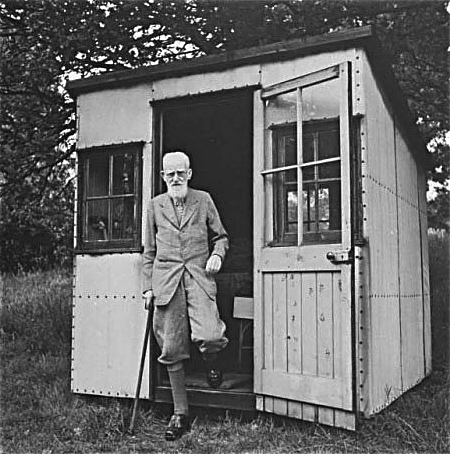
But when it comes to outright shed-creativity, the true champion (in my opinion) has got to be George Bernard Shaw who, for the final decades of his life, worked within the confines of an inredible writer’s shed that he had designed for his Hertfordshire property. To have a rural shed hooked up with electricity, a telephone and a buzzer system in the early half of the 20th Century was remarkable in itself, but what truly made this the Shed of Sheds was the fact that it was built on a turntable, enabling Shaw to push it around to follow the sun.

Man and Supershed – The great man and his writing shed

One way to follow the sun

As an author, a playwright and a progressive voice, Shaw has long been an inspiration, but knowing about his shed-writing habits (e.g. that’s where he wrote “Pygmalion”) was one of the considerations that drove me to accept the offer of some dear friends (whose third floor I was renting) to use the shed at the bottom of their terrace house garden in Tooting (South London) as a “writing hut.”

While it lacked that marvelous turntable, there was ample room for a desk and a case for my books, with windows to steer away the elements and allow me to gaze out at the stars. And while my heating source was a not-very-efficient paraffin heater, there was electricity for my archaic electric typewriter, my battered radio and (certainly not least) my espresso machine. After a year or so I had the entire back wall papered with rejection slips, a cautionary tale to you writers about the futility of unsolicited submissions to publishers through the “slush pile” route.

Although I’ve since come to enjoy the more spacious comforts of attic “garret” offices, there remains something fresh and primal (not to mention cozy) about retreating to the rustic interior of an open-windowed shed. Even if it does let in the rain on occasion, as in today’s selection (…at last) by Gabrielle’s brother, Nick Drake, recorded in 1969 and featured on his debut album, Five Leaves Left.

LISTEN TO TODAY’S SELECTION – Saturday 2 June

Man in a Shed

Well there was a man who lived in a shed

Spent most of his days out of his head

For his shed was rotten let in the rain

Said it was enough to drive any man insane

When it rained

He felt so bad

When it snowed he felt just simply sad.

Well there was a girl who lived nearby

Whenever he saw her he could only simply sigh

But she lived in a house so very big and grand

For him it seemed like some very distant land

So when he called her

His shed to mend,

She said I’m sorry you’ll just have to find a friend.

Well this story is not so very new

But the man is me, yes and the girl is you

So leave your house come into my shed

Please stop my world from raining through my head

Please don’t think

I’m not your sort

You’ll find that sheds are nicer than you thought.


…Hi there, nice to be with you, happy you could stick around

Don’t you hate when that happens?  You wrap yourself around a really cool concept only to find that most of the rest of the world doesn’t “get it.”  It was 25 September 1962 and a couple of students at Central Saint Martins College of Arts and Design (aka CSM) were watching a transatlantic broadcast of the Sonny Liston/Floyd Patterson match (“boom” …third fastest knockout in a world heavyweight title fight).

Somewhere after that first round, tuba player and future lead-vocalist, Vivian Stanshall and saxophonist, Rodney Slater hit it off and started to talk about music.

After pulling in a few of their mates they decided to form a band whose name would be derived from the old “Dada” game of cutting up sentences from a magazine and pulling them out of a hat to re-juxtapose them and form something new. The favorite combination was “Bonzo Dog/Dada” and the band first performed under that name, until they quickly grew tired of having to explain what “Dada” means (most of the rest of the world didn’t “get it”)  And so they became the Bonzo Dog Doo-Dah Band, aka The Bonzos.

Playing mainly as a jazz brass band, they sometimes worked at five pubs a week, gaining a reputation as a band that played “good drinking music” and, in 1966, garnering a record deal.  But the siren call of rock and roll was too hard to ignore and the following year they released their first album, “Gorilla”, featuring today’s selection.

1967 was also the year that Paul McCartney asked them to appear in the Beatles’ Magical Mystery Tour film and preform Stanshall’s song, “Death Cab For Cutie” and it was also the year that they were hired to serve as house band for the ITV program (… I mean, programme) “Do Not Adjust Your Set” which (auspiciously) featured future “Monty Python” alums, Eric Idle, Terry Jones and Michael Palin….

Written by Vivan Stanshall, “The Intro and the Outro” featured every member of the band, credited with their actual instruments, and then moved on to the likes of John Wayne on xylophone and (somewhat) well-known ornithologist, Peter Scott, playing the duck call.  All non-fictional “performers” mentioned were alive at the time with the exception of Casanova and Adolf Hitler.

In 1973, with Stanshell again providing the voiceover, this song provided the framework for Mike Oldfield’s “Tubular Bells”best known as the opening theme for “The Exorcist”

LISTEN TO TODAY’S SELECTION – Friday 1 June

The Intro and the Outro

Hi there, nice to be with you, happy you could stick around

Like to introduce “Legs” Larry Smith, drums

And Sam Spoons, rhythm pole

And Vernon Dudley Bohay-Nowell, bass guitar

And Neil Innes, piano

Come in Rodney Slater on the saxophone

With Roger Ruskin Spear on tenor sax

Hi, Vivian Stanshall, trumpet

Big hello to big John Wayne, xylophone

And Robert Morley, guitar

Billy Butlin, spoons

And looking very relaxed, Adolf Hitler on vibes… Nice!

Princess Anne on sousaphone… Mmmm

Introducing Liberace, clarinet

With Garner “Ted” Armstrong on vocals

Lord Snooty and his pals, tap dancing

In the groove with Harold Wilson, violin

And Franklin McCormack on harmonica

Over there, Eric Clapton, ukulele…. Hi Eric!

On my left Sir Kenneth Clark, bass sax…. A great honour, sir

And specially flown in for us, a session gorilla on vox humana

Nice to see Incredible Shrinking Man on euphonium

Drop out with Peter Scott on duck call

Hearing from you later Casanova, on horn

Yeah! Digging General de Gaulle on accordion….

Really wild, General! Thank you, sir

Roy Rogers on Trigger

Tune in Wild Man of Borneo on bongos

Count Basie Orchestra on triangle…. Thank you

Great to hear the Rawlinsons on trombone

Back from his recent operation, Dan Druff, harp

And representing the flower people, Quasimodo on bells

Wonderful to hear Brainiac on banjo

We welcome Val Doonican as himself (Hullo there)

Very appealing, Max Jaffa…. Mmm, that’s nice, Max!

What a team, Zebra Kid and Horace Batchelor on percussion

And a great favourite, and a wonderful performer, of all of us here

J. Arthur Rank on gong….

…don’t ask me how I know

There are those reading this who may remember a particular music festival in Battersea.  It was 1984 and we had the kind of summery weather that lies at the root of many a poetic inspiration… and we were fancy free and just launching into our physical (though not yet cerebral) prime, with our blankets spread out on a lush green lawn by a carriage drive that runs through one of London’s more interesting parks.

Once separated from the south side of the River Thames by a narrow causeway, the storied Battersea fields mainly consisted of marshland that helped to stock the great city’s markets with carrots, melons, asparagus and with lavender. And this was a celebrated Dueling ground, including the 1829 “settlement of a matter of honour” between the Duke of Wellington and the Earl of Winchilsea.  Winchilsea froze and Wellington, who had “the draw” purposely aimed wide, forcing the imprudent Earl to write him a groveling letter of apology that is remembered to this day.

Lining the riverside itself were industrial wharfs, built to accommodate limekilns, pottery manufacturing, copper and chemical works and in time, that high-tech wonder-of-wonders, the railway.  To the east, where the decommissioned Battersea Power Station nows stands, was a gamey old tavern called the Red House…one of many patronized by Charles Dickens during his incessant research into the human condition.

The old Battersea Power Station as it was, at the northeast corner of the park.

This all changed in the middle of the 19th Century when the Royal Commission to Improve the Metropolis purchased around 200 acres for the development of an idyllically rural park, which was completed in 1858, at about the same time as Chelsea Bridge, to the west.  It was here at Battersea Park, that the first organized football game (“soccer” to some) was played using the rules of the newly formed Football Association in 1864.

In the ensuing years a permanent Children’s Zoo was built, shelters and memorials aplenty were erected, and ponds and various sports facilities were designed-in. There were also numerous venues established for special events that ran from major (most memorably the Festival of Britain) to not-so-major, like that music fest in 1984, held near the southwestern Sun Gate… mere paces from my girlfriend’s indescribably convenient flat, and a refrigerator stocked with great foresight for those between-act beer and cider runs.

Musically, the highlight of this particular event was a spirited set by Alan Price, the iconic keyboard player for the Animals who had gained further acclaim with his solo and film work. Price performed virtually ever song that (at least to me) he’s now remembered for, including today’s selection from the 1953 film, Lili, with a screenplay intriguingly adapted from a short story entitled “The Man Who Hated People.”

Written by Branislau Kaper and Helen Deutsch, the movie version, sung by Leslie Caron and Mel Ferrer reached Number 30 on the pop music charts that year. Although it has since been covered by many artists including: Dinah Shore, Rickie Lee Jones, Gene Vincent, Anne Murray, Slim Whitman, the Everly Brothers and Richard Chamberlain; Alan Price’s appealing 1966 rendition of “Hi-Lilli, Hi-Lo” (which hit Number 11 on the UK Charts) is by far the best…if ever you’re looking for a perfect “song of woe” for that perfect summery day.

LISTEN TO TODAY’S SELECTION – Thursday 31 May 

Hi-Lili, Hi-Lo

 A song of love is a sad song, Hi-Lili, Hi-Lili, Hi-Lo

A song of love is a song of woe

Don’t ask me how I know

A song of love is a sad song

For I have loved and it’s so

I sit at the window and watch the rain, Hi-Lili, Hi-Lili, Hi-Lo

Tomorrow I’ll probably love again, Hi-Lili, Hi-Lili, Hi-Lo.

 A song of love is a sad song, Hi-Lili, Hi-Lili, Hi-Lo

A song of love is a song of woe

Don’t ask me how I know

A song of love is a sad song

For I have loved and it’s so

I sit at the window and watch the rain, Hi-Lili, Hi-Lili, Hi-Lo

Tomorrow I’ll probably love again, Hi-Lili, Hi-Lili, Hi-Lo.

…we know each other very well

It was 1968 and Herb Alpert, known for his phenomenal success with his trumpet, but certainly not for his singing, asked Burt Bacharach if he had any original songs lying around that had never been recorded.  As it happened, Bacharach recalled one, dug it out and said, “Here, Herb, you might like this one.”

The song had an easy-going, Bacharach-David melody, was well within Alpert’s vocal range, and even had a spot for a signature horn solo.  Alpert sang it during a television special (“The Beat of the Brass”) and decided to record it when the network received hundreds of enthusiastic telephone calls after the broadcast.  The resulting single charted at Number 1 on the Billboard Chart and remained there for four straight weeks in 1968. Not only was it Alpert’s first Number One Single, it was also the first Number One Single for his A & M Records label.  But then again, “A & M” stands for “Alpert” & (his partner) “Moss” so perhaps that’s not such a huge surprise after all.

Born and raised in Los Angeles into a musical family with Ukrainian and Romanian roots, Herbert Alpert began his trumpet lessons at the age of eight and played at dances as a teenager. After a stint in the U.S. Army (where he regularly performed during military ceremonies) he gave acting a go (that’s him in the uncredited role of the drummer on Mt. Sinai in the 1956 film, “Ten Commandments”) but while attending the University of Southern California (where he was a member of the Trojan Marching Band) he decided that his future was in music.  This was solidified while attending a bullfight in Tijuana, Mexico, where he (and the rest of the crowd) became inspired by the arousing fanfare of a Mariachi band, whenever it was time for a new event.

Having set up a recording studio in his garage, Alpert adapted the mariachi trumpet style to a tune called “Twinkle Star” and provided his own backing by overdubbing his own trumpet, slightly out of sync.  After mixing in some crowd noise for ambiance he called the song, “The Lonely Bull” by Herb Alpert & the Tijuana Brass” and spread copies around to various radio stations until it caught on.  The song reached Number 6 on the Billboard charts in 1962 and the follow-up album (also called “The Lonely Bull”) was also the first album released by “Alpert & Moss”

In light of the song’s success, Alpert needed a “real” Tijuana Brass” (TJB) and hired a team of session musicians (none of them Hispanic) initially for appearances and then for all ensuing recordings (fourteen of them platinum) with Alpert recordings outselling the Beatles (in North America) in 1966 and with an unprecedented (and never repeated) five simultaneous Top 20 albums (four of them Top 10) on the Billboard Pop Album Chart.

A number of years later, he would become the only solo recording artist ever to chart at Number 1 in the Billboard Hot 100 both with an instrumental performance (1979’s “Rise”) and with a vocal performance, for this expressive 1968 recording of “This Guy’s in Love With You”.

LISTEN TO TODAY’S PERFORMANCE – Wednesday 30 May  

This Guy’s in Love With You

You see this guy, this guy’s in love with you

Yes I’m in love; who looks at you the way I do?

When you smile I can tell we know each other very well

 How can I show you

I’m glad I got to know you ’cause

I’ve heard some talk, they say you think I’m fine

Yes I’m in love and what

I’d do to make you mine

Tell me now is it so, don’t let me be the last to know

My hands are shakin’

Don’t let my heart keep breaking ’cause

I need your love, I want your love

Say you’re in love, in love with this guy

If not I’ll just die

 Tell me now is it so, don’t let me be the last to know

My hands are shakin’

Don’t let my heart keep breaking ’cause

I need your love, I want your love

Say you’re in love, in love with this guy

If not I’ll just die.

…this old world, she’s gonna turn around, brand new bells’ll be ringing

Written by Jonathan Edwards, an Ohio University dropout from Aitkin, Minnesota, who came to the Boston area in the late 1960s, today’s selection is another one of “those songs” that somehow find their way.

With a distinctive voice and a solid repertoire of “country-folk” songs Edwards was beginning to become noticed, serving as opening act for the likes of the Allman Brothers Band and B.B. King, when he signed on with Capricorn Records to record an eponymous debut album.

“We took about a year,” he recounted, “different times, different studios, different sounds, different techniques…Recording was so new in ’69 and ’70. There was a song on the album called ‘Please Find Me’, and for some reason the engineer rolled over it. It got erased. We spent hours looking for it. It was near the end of sessions for the album, “Sunshine” was used to fill the hole.”

Although the unfortunate sound engineer lost his job for (ironically) losing “Please Find Me” Edwards ended up with a hit as the stop-gap song reached Number 4 on the Billboard Charts in 1971.  Having sold well over a million copies, it remains Jonathan Edwards’ (who now lives in Maine and continues to tour) best known song.

LISTEN TO TODAY’S SELECTION – Tuesday 29 May

Sunshine

 Sunshine go away today

I don’t feel much like dancing

Some man’s gone, he’s tried to run my life

Don’t know what he’s asking

He tells me I’d better get in line

Can’t hear what he’s saying

When I grow up I’m going to make it mine

But these ain’t dues I been paying

How much does it cost, I’ll buy it

The time is all we’ve lost, I’ll try it

But he can’t even run his own life

I’ll be damned if he’ll run mine, Sunshine

Sunshine go away today

I don’t feel much like dancing

Some man’s gone he’s tried to run my life

Don’t know what he’s asking

Working starts to make me wonder where

The fruits of what I do are going

He says in love and war all is fair

But he’s got cards he ain’t showing

How much does it cost, I’ll buy it

The time is all we’ve lost, I’ll try it

But he can’t even run his own life

I’ll be damned if he’ll run mine, Sunshine

 Sunshine come on back another day

I promise you I’ll be singing

This old world, she’s gonna turn around

Brand new bells’ll be ringing


…they are not perished, but gone before

Formerly known as Decoration Day and observed on the last Monday of May, Memorial Day originated after our Civil War to commemorate the fallen Union soldiers.  In the South, various regions had their own days of commemoration, but by the early 20th century Memorial Day had been extended to honor All Americans who have died in all wars. By mid century Memorial Day was seen as an occasion for more general expressions of memory, whether the deceased had served in the military or not. On this day I remember all of them, but especially a man who overcame a few challenges to get into combat.


After a battlefield commission, he survived the War in the Pacific (including the New Guinea and Bismarck Archipelago Campaigns and the Invasion of Luzon at Lingayen Gulf) and returned to his homeland as a First Lieutenant in the U.S. Army’s 594th Boat and Shore Regiment.  Upon his return he married his sweetheart and fathered six children, of which I am proudly one.

Today’s selection, written and performed by Peter Skellern (and backed up by the choral group, Libra) was actually written to commemorate Remembrance Day, observed by British Commonwealth countries since the end of The Great War (generally on the 11th of November) to remember those who died in the line of duty.  On this Memorial Day may those whom we all have loved and lost, “Rest in Peace, and Rise in Glory.”

LISTEN TO TODAY’S SELECTION – Monday 28 May

http://www.youtube.com/watch?v=aPh_87UkRFU

 in Peace, and Rise in Glory

For all who need comfort for all those who mourn

All those whom we cherished will be reborn

All those whom we love but see no more

They are not perished, but gone before

And lie in the tender arms of he who died for us all to set us free

From hatred and anger and cruel tyranny

May they Rest in Peace – and Rise in Glory

All suffering and sorrow will be no more

They’ll vanish like shadows at heaven’s door

All anguish and grieving will one day be healed

When all of God’s purpose will be revealed

Though now for a season lost from sight

The innocent slain in the blindness of  “Right”

Are now in the warmth of God’s glorious light

Where they Rest in Peace – and Rise in Glory

Lord give me wisdom to comprehend why I survive and not my friend

And teach me compassion so I may live, all my enemies to forgive

For all who need comfort for all those who mourn

All those whom we cherished will be reborn

All those whom we love but see no more

They are not perished but gone before

Lord keep them safe in your embrace

And fill their souls with your good grace

For now they see you face to face

Where they Rest in Peace – and Rise in Glory

…oh, had I a golden thread

According to her mother she first heard this song while watching Pete Seeger’s public television show, “Rainbow Quest” as it was the opening and closing theme. The family owned many Pete Seeger albums and surely it was also on one of them.

Written in 1958, years later Seeger said he realized that the piece actually incorporated the “…rewritten melody of ‘Nearer My God to Thee.’ … You can see how the folk process has been aided by a bad memory,” he one recounted.

”Regardless, “Oh, Had I a Golden Thread,” with its themes of love, loss, redemption and transcendence, was cited by Eva Cassidy (one of our favorites) as her favorite song, although, curiously, it was never part of her live repertoire. Unplanned, unrehearsed and tossed in at the end of a recording session, today’s selection was incongruously included on her self-released album “Live at Blues Alley” with the record’s other songs recorded live at the Blues Alley Nightclub in Georgetown.

Released only months before her death, she felt that this impromptu studio “knees up,” so fitting for a Memorial Day Weekend, was one of her finest performances.

LISTEN TO TODAY’S SELECTION – Sunday 27 May

Oh Had I a Golden Thread

Oh, had I a golden thread

And a needle so fine

I would weave a magic spell

Of a rainbow design

Of a rainbow design

In it I would weave the courage

Of women giving birth

And in it I would weave the innocence

Of the children of all the earth

Children of all the earth

I want to show my brothers and sisters

My rainbow design

Cause I would bind up this sorry world

With hand and heart and mind

Oh, hand and heart and mind

Oh, had I a golden thread

And a needle so fine

I would weave a magic spell

Of a rainbow design

Of a rainbow design

…don’t forget the robin

No stretch as to where this mind is at the beginning of another Memorial Day Weekend. Why it’s in England via Australia, of course. And it’s not the only time (eh, Rolf Harris?) that it has taken an Aussie to revive the British public’s interest in English folk music…actually British and beyond, because who amongst us doesn’t associate ENGLISH with “Country Garden”?

Born in Melbourne in1882, George Percy Aldridge Grainger was a composer, arranger and pianist who, to this day is most generally associated with his piano arrangement of the folk-dance tune “Country Gardens” (collected by Cecil Sharp and arranged by Grainger).

Landing in London in 1901, he established himself first as a society pianist and then as concert performer, composer and traditional folk music collector.  But then in 1914, at the start of the Great War, the Australian who shed light on one of the most quintessential English tunes moved to America and ended up taking his U.S. citizenship, after serving as a band member in the U.S. Army, in 1918.

Born in Washington State and not to be confused with Jimmy Rogers the Country singer, Jimmie Rodgers grew up in a musical household and served in the United States Air Force in Korea.  After being discharged he became a contestant on Arthur Godfrey’s radio talent show.  And RCA was waiting to sign him up.  You might remember his debut hit in 1957, “Honeycomb” followed by a number of other single hits on the Billboard Charts.    

But in the UK no Jimmie Rodgers song ever topped today’s selection, which reached Number 5 in the chart in June 1962.

LISTEN TO TODAY’S SELECTION – Saturday 26 May

English Country Garden

How many kinds of sweet flowers grow

In an English country garden?

I’ll tell you now of some that I know

And those I miss you’ll surely pardon

Daffodils, Heart’s Ease and Flox

Meadowsweet and Lady Smocks

Gentian, Lupine and tall Hollyhocks

Roses, Foxgloves, Snowdrops, Forget-Me-Nots

In an English country garden

(In an English country garden)

 How many insects come here and go

Through our English country garden?

I’ll tell you now of some that I know

And those I miss you’ll surely pardon

Fireflies, moths and bees

Spiders climbing in the trees

Butterflies that sway on the cool gentle breeze

There are snakes, ants that sting

And creeping things

In an English country garden

(In an English country garden)

 How many songbirds fly to and fro

Through our English country garden?

I’ll tell you now of some that I know

And those I miss you’ll surely pardon

Bobolink, Cuckoo and Quail

Tanager and Cardinal

Bluebird, Lark, Thrush and Nightingale

There is joy in the spring

When the birds begin to sing

In an English country garden

(In an English country garden)

Robin (Robin, robin)

Don’t forget the Robin (Don’t forget the robin)

Robin (Robin, robin)

Don’t forget the robin…