…my life has been a poor attempt to imitate the man

Although it is accompanied by far fewer greeting cards and phone calls than it’s counterpart, Mother’s Day (which has been observed for well over a full century), Father’s Day is now celebrated on this, the third Sunday in June, in numerous countries throughout the world.

In the United States the driving force behind its recognition was Sonora Smart Dodd of Spokane, Washington, whose Civil War veteran father had raised six children as a single parent.  Because of Dodd’s incessant campaigning, the first Father’s Day was commemorated in Spokane in 1910.

In 1916 President Woodrow Wilson traveled to Spokane and proposed that Father’s Day become a national holiday, but Congress was opposed to the idea.  In 1924, President Calvin Coolidge made a similar proposal and he too was rebuffed by Congress.  Actually it wasn’t until 1966, when President Lyndon Johnson issued a presidential proclamation to honor fathers, that this day was designated as Father’s Day, and it wan’t until 1972, when President Richard Nixon signed it into law, that it actually became a permanent national holiday.

Today’s selection was written and performed by Dan Fogelberg, less than a decade after that presidential signing, to honor his own father, Lawrence, who’d long served as director of Peoria’s Woodruff High School Band and who died soon after its release.  Featured on his 1981 (and seventh) album, “The Innocent Age,” which itself was inspired by Thomas Wolfe’s 1935 poignant novel “Of Time and The River,” the song was Fogelberg’s second single (after “Longer”) to reach Number One the U.S. Billboard Charts.

LISTEN TO TODAY’S SELECTION – Father’s Day 17 June

The Leader of the Band

An only child alone and wild

A cabinetmaker’s son

His hands were meant for different work

And his heart was known to none

He left his home and went his lone

And solitary way

And he gave to me a gift I know

 I never can repay

A quiet man of music

Denied a simpler fate

He tried to be a soldier once

But his music wouldn’t wait

He earned his love through discipline

A thundering, velvet hand

His gentle means of sculpting souls

Took me years to understand

The leader of the band is tired

And his eyes are growing old

But his blood runs through my instrument

And his song is in my soul

My life has been a poor attempt

To imitate the man

I’m just a living legacy

To the leader of the band

My brothers’ lives were different

For they heard another call

One went to Chicago

And the other to St. Paul

And I’m in Colorado

When I’m not in some hotel

Living out this life I’ve chose

And come to know so well

I thank you for the music

And your stories of the road

I thank you for the freedom

When it came my time to go

I thank you for the kindness

And the times when you got tough

And, papa, I don’t think

I said, “I love you” near enough

The leader of the band is tired

And his eyes are growing old

But his blood runs through my instrument

And his song is in my soul

My life has been a poor attempt

To imitate the man

I’m just a living legacy

To the leader of the band

I am the living legacy

To the leader of the band

…what a world of happiness their harmony foretells

It was a tradition that lasted 60 years.  And then it stopped in 2009.

Every January 19th (starting in 1949, or so it’s believed) a mysterious visitor, clad in black, his face obscured by a scarf, with a silver tipped cane in his hand, would furtively appear from the early morning shadows in the churchyard of Baltimore’s Westminster Church. He would leave three roses on the original (as opposed to “new”) gravestone of Edgar Allan Poe…then pour himself a glass of Martell cognac, raise a toast and, after leaving the bottle next to the roses, he would vanish back into the darkness.

Despite the presence of a growing crowd of reporters and Poe enthusiasts through the years, the man’s (or more likely father and son’s) identity remains a mystery. According to the curator of the Edgar Allan Poe Society (who bore witness to every visitation from 1976 on) the “Toaster” as he came to be called, was stealthy and specific, always making a “certain” quiet gesture at the grave, always arranging the flowers in a certain, unique pattern.  When impostors (known as “Faux Toasters”) began to appear in the years after 2009, they were immediately recognized as such because:

  1. They arrived in full sight of those waiting to observe the spectacle,
  2. They didn’t used the “Toaster’s” specific gestures at the grave,
  3. They didn’t follow the precise pattern of the Toaster’s flower arrangement .

And of course there has been a great deal of “expert” interpretation throughout it all. The year 1949 is noteworthy as it marked the 100th anniversary of Poe’s perplexing death in 1849.  While January 19th is Poe’s birthday, and January 19th,  2009 marked his 200th birthday.

Which just goes to show the eternal effects of tortured genius. Certainly in his short, rather difficult life, Poe was all that.  He was also la literary pioneer in multiple fiction genres, including: Mystery, Macabre (yes), Detective Fiction and Science Fiction. And he was a well-respected literary critic.

Then there was Poetry, the “aesthetic art of literary language.”   Regardless of the opinions of those (sometimes pompous) Transcendentalists, who derisively referred to him as the “Jingle Man”  (…but then, he didn’t much like them either), Edgar Allan Poe was a masterful poet who adhered to strict mathematical reasoning within his work.

Noting that theorists have long used mathematics to understand musical form; he used similar calculated rhythms when employing assonance and alliteration. The world recognizes “The Raven” as a shining example, but here’s another marvel (for which he received $15 in 1848), that wasn’t published until after his death in 1849.

As performed by a truly authentic (and tortured) genius of the next century, the much lamented Phil Ochs, this slightly syncopated musical adaptation of  Poe’s “The Bells” was included on Ochs’ seminal 1964 album, “All the News That’s Fit to Sing”.   

LISTEN TO TODAY’S SELECTION – Saturday 15 June

The Bells

 Hear the sledges with the bells

Silver bells

What a world of merriment

Their melody foretells

How they tinkle, tinkle, tinkle

In the icy air of night

All the heavens seem to twinkle

With a crystalline delight

Keeping time, time, time

With a sort of Runic rhyme

From the tintinnabulation

That so musically wells

From the bells, bells, bells, bells, bells, bells, bells

From the jingling and the tinkling of the bells

 Hear the mellow wedding bells

Golden bells

What a world of happiness

Their harmony foretells

Through the balmy air of night

How they ring out their delight

Through the dances and the yells

And the rapture that impels

How it swells

How it dwells

On the future

How it tells

From the swinging and the ringing of the molten golden bells

Of the bells, bells, bells, bells, bells, bells, bells

Of the rhyming and the chiming of the bells

Hear the loud alarum bells

Brazen bells

What a tale of terror now

Their turbulence tells

Much too horrified to speak

Oh, they can only shriek

For all the ears to know

How the danger ebbs and flows

Leaping higher, higher, higher

With a desperate desire

In a clamorous appealing to the mercy of the fire

With the bells, bells, bells, bells, bells, bells, bells

With the clamor and the clanging of the bells

 Hear the tolling of the bells

Iron bells

What a world of solemn thought their monody compels

For all the sound that floats

From the rust within our throats

And the people sit and groan

In their muffled monotone

And the tolling, tolling, tolling

Feels a glory in the rolling

From the throbbing and the sobbing

Of the melancholy bells

Oh, the bells, bells, bells, bells, bells, bells, bells

Oh, the moaning and the groaning of the bells.

 Hear the sledges with the bells

Silver bells

What a world of merriment

Their melody foretells

How they tinkle, tinkle, tinkle

In the icy air of night

All the heavens seem to twinkle

With a crystalline delight

Keeping time, time, time

With a sort of Runic rhyme

From the tintinnabulation

That so musically wells

From the bells, bells, bells, bells, bells, bells, bells

From the jingling and the tinkling of the bells

…oh set me up with the spirit in the sky

Born in 1942 in Malden, Massachusetts, Norman Greenbaum, who attended Hebrew school, was raised in a traditional Jewish household.  He went on to study music at Boston University where he (let’s say it by rote) performed-at-local-coffeehouses, before dropping out and moving to L.A.

In Los Angeles he joined Dr. West’s Medicine Show and Junk Band, with whom he had a novelty hit with the psychedelic, “The Eggplant That Ate Chicago” in 1968.  I don’t remember that one either. The following year, after leaving the Junk Band, he was inspired to write a song that you WILL remember, however, after watching Porter Wagner and Dolly Parton perform on a Sunday morning gospel show.

“I thought, yeah, I can do that,” said Greenbaum, who conceded that he knew nothing about such music, “so I sat down and wrote my own gospel song. It came easy and I wrote it in 15 minutes.”

Released in 1969, “Spirit in the Sky” reached Number Three on the U.S. Billboard charts and hit number one on the UK, Australian and Canadian charts in 1970.

LISTEN TO TODAY’S SELECTION – Friday 15 June

Sprit in the Sky

When I die and they lay me to rest

Gonna’ go to the place that’s the best

When I lay me down to die

Goin’ up to the spirit in the sky

Goin’ up to the spirit in the sky

That’s where I’m gonna go when I die

When I die and they lay me to rest

Gonna’ go to the place that’s the best

Prepare yourself you know it’s a must

Gotta have a friend in Jesus

So you know that when you die

He’s gonna recommend you

To the spirit in the sky

Gonna recommend you

To the spirit in the sky

That’s where you’re gonna go when you die

When you die and they lay you to rest

You’re gonna go to the place that’s the best

Never been a sinner I never sinned

I got a friend in Jesus

So you know that when I die

He’s gonna set me up with

The spirit in the sky

Oh set me up with the spirit in the sky

That’s where I’m gonna go when I die

When I die and they lay me to rest

I’m gonna go to the place that’s the best

Go to the place that’s the best


…I dance now at ev’ry chance in honky-tonks

Born in Oneonta, New York in 1942, Ronald Clyde Crosby was rather a wandering sort as a young man.  After enlisting in the National Guard he went AWOL to travel around the country, busking with his ukulele, from New York to Florida, then on to Louisiana, Texas and California.  After switching to the guitar and making his way back east he joined the Greenwich Village folk scene and eventually adopted his stage name, Jerry Jeff Walker.

In the 1968 Jerry Jeff wrote the song that would make him famous and featured it on his seminal album of the same title.  As you’ll hear, it was inspired by an encounter in a New Orleans jail cell in 1965, with an aging street performer who called himself “Mr. Bojangles” to conceal his true identity from the police.

Not to be confused with Bill “Bojangles” Robinson, the famous, black tap dancer of the 1930s, this Mr. Bojangles was actually Caucasian (New Orleans jail cells were segregated at the time) and he and Jerry Jeff and others in the cell chatted for days.  Indeed, when Mr. Bojangles told the story of his dog, the atmosphere apparently dampened until a call came out to lighten the mood, and the old man began to dance…

Numerous cover versions of “Mr. Bojangles” including today’s, are far better known than Walker’s original, particularly that of the Nitty Gritty Dirt Band, but as with other classic songs, there’s a fascinating array of popular artists who have recorded it, including: Cat Stevens, Harry Belafonte, John Denver, Neil Diamond, Nina Simone, Don McLean, Harry Nilsson, Lulu, Rod McKuen, Frank Sinatra, The Byrds, J.J. Cale, Harry Chapin, Sammy Davis Jr., Bob Dylan, Chet Atkins, Hugues Aufray (in a 1984 French version), Elton John, Frankie Laine, Garth Brooks, Arlo Guthrie, Whitney Houston, Billy Joel, Jim Stafford, and Bebe Neuwirth (remember “Frasier’s” ex-wife?)

A choreographed version of “Mr Bojangles” was also featured in Bob Fosse’s 1978 Broadway show, “Dancin’” and the song is even referenced in Philip Glass’ 1976 minimalist opera, “Einstein On The Beach”.

I’m pleased to say that I saw it performed live by David Bromberg, who had been one of Walker’s band members on the original version, when he shared a concert billing with John Sebastian at Boston College’s Roberts Center in November of 1976.  Bromberg, who grew up in Tarrytown, NY, toured extensively throughout the ‘60s and ‘70s with his Bluegrass, Folk, Blues, Jazz, Country & Western and Rock n’ Roll catalog of covers and originals.

In recent years, he and his wife have concentrated on running a violin sales and repair shop in Wilmington, Delaware and he makes only occasional appearances… like tonight when he’s billed with Loudon Wainwright III at the Somerville Theatre in Davis Square. Today’s selection is a track from Bromberg’s 1972 album, “Demon in Disguise”.  Ask me later if he still remembers all the words.

LISTEN TO TODAY’S SELECTION – Thursday 14 June

Mr. Bojangles

I knew a man Bojangles and he danced for you

In worn out shoes

With silver hair, a ragged shirt, and baggy pants

The old soft shoe

He jumped so high, he jumped so high

Then he’d lightly touch down

Mr. Bojangles, Mr. Bojangles, Mr. Bojangles

Dance!

I met him in a cell in New Orleans

I was
 down and out

He looked to me to be the eyes of age

As he spoke right out

He talked of life, he talked of life

He laugh-slapped his leg a step

He said the name, Bojangles and he danced a lick

Across the cell

He grabbed his pants, a better stance, he jumped up high

 
He clicked his heels

He let go a laugh, he let go a laugh

Shook back his clothes all around

Mr. Bojangles, Mr. Bojangles, Mr. Bojangles

Dance!

This is really a true story, you know, a lot of people have heard the song, and…

Well, at least, Jerry Jeff tells me it’s a true… true story.

I played guitar with Jerry Jeff Walker for about two years and we…

We did this song every night for two years., and I never got tired of it.

Jerry got a little tired of it — at night, after the clubs would close,

We’d do horrible things to it…

‘Twas a true story, he… this guy, Bojangles,

Was a… he was a street dancer in New Orleans,

And what he’d do, he’d go from bar to bar and…

He’d put money in the jukebox, or get somebody else to do it…

And then he’d either dance or pantomime the tune.

And for that, people would buy him drinks and get him pretty drunk,

And then he’d go on to the next bar, and the next one, until it was closing time…

And then he’d go on, the next night.

After a few nights of this, he’d end up on the corner,

And the cops would pick him up and then take him to the drunktank –

This is where Jerry Jeff met him.

Jerry Jeff wasn’t there on a research project –

I mean, the way I got that story, I may have that wrong,

But the way I got that is that he propositioned the right woman at the right time

And the wrong place — and her husband, the bartender…

Called the cops, and they took Jerry to the… Parish jail.

And he and this guy just talked for three days in the cell about what’ve you got…

He danced for those at minstrel shows and county fairs

Throughout the South

He spoke with tears of fifteen years how his dog and him

Had traveled about

His dog up and died, he up and died

After 20 years he still grieves

Mr. Bojangles, Mr. Bojangles, Mr. Bojangles

Dance!

He said “I dance now at ev’ry chance in honky-tonks

For drinks and tips

But most of the time I spend behind these county bars

‘Cause ‘I drinks a bit.”

He shook his head, and as he shook his head I heard someone ask

“Please, 
Mr. Bojangles, Mr. Bojangles, Mr. Bojangles

Dance!”

…Nanny bakes fairy cakes on a Sunday morning

If the occasion is at all formal, then cups and saucers, rather than mugs, ought to be used and the host/hostess should serve, while adhering to the following protocols:

  1. Fresh water in the kettle should be brought to a boil.
  2. Enough of the boiling water should be swirled within the teapot to warm it, and then poured out.
  3. Loose (preferably black) tea leaves should be added, with a level spoonful per cup, and then one for the pot.  Tea bags may be used, if you must.
  4. Fresh, boiling water should be poured over the tea leaves and the tea should be allowed to brew for two to five minutes, while a tea cosy is placed over the pot to keep it warm.
  5. Be mindful that the tea should not be allowed to over-steep (no more than ten minutes), else it will become “stewed” and bitter to the taste.
  6. Milk (not cream) may be added to one’s teacup, with the host/hostess asking the guest if milk is desired.
  7. Sugar may also be added to one’s teacup, according to taste.
  8. When it’s ready, (unless tea bags are used) a tea strainer should be placed over the top of each teacup while the tea is poured.
  9. If tea bags are used, they may be removed from the pot, once the desired strength has been attained.
  10. If the pot contains extra tea, then the tea cosy should re-cover the teapot.

If the occasion is, shall we say, more utilitarian, then a bag of Tetley or PG Tips in a mug with lots of milk and sugar (aka “builder’s tea”) and boiling water straight from the kettle is quite all right. And there you have the basics of making English (okay, and Scottish, Welsh and Irish too) tea

The British have been the world’s largest consumers of tea per capita (now averaging 2.5 kilos per year) since the 18th Century when China tea (“tcha” in Chinese) along with (Central American) chocolate could be found in coffeehouses as alternatives to coffee.  By the 19th Century shoots from the tea plant had been stealthily “exported” from China to the Indian subcontinent under British control, and while London burgeoned into the center of international tea trade, the beverage itself became the brew of choice for the vast majority of British subjects.

With its ever-increasing popularity teashops, ranging from rudimentary to gracious, spread throughout the Kingdom, as did certain class-based traditions, such as tea parties and tea dances.  Tea also became synonymous with certain meals.

Afternoon tea is a late-afternoon snack meant to hold one over until mid-evening suppertime. For some this might include finger sandwiches or buttered scones. Or it could be a cream tea, referring to the clotted cream that’s spread over the scones along with strawberry jam. Then there’s high tea, usually taken between 5:00 pm and 7:00 pm, which is actually a full meal (as such, “tea” refers to the main evening meal in many parts of the UK), although “high tea” is/was traditionally eaten by upper and upper middle class children, whose parents dined formally later in the evening.

Which brings us to today’s pastoral selection, written and performed by a man who has experienced the full spectrum of class (and presumably tea) society in his 70 years (next Monday) as an Englishman.  Sir James Paul McCartney, MBE is recognized by that towering authority of such matters, “The Guinness Book of World Records” as the most commercially successful songwriter, musician and composer in the history of popular music. Today’s song was featured on his 2005 (and 13th solo) album, “Chaos and Creation in the Back Yard.”

Personally I envision it being sung by a young boy in the back garden of his home on the outskirts of an English cathedral town…in 1964.  And where is he now?  Secure in the knowledge that he still enjoys his tea, have a look for yourself:

LISTEN TO TODAY’S SELECTION – 13 June

English Tea

Would you care to sit with me?

For a cup of English tea

Very twee, very me

Any sunny morning

 What a pleasure it would be

Chatting so delightfully

Nanny bakes fairy cakes

Every Sunday morning

 Miles and miles of English garden, stretching past the willow tree

Lines of hollyhocks and roses, listen most attentively

Do you know the game croquet?

An adventure we might play

Very gay, hip hooray

Any sunny morning

 (solo)

 Miles and miles of English garden, stretching past the willow tree

Lines of hollyhocks and roses, listen most attentively

 As a rule the church bells chime

When it’s almost suppertime

Nanny bakes fairy cakes

On a Sunday morning

…but I can’t seem to find my way over

Born James Chambers in 1948, he is the only living musician to hold the Order of Merit (OM), the highest honor granted by the Jamaican government for Achievement in the Arts and Sciences.

After hearing a neighbor’s sound system as a small boy, he began to write his own songs and while attending trade school in Kingston (where he shared his cousin’s rented room) he became a talent contest regular and would wander in vain from record label to record label, fruitlessly looking for an in. Finally he convinced a local restaurateur to back him and at the age of 14 Jimmy Cliff, as he was now known, had a minor hit with “Hurricane Hattie”.

In 1964, Cliff was chosen to represent Jamaica at the World’s Fair in New York, where a record executive actually knocked on his door and after signing with Island Records, he moved to the UK where he gained a solid following.  Of course, it was the 1972 film, “The Harder They Come” and its subsequent soundtrack that made Jimmy Cliff a worldwide star.

Lauded as the most significant movie to come out of Jamaica since it gained its independence, Cliff convincingly played the part of protagonist Ivanhoe Martin, who comes to Kingston as a poor boy trying to make it in the recording business… With six of the album’s tracks performed by Cliff, and the remaining tracks featuring songs by Toots and the Maytals, Desmond Dekker, the Melodians and other seminal reggae starts, “The Harder They Come” record, has long been credited with introducing reggae to the world.

Written by Cliff and first released on his eponymous (second) album in 1969, “Many Rivers to Cross” was one of those celebrated soundtrack numbers.  It has since been covered by artists as varied as: Percy Sledge, The Blind Boys of Alabama, Nilsson, Martha Reeves, Linda Ronstadt, The Animals, Desmond Dekker, Joe Cocker, UB40, Elvis Costello, Bruce Springsteen, Cher, U2, Bill Withers,  Lenny Kravitz, Annie Lennox and (indeed) the Soweto Gospel Choir.

LISTEN TO TODAY’S SELECTION – Tuesday 12 June

Many Rivers to Cross

 Many rivers to cross

But I can’t seem to find my way over

Wandering I am lost

As I travel along the White Cliffs of Dover

 Many rivers to cross

And it’s only my will that keeps me alive

I’ve been licked, washed up for years

And I merely survive because of my pride

And this loneliness won’t leave me alone

It’s such a drag to be on your own

My woman left me and she didn’t say why

Well, I guess I’ll have to cry

 Many rivers to cross

But just where to begin I’m playing for time

There have been times I find myself

Thinking of committing some dreadful crime

 Yes, I’ve got many rivers to cross

But I can’t seem to find my way over

Wandering, I am lost

As I travel along the White Cliffs of Dover

 Yes, I’ve got many rivers to cross

And I merely survive because of my will…


…been waiting for the sun to rise and shine

Moments before sunrise and my son and I were speeding down New Hampshire Route 101, with today’s selection as our musical accompaniment.  There are a myriad of ways to see in your 50th birthday and I’d decided to see in mine by watching day break over the Atlantic at Hampton Beach.

Why Hampton Beach?  Well, it’s within easy reach of our Boston-area home, and in the early morning you can find hundreds of parking spaces along the competently manicured strand.  Hampton also holds schoolboy memories of a time long lost…gone. And although I never could vouch for its honky-tonk surrounds, any dawn in decent weather brings that enchanted moment, when the world holds its breath and the sun cracks the cerulean horizon before blending into the day.  Over in an instant, it’s the “grand commencement,” and what happens next is all up to you.

When the baby of our family whooped it up at her own (high school) commencement this past weekend, with her pal, Christian providing “musical accompaniment” on a plastic trumpet (from his impromptu perch near the podium), it reminded me of that moment and this song, featured on Todd Rundgren’s 1973 album, “A Wizard, A True Star.”

Propitiously perhaps, the vinyl album is memorable for pushing the limits of how much music (55:56) could fit on an LP (long-playing record). Acknowledging a slightly diminished sound quality, in the liner notes, Rundgren advised listeners to crank up the volume.

Hmmm, push the limits and crank up the volume.  Sounds like sage advice to me.

LISTEN TO TODAY’S SELECTION – Monday 11 June  

Just One Victory

 We’ve been waiting so long

We’ve been waiting so long

We’ve been waiting for the sun to rise and shine

Shining still to give us the will

 Can you hear me, the sound of my voice?

I am here to tell you I have made my choice

I’ve been listening to what’s been going down

There’s just too much talk and gossip going round

 You may think that I’m a fool, but I know the answer

Words become a tool, anyone can use them

Take the Golden Rule, as the best example

Eyes that have seen will know what I mean

 The time has come to take the bull by the horns

We’ve been so downhearted; we’ve been so forlorn

We get weak and we want to give in

But we still need each other if we want to win

 (Hold that line, baby hold that line

Get up boys and hit ’em one more time

We may be losing now but we can’t stop trying

So hold that line, baby hold that line)

If you don’t know what to do about a world of trouble

You can pull it through if you need to and if

You believe its true, it will surely happen

Shining still, to give us the will

 We’ve been waiting so long

We’ve been waiting so long

We’ve been waiting for the sun to rise and shine

Shining still to give us the will

Bright as the day, to show us the way

Somehow, someday

We need just one victory and we’re on our way

Prayin’ for it all day and fightin’ for it all night

Give us just one victory, it will be all right

We may feel about to fall but we go down fighting

You will hear the call if you only listen

Underneath it all we are here together

Shining still to give us the will

Bright as the day, to show us the way

Somehow, someday

We need just one victory and we’re on our way

Prayin’ for it all day and fightin’ for it all night

Give us just one victory, it will be all right.

 (Hold that line, baby hold that line

Get up boys and hit em one more time

We may be losing now but we can’t stop trying

So hold that line, baby hold that line)


…there’s more to love than boy meets girl

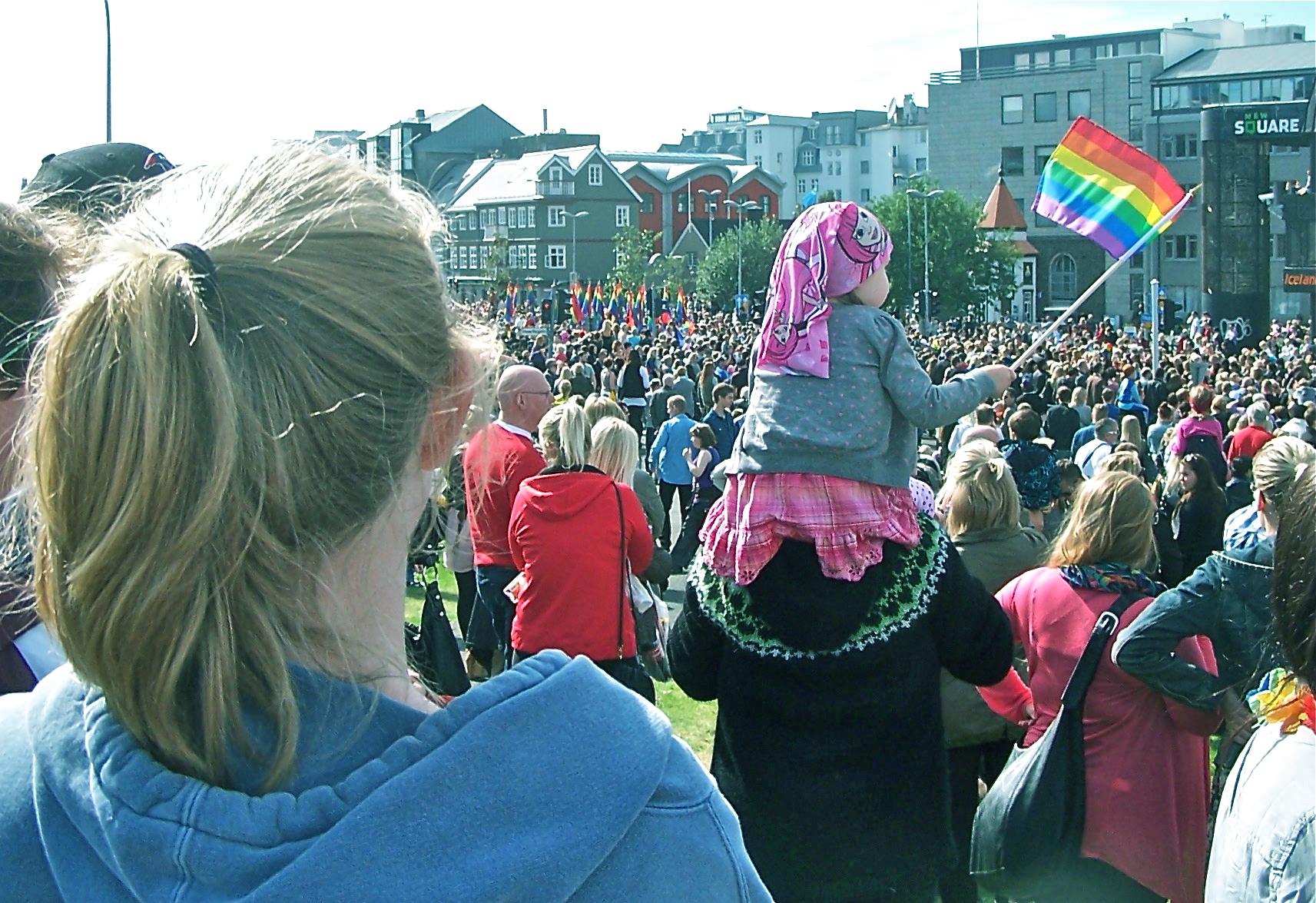
Viewed by many as a way to support human rights for all, there are now Gay Pride celebrations in numerous cities throughout the world.  In Reykjavik, for example, the annual parade attracts some 80,000 people…which is nearly a third of Iceland’s population.

While estimates vary (based upon whichever study/survey you subscribe to), we’re on solid ground when we say that at least 7 percent of women and 8 percent of men, between the ages of 14 and 94, identify themselves as gay, lesbian or bisexual in these United States.  With a sum total in the vicinity of 25 million, that represents a population that’s greater than those of most countries on earth.

Yet well within Baby-boom memory (‘though many of us remained blithely unaware), this considerable segment of society was deemed to be un-American and subversive. Designated as “security risks” (ostensibly for their lack of “emotional stability”), the names of known homosexuals were included on the same U.S. State Department watch lists as anarchists and communists.

Right through the 1960s, the FBI, local police and even the U.S. Post Office also “kept track” while state and local legislators amped the vitriol even further.  Thousands of American citizens were harassed, humiliated, jailed or institutionalized. Gay enclaves (discreetly) remained in major cities like New York, of course, but there were no legal establishments where gays or lesbians could openly congregate without being arrested.

Ever a bohemian magnet, New York’s Greenwich Village, with its rich history of Prohibition speakeasies, seemed to provide a tolerable remedy at least, and right through the ‘60s “private bottle clubs” catered to members of the gay community. With peepholes at the door so that bouncers could examine those wishing to enter, such unlicensed “clubs” were generally owned by mobsters, who overcharged for watered-down drinks and treated their patrons with distain.

The Stonewall Inn at 43 Christopher Street was a prime example of such an establishment, with overrunning toilets, no fire exits and used glasses that were “washed” in tubs of water behind the bar prior to reuse.  However, it was the only gay club in all of New York that allowed dancing, and on Saturday the 28th of June 1969, the place was packed.

That evening a number of undercover police had infiltrated the swarm to gather “visual evidence” while the Sixth Precinct’s Public Morals Squad waited quietly outside. When the signal was given, they commenced with their raid and in typical fashion, the lights were turned on, the music turned off and harried customers were lined up to have their IDs checked and recorded.  Those in full drag, or in the case of women, those who weren’t wearing at least three pieces of “feminine” clothing were arrested, as were those without proper identification.

Two paddy wagons were needed that night and when the first one arrived a crowd began to gather.  But the second wagon was delayed, leaving incarcerated patrons and their police captors in full view of an ever-growing throng.  When a cop shoved one of the drag queens she hit him on the head with her purse and someone shouted “Gay power!” which became a chant.  Meanwhile it was being rumored that people were being beaten up inside and onlookers began to throw coins, then bottles at the police.

Next came an “unknown woman” in handcuffs (described as typically “New York butch”) who’d been struggling with the police and, in plain sight, was bashed in the head with a billy club.  Staggering, she turned to the crowd and shouted, “Why don’t you guys do something!?” And thus began the Stonewall riots.

By dawn a “surreal quiet” is said to have descended over Christopher Street, as the morning’s newspapers all displayed a similar tally: four police officers injured, thirteen people arrested, some of them hospitalized.  There was further rioting that Sunday night (and for a few nights after that) with many more police (including the riot squad) and many more protesters, some of whom would come to form the Gay Liberation Front in the months ahead.

Beat poet (and gay literary icon), Allen Ginsberg, himself a Christopher Street resident, was there as well. “You know, the guys there were so beautiful,” he later commented. “They’ve lost that wounded look that fags all had 10 years ago.”

As another witness put it, “From going to places where you had to knock on a door and speak to someone through a peephole in order to get in. We were just out. We were in the streets.”

“Stonewall” is now recognized as the catalyst for today’s LGBT (Lesbian, Gay, Bi-sexual, Transgender) movement, and in the United States LGBT Pride events are generally held in June as a result.  “Boston Gay Pride” the largest such event here in New England, takes place this weekend (June 8 – 10).  And to commemorate a classic human rights struggle we posit this “weekend” selection.

Known equally for his falsetto voice and his vocal support of gay rights, the diminutive James William Somerville was born in Glasgow in 1961.  In 1983 he co-founded the openly gay, “synth pop” group, Bronksi Beat, which proceeded to have a string of hits on the British charts.

Then, in 1985 he and classically trained pianist, Richard Coles (now of Church of England Vicar) formed the “synth pop” duo, The Communards, which also had a string of hits during its three year run.  Today’s selection, co-written by Somerville and Coles, is the second track from the duo’s second album, “Red” released in 1987.

LISTEN TO THIS WEEKEND’S SELECTION – Friday/Saturday 8/9 June  

There’s more to love than boy meets girl

I would like to shout it from the highest mountain

To tell the world I’ve found love and what it means to me

But all around there’s violence and laws to make me think again

Maybe one day they will understand

There’s more to love than boy meets girl

There’s more to love than boy meets girl

For love is strange and uncontrolled, it can happen to anyone

There’s more to love than boy meets girl

How can one man decide the fate and destiny of innocent lovers

And why is it less of a crime to take the life of another?

Through time they’ve always tried to hide

and cast aside this love denied

In the shadows we held each other tight

There’s more to love than boy meets girl

There’s more to love than boy meets girl

For love is strange and uncontrolled, it can happen to anyone

There’s more to love than boy meets girl

 I saw your face, it caught the light, infatuation swirls inside

My every thought for days was only you

So I’ll climb that mountain and shout it loud

I’ll never let them bring me down

And one day they will have to understand

There’s more to love than boy meets girl

There’s more to love than boy meets girl

For love is strange and uncontrolled, it can happen to anyone

There’s more to love than boy meets girl

There’s more to love than boy meets girl

There’s more to love than boy meets girl

For love is strange and uncontrolled, it can happen to anyone

There’s more to love than boy meets girl

 There’s more to love than boy meets girl

There’s more to love than boy meets girl

For love is strange and uncontrolled, it can happen to anyone

There’s more to love than boy meets girl

….I’ll kiss you for each leaf on every tree

In the 1940s many of his recordings included the following “Copyright Warning”:

“This song is Copyrighted in U.S., under Seal of Copyright # 154085, for a period of 28 years, and anybody caught singin’ it without our permission, will be mighty good friends of ourn, cause we don’t give a dern. Publish it. Write it. Sing it. Swing to it. Yodel it. We wrote it, that’s all we wanted to do.” 

Of course there are many factions who still claim the copyrights to many of these songs  and the obfuscated legalese contained within their warnings is no longer quite so friendly and folksy.

Born in Okemah, Oklahoma in 1912 and named after the Democratic Governor of New Jersey, and soon to be President of the United States, Woodrow Wilson “Woody” Guthrie’s folk compendium includes well over a thousand traditional, political and children’s songs. Cited for his natural ability to play by ear (and never learning to read or write music), Guthrie began to learn old ballads and English and Scottish folks songs as an adolescent. Although he never graduated from high school those who knew him noted how he always seemed to be reading.

With the onset of the Great Depression, Guthrie joined the wave of migrant workers, moving from Oklahoma to California, learning countless folk and blues songs along the way.  After “borrowing” a plethora of styles, he began to write and perform songs about his own experiences, and came to be known as the “Dust Bowl Troubadour.”

Eventually the twice married and twice divorced Guthrie accepted an invitation from his friend Will Geer (that’s right “Grampa Walton”) and moved to New York City where he performed in various venues and on the radio, his guitar displaying the slogan, “This Machine Kills Fascists”.  It was in New York, in 1940, that his most famous song came into being. After growing tired of listening to Irving Berlin’s “God Bless America” (which he considered to be complacent and unrealistic) he wrote “This Land is Your Land” (subtitled: “God Blessed America For Me”).

Although he thought the best use of his talents would be to perform his anti-fascist songs as a USO performer, the US Army disagreed and conscripted him for the draft.  As some of his friends were going into the Merchant Marine he decided to join them, serving as dishwasher and troop entertainer on the long transatlantic voyages.  However, in 1945 some of Guthrie’s “left-leaning” associations came to light (although he never considered himself to be Communist he was accused of being one) and, now barred from the Merchant Marine, he was drafted into the Army.

While on furlough he married his third wife, Marjorie, and after the war they moved to a house on Mermaid Avenue in Coney Island, where they had four children, including Nora and little Arlo (who would follow in his father’s folk footsteps). The years that followed were Woody Guthrie’s most productive as a songwriter and the resulting collection (much of it never recorded) was archived by Marjorie after his death in 1967 (from Huntington’s Chorea) and later by his daughter Nora.

In 1992 Nora, who wanted to introduce her father’s songs to a new generation of musicians, approached (our old friend), English “non-folk” singer, Billy Bragg, after attending his Guthrie tribute concert in Central Park.  As Woody didn’t write music, the lyrics Nora presented to Bragg included only stylistic notations.

Bragg then approached the band, Wilco (none of whom he’d previously met) and asked them to participate in the project, which included writing contemporary music for a selection of Guthrie’s lyrics and then recording the songs. The resulting album, Mermaid Avenue, was Released in 1998.

Hailed as a huge success and nominated for a Grammy Award as Best Contemporary Folk Album, after it’s release two follow-up albums were produced and other artists began to follow suit by recording unpublished material by Woody Guthrie.  Not that the Billy Bragg and Wilco were first at the door. As a matter of fact, as Bob Dylan noted in his autobiography, “Chronicles” Woody Guthrie had offered his unpublished songs to him back in the early 1960s, but he was unable to access them because Arlo Guthrie wouldn’t let him in the house.

Performed by Jeff Tweedy of Wilco, This is track number 13.  Between his mother and his daughter, Guthrie clearly thought a lot of the name, Nora.

LISTEN TO TODAY’S SELECTION – Thursday 7 June  

Hesitating Beauty

 For your sparkling cocky smile I’ve walked a million miles

Begging you to come and wed me in the spring

Why do you my dear delay

What makes you laugh and turn away

You’re a hesitating beauty, Nora Lee

 Well I know that you are itching to get married, Nora Lee

And I know how I’m twitching for the same thing, Nora Lee

By the stars and clouds above we could spend our lives in love

You’re a hesitating beauty, Nora Lee

 We can build a house and home where the flowers come to bloom

Around our yard I’ll nail a fence so high

That the boys with peeping eyes cannot see that angel face

My hesitating beauty Nora Lee

Well I know that you are itching to get married Nora Lee

And I know how I’m twitching for the same thing Nora Lee

By the stars and clouds above we can spend our lives in love

If you quit your hesitating, Nora Lee

 We can ramble hand in hand across the grasses of our land

I’ll kiss you for each leaf on every tree

We can bring our kids to play where the dry leaves blow today

If you quit your hesitating, Nora Lee

 Well I know that you are itching to get married, Nora Lee

And I know how I’m twitching for the same thing, Nora Lee

By the stars and clouds above we could spend our lives in love

If you quit your hesitating, Nora Lee

…she’s really got a magical spell

His is not a household name, especially on these North American shores, but as lead singer he is credited with singing more hit singles (on both sides of the Atlantic) with different groups than any other recording artist in history.  Born in Exeter, Devon in 1942, Anthony “Tony” Burrows’ first started singing professionally in the early 1960s with the vocal harmony group, The Kestrels.

What?  Never heard of them? No matter, because after joining The Ivy League in 1967, he had his first (albeit marginal) hits with “Willow Tree” and “My World Fell Down”.  No?  Well, later that year The Ivy League changed its name (ah ha!) to The Flower Pot Men and it was with The Flower Pot Men that Tony Burrows had his first major hit single, at least in the UK, “Let’s Go to San Francisco” which charted at Number 4.

Still not ring a bell?  No matter, because by 1970 Burrows was firmly established as a “session vocalist” and his next big release (which peaked at Number 5 on the U.S. Billboard Chart) remains the fastest rising Number 1 hit record in UK history, remaining at the top for five straight weeks. The “band” was a studio assemblage that for the sake of the release was dubbed Edison Lighthouse and the song (written by Tony Macaulay and Barry Mason) was none other than “Love Grows (Where My Rosemary Goes).”

But “Love Grows” grew so fast that there wasn’t time to reconnect the disparate session musicians who recorded it, so the studio producer ferreted out a local pub group (called Greenfields) and, along with Burrows, brought them to the BBC studios to mime the song and stand in as Edison Lighthouse for that week’s “Top of the Pops” broadcast.

Tony Burrows, in the mean time, was on an epic roll and (on 26 February 1970) two weeks after that initial “Top of the Pops” appearance he became the only person ever to front three different groups on the same show.  In addition to Edison Lighthouse (still with the Number 1 hit) he sang “My Baby Needs Lovin’” (which hit Number 9 in the UK and Number 13 on the U.S. Charts) for White Plains, a “studio project” that had evolved from The Flowerpot Men; and then peaking at Number 10 in the UK and Number 13 in the U.S, he sang “United We Stand” with the real-live pop group (and future Eurovision Song Contest winner) The Brotherhood of Man.

And yet there’s more.  Later that year (1970) Tony Burrows and Roger Greenway (who most famously wrote “I’d Like to Teach the World to Sing”) had a hit single (Number 6 in the UK and Number 9 on the U.S. Billboard Charts) as the “novelty duo” The Pippins, singing a song that is considered to be the first-ever rap record, “Gimme Dat Ding”.

For the next few years Burrows kept a relatively low profile, serving as session singer for Elton John, Cliff Richard and big band leader, James Last.  Then in the summer of 1974 he was enlisted by a producer friend who needed someone to front yet another studio assemblage using the name, The First Class, and the resulting Beach Boys influenced release peaked at Number 13 in the UK and made it all the way to Number 4 on the U.S Billboard Charts.  But then again, “Beach Baby” is a song for another day.

LISTEN TO TODAY’S SELECTION – Wednesday 6 June

Love Grows Where My Rosemary Goes

She ain’t got no money

Her clothes are kinda funny

Her hair is kinda wild and free

Oh, but Love grows where my Rosemary goes

And nobody knows like me

She talks kinda lazy

And people say she’s crazy

And her life’s a mystery

Oh, but Love grows where my Rosemary goes

And nobody knows like me

 There’s something about her hand holding mine

It’s a feeling that’s fine

And I just gotta say, hey!

She’s really got a magical spell

And it’s working so well

That I can’t get away

I’m a lucky fella’

And I’ve just got to tell her

That I love her endlessly

Because Love grows where my Rosemary goes

And nobody knows like me

There’s something about her hand holding mine

It’s a feeling that’s fine

And I just gotta say, hey!

She’s really got a magical spell

And it’s working so well

That I can’t get away

I’m a lucky fella’

And I’ve just got to tell her

That I love her endlessly

Because Love grows where my Rosemary goes

And nobody knows like me

It keeps growing every place she’s been

And nobody knows like me

If you’ve met her, you’ll never forget her

And nobody knows like me

 La la la- believe it when you’ve seen it

Nobody knows like me