…here she comes now

Born in London in 1948, Steven Demetre Georgiou was the youngest of three kids living above their divorced parent’s restaurant on Shaftsbury Avenue, where the entire family worked. After teaching himself to play piano on the restaurant’s baby grand he acquired his first guitar and would escape to the rooftop to write songs and listen to the musical numbers emanating from some of the nearby West End theatres.

At the age of seventeen Georgiou began to perform in local coffee houses and pubs and soon concluded that he preferred performing solo. As the stage name he’d then adopted (Steve Adams) didn’t seem to be cutting it, he decided to come up with something a little more memorable. The British love their animals and since his girlfriend especially liked cats, Steven Demetre Georgiou thought he might be able to gain a few fans by calling himself Cat Stevens.  The following year (1966) he got his big break when a producer was impressed enough with his songs to help him to land a record deal. The title song for that first album, Matthew and Son hit Number 2 on the British charts and Cat Stevens was on his way.

In 1967 he sold one of his songs to P. P. Arnold for £30, and although her rendition of The First Cut is the Deepest managed to reach Number 18 on the U.K. Chart, its durability would become the real surprise with major hit covers by Keith Hampshire in 1973, Rod Stewart in 1977 and Sheryl Crow in 2003.  It would go on to earn Stevens back-to-back ASCAP “Songwriter of the Year” awards in 2005 and 2006, forty years after it was written.

After he nearly died from tuberculosis and discovered newfound faith while convalescing, the course of Cat Stevens’ music changed dramatically, making him an international superstar in the ’70s.  Ultimately he changed his name as well, this time after nearly drowning off the coast of Malibu, when he decided to devote himself completely to God.  But lest we forget, before that ‘70s superstardom, today’s Mr. Ysuf Islam was once the epitome of a ’60s pop idol.

First recorded in 1967 for his debut album Matthew and Son, today’s selection (minus the final verse) became a huge hit for the Tremeloes whose version peaked at Number 4 on the UK Singles Chart and reached Number 13 on the U.S. Billboard Hot 100 chart that very same year.

 LISTEN TO TODAY’S SELECTION – Wednesday 11 April

Here Comes My Baby

In the midnight moonlight, I’ll…

Be walking a long and lonely mile

And every time I do

I keep seeing this picture of you

Here’s comes my baby

Here she comes now

And it comes as no surprise to me

With another guy

Here’s comes my baby

Here she comes now

Walking with a love

With a love that’s all so fine

Never to be mine

No matter how I try
 You never walk alone

And you’re forever talking on the phone

I’ve tried to call you names

But every time it comes out the same

 Here’s comes my baby

Here she comes now

And it comes as no surprise to me

With another guy

Here’s comes my baby

Here she comes now

Walking with a love

With a love that’s all so fine

Never to be mine

No matter how I try

I’m still waiting for your heart

‘Cause I’m sure that some day it’s gonna’ start

You’ll be mine to hold each day

But ’til then this is all that I can say

 Here’s comes my baby

Here she comes now

And it comes as no surprise to me

With another guy

Here’s comes my baby

Here she comes now

Walking with a love

With a love that’s all so fine

Never to be mine

No matter how I try

…It takes lots of strength to run and play

Born on a cotton-farm near Kosse, Texas in 1905, his father was a statewide fiddle champion and so Robert “Bob” Wills gained some impressive skills at a very young age, namely how to pick cotton and how to play fiddle and mandolin. As part of a large family he, his parents and several siblings frequently played at “kitchen” dances, either in their home or at other ranches around West Texas and eastern New Mexico.

In addition to traditional country music Wills was also deeply immersed in the world of Negro spirituals while working in the cotton fields. “I don’t know whether they made them up as they moved down the cotton rows or not,” Wills once said, “but they sang blues you never heard before.”

Other than his siblings, his playmates were all children of African American cotton pickers and his father, in particular, enjoyed watching him dance the jig with the other kids. However, by the age of 16, with his family struggling to make ends meet, Wills ventured out on his own and drifted for several years by hopping freight trains (he was nearly killed more than once). In his early 20s he attended barber school and got married, alternating between barbering and performing at minstrel shows where he played his violin, cracked jokes and entertained the audience with his amazing jigs.

By 1934 he had formed the basis of the band that would make him famous and moved his family to Tulsa, Oklahoma where Bob Wills and his Texas Playboys became a local institution with live (Monday through Friday) noontime broadcasts and evening dances at Cain’s Ballroom (still in existence).

While the band’s front line consisted of fiddles and/or guitars, Wills accidentally added a trumpet when he hired an announcer who happened to have played with the New Orleans symphony and thought he’d been hired as a trumpeter and simply began to play with the band. Then a struggling young sax player was allowed to play and Wills realized he now needed a drummer to balance things out.  In 1935 a steel guitar player who could serve as a second vocalist was added and by 1938 Texas Playboy recordings included lead, rhythm, steel and electric guitars.  Inductees in the Rock and Roll Hall of Fame (in the Early Influence category) their recording of Ida Red was tellingly re-worked by Chuck Berry as Maybelline decades later.

By now a new genre had been developed, incorporating jazz, blues, popular music and improvised scats, and with an orchestra that sometimes contained as many as 23 members, Bob Wills was (and is) known by all as the King of Western Swing.  Written by (Evansville, Indian born) Fred Rose, today’s selection was first recorded by Bob Wills and His Texas Playboys in 1946.

LISTEN TO TODAY’S SELECTION – Tuesday 10 April 

Roly Poly

 Roly Poly, eatin’ corn and taters

Hungry every minute of the day

Roly Poly, gnawin’ on a biscuit

Long as he can chew it it’s ok

He can eat an apple pie

And never even bat an eye

He likes everything from soup to hay

Roly Poly, daddy’s little fatty

Bet he’s gonna be a man someday

 Roly Poly, scrambled eggs for breakfast

Bread and jelly 20 times a day

Roly Poly eats a hearty dinner

It takes lots of strength to run and play

Pulls up weeds and does the chores

Runs both ways to all the stores

He works up an appetite that way

Roly Poly, daddy’s little fatty

Bet he’s gonna be a man someday

…少年ナイフ

First formed in 1981 perhaps you’re familiar with 少年ナイフ, aka Shonen Knife (literally “Boy Knife”), an all-female trio from Osaka, Japan, which describes itself as the “oo-oo-ultra-eccentric-super-cult-punk-pop-band-shonen-knife!”

With influences that include the Beach Boys, the Ramones and all those girl groups from the ‘60s, Shonen Knife has long had a worldwide cult following including Curt Colbain, who was one of their most ardent fans. After attending one of their concerts he asked them to open for his group, Nirvana.  It was only later that lead singer, Naoko Yamano admitted that they had no idea what Nirvana was.

“So I went to a record store, and I bought their CD,” she said. “And when I saw their photograph, I thought they might be scary persons, because their hairstyles and their clothes were very grunge. But once the tour had started, I noticed that all the members were nice, good persons.”

Long a favorite in our family when we’re in the mood to dance, today’s selection is the  少年ナイフ rendition of a number that was written by Richard Carpenter and John Bettis and featured on the Carpenter’s 1972 album, A Song for You.  First released as a single by Lynn Anderson the following year (reaching Number 2 on the U.S. Country Singles charts) the Carpenters quickly released their own version as a single, which topped the U.S. pop singles charts for two weeks in 1973.

Along with other unconventional covers of Carpenter songs by such artists as Sonic Youth, the Cranberries, Sheryl Crow, Dishwalla and Cracker, today’s selection was the second track on the winningly peculiar 1994 tribute album If I Were a Carpenter.

 LISTEN TO TODAY’S SELECTION – Monday 9 April

On Top of the World

Such a feeling coming over me

There is wonder in the things I see

Not a cloud in the sky, got the sun in my eyes

And I won’t be surprised if it’s a dream

 Everything I want the world to be

Is coming true especially for me

And the reason is clear, it’s because you are here

You’re the nearest thing to heaven that I’ve seen

 I’m on the top of the world looking down on creation

And the only explanation I can find

Is the love that I’ve found ever since you’ve been around

Your love put me on the top of the world

Top of the world

Top of the world

Top of the world

Top of the world

 Something in the wind has learned my name

Telling me that things are not the same

In the leaves on the trees and the touch of the breeze

There’s a pleasant sense of happiness for me

 There is only one wish on my mind

When this day is through I hope I’ll find

Tomorrow will be the same for you and me

All I need will be mine if you are here

 I’m on the top of the world looking down on creation

And the only explanation I can find

Is the love that I’ve found ever since you’ve been around

Your love put me on the top of the world

Top of the world

Top of the world

Top of the world

Top of the world

Top of the world

Top of the world

 Top of the world

Such a feeling coming over me now

 Top of the world

Everything I want the world to be now

Top of the world

On top, on top, on top of the world

I’m on the top now, I’m on the top now

Top of the world

I’m on top, top, top

Top of the world


…It’s not a cry you can hear at night

Written and first performed by Leonard Cohen on his 1984 album Various Positions it took a long time for today’s selection to become an instant hit.  First it took someone who liked Cohen’s lyricism enough to release a tribute album, and that was Welsh singer-songwriter John Cale, who performed a cover version of Hallelujah on his 1991 album, I’m Your Fan.

Cale had watched Cohen perform the song in his typical dispassionate manner and asked if he wouldn’t mind sending the lyrics. Cohen then faxed Cale fifteen pages of lyrics, many of them evoking stories from the Old Testament.  In the end Cale’s melodious version featured vocals, piano and lyrics that Cohen had only performed live, with just a few of the biblical references remaining, including Samson and Delilah (“she broke your throne and she cut your hair”) and King David and Bathsheba (“you saw her bathing on the roof, her beauty in the moonlight overthrew you”)

Since Cale first covered the song it has been performed by approximately 200 artists in various languages. During a CBC Radio interview, Cohen said that he found this amusing given that when he wrote it his record company refused to release it as a single.   However he added, “I was just reading a review of a movie that uses it and the reviewer said – ‘Can we please have a moratorium on Hallelujah in movies and television shows?’ And I kind of feel the same way…I think it’s a good song, but I think too many people sing it.”

It’s Cale’s version that forms the basis of most of these subsequent performances, including Cohen’s during his 2008–2009 world tour, as well as the famous version used in the 2001 film Shrek (although Rufus Wainwright’s version appears on film’s soundtrack album. Cale’s version is also the source for today’s selection, the most critically celebrated rendition, by Jeff Buckley.

Included on Grace, Buckley’s only complete album, in 1994, years later a Q Magazine poll of 50 songwriters, listed it among the all-time “Top 10 Greatest Tracks”. Unfortunately Buckley drowned in 1997 while swimming in a slackwater channel in Memphis and didn’t live to hear the ultimate acclaim his version would receive. Like Cohen’s original, the Buckley version was never officially released as a single and took a looooooong time to garner appreciation.

It wasn’t until 2006 that his cover first hit the charts… in Norway. It was then a hit in Sweden in 2007, and then in March 2008 it was Number One in France before finally topping the U.S. Billboard’s Hot Digital Songs in April 2008, finally propelling it into Platinum status.

Time Magazine called Buckley’s version “exquisitely sung,” observing “Cohen murmured the original like a dirge, but … Buckley treated the … song like a tiny capsule of humanity, using his voice to careen between glory and sadness, beauty and pain… It’s one of the great songs.”

 LISTEN TO TODAY’S SELECTION – Easter Sunday 8 April

Hallelujah

I’ve heard there was a secret chord

That David played, and it pleased the Lord

But you don’t really care for music, do you?

It goes like this

The fourth, the fifth

The minor fall, the major lift

The baffled king composing Hallelujah

Hallelujah, Hallelujah

Hallelujah, Hallelujah

Your faith was strong but you needed proof

You saw her bathing on the roof

Her beauty and the moonlight overthrew you

She tied you to a kitchen chair

She broke your throne, and she cut your hair

And from your lips she drew the Hallelujah

 Baby I have been here before

I’ve seen this room, I’ve walked this floor

I used to live alone before I knew you

I’ve seen your flag on the marble arch

Love is not a victory march

It’s a cold and it’s a broken Hallelujah

Hallelujah, Hallelujah

Hallelujah, Hallelujah

There was a time you let me know

What’s really going on below

But now you never show it to me, do you?

And remember when I moved in with you

The holy dove was moving too

And every breath we drew was Hallelujah

Hallelujah, Hallelujah

Hallelujah, Hallelujah

Maybe there’s a God above

But all I’ve ever learned from love

Was how to shoot somebody who outdrew you

It’s not a cry you can hear at night

It’s not somebody who has seen the light

It’s a cold and it’s a broken Hallelujah

Hallelujah, Hallelujah

Hallelujah, Hallelujah

Hallelujah, Hallelujah

Hallelujah, Hallelujah

Hallelujah, Hallelujah

Hallelujah, Hallelujah

Hallelujah, Hallelujah

Hallelujah, Hallelujah

Hallelujah

OTHER VERSES INCLUDE:

You say I took the name in vain

I don’t even know the name

But if I did, well really, what’s it to you?

There’s a blaze of light in every word

It doesn’t matter which you heard

The holy or the broken Hallelujah

Hallelujah, Hallelujah

Hallelujah, Hallelujah

I did my best, it wasn’t much

I couldn’t feel, so I tried to touch

I’ve told the truth, I didn’t come to fool you

And even though it all went wrong

I’ll stand before the Lord of Song

With nothing on my tongue but Hallelujah

Hallelujah, Hallelujah

Hallelujah, Hallelujah

Hallelujah, Hallelujah

Hallelujah, Hallelujah

Hallelujah, Hallelujah

Hallelujah, Hallelujah

Hallelujah, Hallelujah

Hallelujah, Hallelujah

Hallelujah

…as restless as a willow in a windstorm

It’s a legendary story.  Saxophonist, Stan “The Sound” Getz had been experimenting with Brazilian rhythms and in 1963 made a record with a couple of Jazz Samba “pioneers,” pianist Antonio Carlos Jobim and guitarist/vocalist João Gilberto.

Recorded in New York, one of the tracks was a song that Jobim had written about an actual young woman who was known to attract a lot of attention around Rio’s upscale Ipanema district.  Entitled The Girl From Ipanema, the lyrics were all in Portuguese. But after Gilberto had recorded his vocals the producer decided that part of the number should be sung in English for maximum crossover potential.

With no professional musical experience of any kind, the only person at the session with a strong grasp of both languages was Gilberto’s wife, Astrud. Coaxed by her husband into singing the second verse in English, her hesitant, heavily accented performance helped to catapult the song up the pop charts, where it peaked at Number 5 in the U.S. and Number 29 in the UK.

Although Astrud’s participation was uncredited, Getz/Gilberto (as the record was called) became the best-selling jazz album up to that time, based in large part upon the phenomenal success of The Girl From Ipanema.

That impromptu professional singing debut also launched a fine career.  Born as Astrud Weinert (her father was German) in 1940, in Bahia, Brazil, she was raised in Rio de Janeiro and emigrated to the States with her musician-husband in the early ‘60s.  In 1964, with a voice now recognized around the globe, Astrud recorded a solo album and began to tour with Getz, with whom she would have a relationship after divorcing João Gilberto a few years later.

Although she has since written a number of her own compositions and has recorded songs in Portuguese, English, Spanish, Italian, French, German and Japanese, Astrud Gilberto remains best known to most for her renditions of bossa nova and jazz standards, including today’s selection.

Featured in the movie, State Fair (the only Rodgers and Hammerstein musical written directly for film)  It Might As Well Be Spring won the Academy Award for Best Original Song in 1945.

LISTEN TO TODAY’S SELECTION – Saturday 7 April

 It Might As Well Be Spring

 I’m as restless as a willow in a windstorm

I’m as jumpy as puppet on a string

I’d say that I had spring fever, but I know it isn’t spring

I am starry eyed and vaguely discontented

Like a nightingale without a song to sing

O why should I have spring fever, when it isn’t even spring

I keep wishing I were someone else

Walking down a strange new street

And hearing words that I’ve never heard from a girl I’ve yet to meet

I’m as busy as a spider spinning daydreams

I’m as giddy as a baby on a swing

I haven’t seen a crocus or a rosebud, or a robin on the wing

But I feel so gay in a melancholy way

That it might as well be spring

It might as well be spring

…I never thought I’d come to this

The subject was somewhat controversial (and condemned by a number of religious groups) but that didn’t keep two versions of the same song, by two different artists, from working their way up the Billboard Top 40…at the same time.

Written by Andrew Lloyd Webber and Tim Rice today’s selection was first published in 1967 under the title of Kansas Morning.  Then, a few years later when Webber and Rice were working on their (blasphemous to some) concept album, Jesus Christ Superstar and needed a solo number for the character of Mary Magdalene, they bought back the rights from the publisher for £50.

With re-written lyrics the song was recorded by Yvonne Elliman, who was initially perplexed by their romantic nature, and by the new title, I Don’t Know How to Love Him. She thought the Mary she’d been recruited to play was Jesus’ mother.

Born and raised in Hawaii, Elliman was working as a club singer in London when Rice and Webber noticed her one evening and (imagine?) asked if she might be interested in taking part in their new rock opera.

Considered to be Jesus Christ Superstar’s best track right from the start, it wasn’t until after Helen Reddy’s 1971 version of the song had hit the Billboard charts (reaching Number 13, it was her first chart appearance and breakthrough hit) that Elliman’s original was released as a single (peaking at Number 28) and finally received airplay.

Released in the UK the following year, Elliman’s version charted at Number 47 but faced competition from yet another concurrent cover, this time by Petula Clark, which reached Number 42 and would be her final chart appearance.

While Elliman remained involved with the production for four years, performing the song on the original 1970 concept album, the 1971 Broadway cast album and on the 1973 film soundtrack (for which she received a Gold Globe nomination) it has since been recorded by a broad range of artists including: Shirley Bassey, Judy Collins, Cilla Black, Sinead O’Conner, Peggy Lee, Elaine Page, Sarah Brightman, Bonnie Tyler and (as was typical) by Petula Clark again, who also had a hit with it in French as La Chanson de Marie-Madeleine… a far catchier title than Kansas Matin and well worth that £50 investment.

 LISTEN TO TODAY’S SELECTION – Good Friday 6 April

I Don’t Know How to Love Him

 I don’t know how to love him

What to do, how to move him

I’ve been changed, yes really changed

In these past few days, when I’ve seen myself

I seem like someone else

I don’t know how to take this

I don’t see why he moves me

He’s a man. He’s just a man

And I’ve had so many men before

In very many ways

He’s just one more

Should I bring him down?

Should I scream and shout?

Should I speak of love

Let my feelings out?

I never thought I’d come to this

What’s it all about?

Don’t you think it’s rather funny

I should be in this position

I’m the one who’s always been

So calm, so cool, no lover’s fool

Running every show

He scares me so

I never thought I’d come to this

What’s it all about?

Yet, if he said he loved me

I’d be lost. I’d be frightened

I couldn’t cope, just couldn’t cope

I’d turn my head. I’d back away

I wouldn’t want to know

He scares me so

I want him so

I love him so

…you could see it written in his eyes

Anyone who has moved around a bit might empathize. Sometimes you can grow so accustomed to using a term in one place that you forget that its usage may not be common (or even comprehended) elsewhere.  I haven’t resided in England for 25 years and although I no longer think in terms of “stone” (a unit of weight that equals 14 pounds) or even kilos for that I matter, I still like to rely on the word “fortnight” because occasionally one thinks along those lines and the lexicon of American English simply doesn’t provide a single-word term for the concept.

Frequently used in the UK and throughout most of the Commonwealth, a fortnight (derived from “fourteen nights”) is a unit of time that amounts to precisely two weeks.  It’s actually pretty practical, both as a means of stating something simply (always a good thing) and because it avoids the ambiguity of  “biweekly.”  That said, I can now use the term and feel completely confident that you’ll understand; so here goes…

A fortnight ago we featured Nick Drake’s Northern Sky along with a short background on Drake himself.  As noted, after his untimely death from a drug overdose in 1974 his records slowly gained word-of-mouth appreciation, especially among fellow musicians. Today’s featured group is a case in point.

In the early ‘80s three London musicians, Nick Laird-Clowes, Gilbert Gabriel and Kate St. John opted to venture away from the then-ubiquitous power-pop trend and, calling themselves The Dream Academy, adopted a sub-genre of alternative rock known as “dream pop” by mixing strings, woodwinds and percussion instruments with ethereal melodies.  Thus established it took the band nearly two years (and many failed attempts) to land a recording contract and then still another year to record a debut single.

With lyrics that specifically refer to Nick Drake (the song is meant as a tribute) and an initial title called Morning Lasted All Day (until Paul Simon, who heard it before its release, happened to suggest that they change the name) the single was a worldwide success (the band’s only one) in 1985/86, reaching Number 15 on the UK Singles chart and Number 7 on the US Billboard chart.

Although a music video filmed in West Yorkshire was made prior to the song’s release, a second version featuring both northern English and American towns was filmed (over a fortnight) after its international success and you can see via this URL.

http://www.youtube.com/watch?v=O17MA58P-QY

 LISTEN TO TODAY’S SELECTION – Thursday 5 April

Life in a Northern Town

 A Salvation Army band played

And the children drank lemonade

And the morning lasted all day,

All day

And through an open window came

Like Sinatra in a younger day,

Pushing the town away

Ah –

Ah hey ma ma ma

Life in a northern town.

 They sat on the stoney ground

And he took a cigarette out

And everyone else came down

To listen

He said “In winter 1963

It felt like the world would freeze

With John F. Kennedy

And the Beatles.”

Ah hey ma ma ma

Life in a northern town.

Ah hey ma ma ma

All the work shut down.

 The evening had turned to rain

Watch the water roll down the drain,

As we followed him down

To the station

And though he never would wave goodbye,

You could see it written in his eyes

As the train rolled out of sight

Bye-bye.

 Ah hey ma ma ma

Life in a northern town.

Ah hey ma ma ma

Life in a northern town.

…there’s one life…no return and no deposit

It’s the only Broadway musical to have won a Tony Award for Best Revival of a Musical twice and the only show to win a Best Production Tony Award for each of its Broadway productions (1983, 2004, 2010), but its beginnings were far from auspicious to say the least.

Having produced the 1974 Tony nominated revival of Gypsy, for Broadway director, Arthur Laurents, executive producers Fritz Holt and Barry Brown approached their old “teammate” with a new venture, a musical based on a French farce about the son of a St. Tropez nightclub owner and his gay lover, who brings his fiancée’s ultraconservative parents home for dinner. This was 1983 at the height of the burgeoning AIDS epidemic and homophobia was in full surge.  No fan of camp entertainment himself, Laurents figured Holt and Brown would never find the financial backing and only agreed to sign on because they were his friends.

His enthusiasm brightened however, upon meeting the show’s playwright, Harvey Fierstein and its composer/lyricist, Jerry Herman.  Although a script had yet to be completed, Fierstein did have a plot plan for the production, which would bear the name of the original play (and film), La Cage aux Folles, and Herman had already written the song that would serve as the finale for the musical’s first act, and it was a show-stopper.

As the composer/lyricist for such enduring classics as Mame and Hello Dolly! Jerry Herman had long been a Broadway legend, albeit one without a hit for nearly two decades.  Having concentrated on darker-themed productions he was keen to return to form with an optimistic, mainstream, song-and-dance musical that an average, everyday audience would enjoy.  Of course in 1983 nothing said “mainstream and everyday” quite like a gay nightclub owner and his drag queen wife, and Herman is said to have suffered a panic attack before the pre-Broadway Boston unveiling of “La Cage”. For its part, the Boston audience (here in the one-time home of the censorious Watch and Ward Society), gave the show a standing ovation and Jerry Herman would go on to win the Tony Award for Best Musical Score.

While the role of Georges, the St. Tropez nightclub owner and master of ceremonies, was played by (“Bat Masterson” himself) Gene Barry, the pivotal role of Albin, the star drag performer of La Cage aux Folles (and Georges wife) was played by George Hearn.  A long-time Broadway and West End leading man (who’s been married five times), it is Hearn who was most responsible for breathing life into one of Broadway’s most endearing characters.

Written by Herman and sung by Hearn, today’s selection is that show-stopping first act finale, concerning an individual who has been compelled to take a stand in the name of human dignity.

LISTEN TO TODAY’S SELECTION – Wednesday 4 April

I Am What I Am

 I am what I am

I am my own special creation

So come take a look

Give me the hook or the ovation

It’s my world that I want to take a little pride in

My world, and it’s not a place I have to hide in

Life’s not worth a damn

‘Til you can say, “Hey world, I am what I am”

 I am what I am

I don’t want praise, I don’t want pity

I bang my own drum

Some think it’s noise, I think it’s pretty

And so what, if I love each feather and each spangle

Why not try to see things from a different angle?

Your life is a sham ‘til you can shout out loud

I am what I am!

I am what I am

And what I am needs no excuses

I deal my own deck

Sometimes the ace, sometimes the deuces

There’s one life, and there’s no return and no deposit

One life, so it’s time to open up your closet

Life’s not worth a damn ’til you can say

“Hey world, I am what I am!”

…Is it wrong to wish on space hardware?

Perhaps it’s partly as a result of his pluck and determination, but Billy Bragg is one of those artists who grow on you. I became marginally aware of him in the early ‘80s after hearing Kirsty MacColl’s version of today’s selection, but never had occasion to listen to the man himself until the late ‘90s, having purchased the album, Mermaid Avenue.

The actual Mermaid Avenue is the Coney Island street where Woody Guthrie lived (the album cover includes a picture of his house) and Guthrie’s daughter, Nora had asked Bragg to set some of her father’s unrecorded lyrics (and he had many) to music after seeing him perform a Woody Guthrie tribute concert in Central Park.

Bragg asked if he could recruit Wilco (out of Chicago) to serve as his band and the result was a surprising success; so much so that a Volume II was later released. Unsurprisingly, the word “surprising” is used regularly when discussing Stephen William Bragg

Born in Barking, Essex in 1957, he first formed a punk band (called Riff Raff) in the late ‘70, playing pub gigs in the evenings with days spent working in a record store.  But after a number of years and a number of unsuccessful demo tapes, he became disillusioned with his music and joined the British Army as a recruit for the Queen’s Royal Irish Hussars.  Three months in and Bragg saw the light.  Having completed basic training, he managed to buy his way out of the army.

The theory behind such an option is that it’s in no one’s best interest to have a malcontent within the ranks of a professional army, although the more training one has received the higher the cost.  In Bragg’s case it was £175 (in 1981) and he returned to London, initially as a busker and then as a solo act in clubs and pubs around town.

In due course he began to circulate a new demo tape, once again without success.  But this time Billy Bragg wasn’t going to leave it at that and after pretending to be a television repairman, managed to get into the A&R (Artists and Repertoire) offices of aptly named, Charisma Records. Even though Charisma was near bankruptcy (and soon acquired by Virgin Records) Bragg convinced enough of the right people that his music would make a good record and in 1983 the album Life’s a Riot With Spy vs. Spy was released.

He didn’t stop there, however, upon hearing an influential disc jockey at BBC Radio 1 mention on-air that he was hungry, Bragg rushed to the studio with a takeaway biryani and the thankful DJ played a song from his album.  Regrettably the album was unconventionally cut to play at 45 rpm and the DJ played it at the wrong speed.

All was well in the end, however and after repeated play at the correct speed, Life’s a Riot With Spy vs. Spy hit the UK charts, reaching Number 30. Today’s selection comes from that debut album but in typical Billy Bragg fashion, yet another story comes attached.

The idea for “A New England” (not to be confused with “our” New England) came about when Bragg sighted two satellites flying side by side and considered it to be rather romantic. Eventually the notion changed direction, especially after he borrowed the melody from Thin Lizzy’s “Cowboy Song.” You may also recognize a touch of Paul Simon (who Bragg cites as a major influence) as the song’s opening two lines were taken verbatim from Simon and Garfunkel’s “Leaves that are Green.”

None of this “sampling” mattered to Kirsty MacColl who was already a BBC “Top of the Pops” regular.  Nevertheless, she did think that today’s (original) version was too short, so Bragg wrote an additional verse just for her (the additional lyrics are bracketed below) and MacColl’s cover reached Number 7 on the UK charts (her highest charting ever) in 1984.

Upon learning of her death (she was struck while pushing her son out of the way of an oncoming speed boat in Cozumel), Bragg included the additional verse in his next performance and has done so, as a tribute, ever since.

LISTEN TO TODAY’S SELECTION – Tuesday 3 April

A New England

 I was twenty-one years when I wrote this song

I’m twenty-two now, but I won’t be for long

People ask when will you grow up to be a man

But all the girls I loved at school

Are already pushing prams

I loved you then as I love you still

Though I put you on a pedestal,

They put you on the pill

I don’t feel bad about letting you go

I just feel sad about letting you know

 I don’t want to change the world

I’m not looking for a new England

I’m just looking for another girl

I don’t want to change the world

I’m not looking for a new England

I’m just looking for another girl

I loved the words you wrote to me

But that was bloody yesterday

I can’t survive on what you send

Every time you need a friend

 I saw two shooting stars last night

I wished on them but they were only satellites

Is it wrong to wish on space hardware?

I wish, I wish, I wish you’d care

 I don’t want to change the world

I’m not looking for a new England

I’m just looking for another girl

(Looking for another girl)

(Looking for another girl)

(Looking for another girl)

 {My dreams were full of strange ideas

My mind was set despite the fears

But other things got in the way

I never asked that boy (girl) to stay

 Once upon a time at home

I sat beside the telephone

Waiting for someone to pull me through

When at last it didn’t ring, I knew it wasn’t you.

 I don’t want to change the world

I’m not looking for a new England

I’m just looking for another girl

(Are you looking for another girl)}

…I walked across that burning bridge

“Short, sharp shock.” I always assumed the term was coined by British Home Secretary, Willie Whitelaw who, as part of the Thatcher government, used it to describe the quick, severe punishment meted out to young offenders in hopes of scaring them straight.  But as any attentive Gilbert and Sullivan enthusiast will tell you, it stems back at least as far as The Mikado:

To sit in solemn silence in a dull, dark dock,

In a pestilential prison with a life-long lock

Awaiting the sensation of a short, sharp shock

From a cheap and chippy chopper on a big, black block

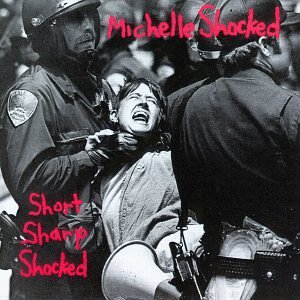
Painful, but quick. Fast forward a century to a 22 year-old singer/songwriter from Dallas, Texas named Michelle Karen Johnston, who decided to change her stage name right after the 1984 Democratic National Convention in San Francisco, where she was forcibly arrested (in a big way) for protesting against major corporations that contribute money to both Democratic and Republican campaigns.

Thereafter known as Michelle Shocked (a contraction of “Miss Shell Shocked”), she later explained that the name refers to the thousand-yard stare symptomatic of shell-shock victims (as they once called those suffering from battle fatigue before it was known as PTSD).  “These people from outward appearances had survived the war quite well,” said Shocked, “when in fact their minds were blown.”

Michelle Shocked first gained popularity in Britain with her 1986 debut album The Texas Campfire Tapes, which perhaps is where she derived the name for her second album in 1988, Short Sharp Shocked.  Today’s pleasantly diverting, slightly incongruous selection is a featured track.

The album cover (which was later closely cropped on re-issue) features a photo taken of the 22 year old Michelle Karen Johnston during the 1984 Democratic National Convention. Explanation, perhaps, for what could possibly compel one to ever come up with such a peculiar new appellation as a performer.

 LISTEN TO TODAY’S SELECTION – Monday 2 April

Anchorage

 I took time out to write to my old friend

I walked across that burning bridge

Mailed my letter off to Dallas

But her reply came from Anchorage, Alaska

 [She said]

“Hey girl, it’s about time you wrote

It’s been over two years you know, my old friend

Take me back to the days of the foreign telegrams

And the all-night rock and rollin’… hey Shell

We was wild then

 Hey Shell, you know it’s kind of funny

Texas always seemed so big

But you know you’re in the largest state in the union

When you’re anchored down in Anchorage

 Hey Girl, I think the last time I saw you

Was on me and Leroy’s wedding day

What was the name of that love song they played?

I forgot how it goes

I don’t recall how it goes

Anchorage

Anchored down in Anchorage

 Leroy got a better job so we moved

Kevin lost a tooth now he’s started school

I got a brand new eight month old baby girl

I sound like a housewife

Hey Shell, I think I’m a housewife

Hey Girl, what’s it like to be in New York?

New York City – imagine that!

Tell me, what’s it like to be a skateboard punk rocker?

Leroy says “Send a picture”

Leroy says “Hello”

Leroy says “Oh, keep on rocking, girl”

“yeah, keep on rocking”

Hey Shell, you know it’s kind of funny

Texas always seemed so big

But you know you’re in the largest state in the union

When you’re anchored down in Anchorage

Oh, Anchorage

Anchored down in Anchorage

Oh, Anchorage