…you’re never gonna keep me down

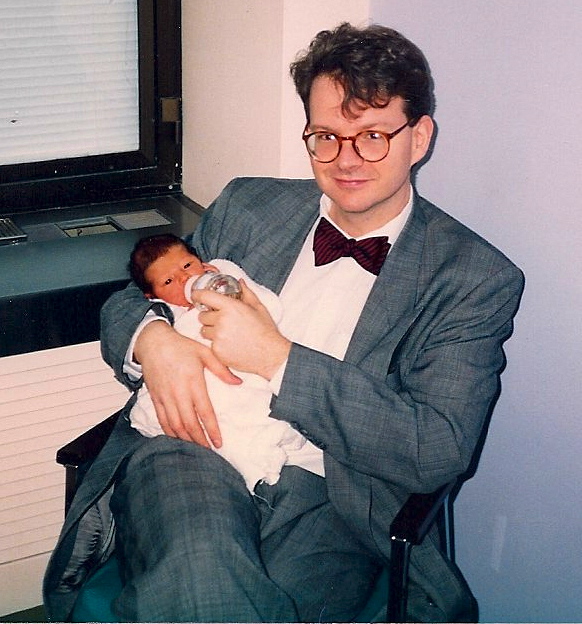
There’s no actual time written on the official Statement of Live Birth, which (unnervingly) is in my handwriting (that’s how it’s done in the Province of Ontario) so I’ll have to rely on recollection in saying that he was born at around 01:30, the morning of Wednesday 17 April 1991 at Women’s College Hospital in Toronto.

After receiving stellar advice we’d brought a cooler to the delivery room with sandwiches (for the waiting father), beer (ostensibly for the post-partum mother to help with lactation) and champagne for all participants, except the doctor…and the baby.  We also brought pillows, a telephone, playing cards and a cassette player.

Other than the cards, (just couldn’t get a game going) all else came in handy because it…took…a…long…time (hours and hours) for those final centimeters of dilation. Although Linda wasn’t eating much besides Lime Jello, I eventually availed myself of the sandwiches, and the beer too (he started out lactose intolerant in any event). After which I made use of the phone. We knew there was a betting pool about the baby’s birth amongst members of the family so I called to lock in my bet.  I know, that’s “insider knowledge,” but I never collected in the end.

Midnight came and went and as Linda had enough pillows, thank you, I availed myself of the ones from home and we dozed a bit with Puccini on the cassette player. Then came “Um, honey, you’d better get the doctor,” and everything happened in a flash.  I held Linda’s hand and worked on the rhythmic breathing (nearly hyperventilating and passing out due to the surgical mask I was wearing) and Giles was born with the Aria from Madame Butterfly playing in the background.

Soon the cork was popped (we left most of the bottle for the grateful nurses who were having a slow night), phone calls were made to expectant grandparents and it was time for mother and baby to get some rest…and father to go home.  By now it was nearly 03:00 a.m. and while stopped at a red light on Bay Street I saw a homeless fellow asleep on a subway grate, so I leapt out of my car and handed him a $5 bill.  Next block same thing. On this day, it seemed important for everyone to be happy, if only just a little bit.

In later years Giles and I would learn how to snowboard together.  Eventually he got really good while I was ordered by my eye specialists to revert to skiing (after lots of surgery, “no falling allowed”) but today’s selection was the song we liked to sing together back in the earlier, free-falling stages.  That it has a more literal meaning that might be applicable to a 21 year old college kid in New Orleans is beside the point.

Written and recorded by the British band Chumbawumba, Tubthumping was released on their 1997 album of the same name.  It peaked at Number 2 on the UK Singles Charts and Number 6 on the U.S. Billboard Hot 100. That sampled monologue at the very beginning is the late Pete Postlewaite in the 1996 film, Brassed Off.

Happy Birthday, Old Man.

LISTEN TO TODAY’S SELECTION – Tuesday 17 April
Tubthumping

 The truth is, I thought it mattered

I thought that music mattered

But does it? Bollocks! Not compared to how people matter

(We’ll be singing, when we’re winning, we’ll be singing)

 I get knocked down, but I get up again

You’re never gonna keep me down

I get knocked down, but I get up again

You’re never gonna keep me down

I get knocked down, but I get up again

You’re never gonna keep me down

I get knocked down, but I get up again

You’re never gonna keep me down

(Pissing the night away, pissing the night away)

He drinks a whisky drink, he drinks a vodka drink

He drinks a lager drink, he drinks a cider drink

He sings the songs that remind him of the good times

He sings the songs that remind him of the best times

(Oh Danny Boy, Danny Boy, Danny Boy)

I get knocked down, but I get up again

You’re never gonna keep me down

I get knocked down, but I get up again

You’re never gonna keep me down

I get knocked down, but I get up again

You’re never gonna keep me down

I get knocked down, but I get up again

You’re never gonna keep me down

(Pissing the night away, pissing the night away)

He drinks a whisky drink, he drinks a vodka drink

He drinks a lager drink, he drinks a cider drink

He sings the songs that remind him of the good times

He sings the songs that remind him of the best times

(Don’t cry for me, next door neighbour)

 I get knocked down, but I get up again

You’re never gonna keep me down

I get knocked down, but I get up again

You’re never gonna keep me down

I get knocked down, but I get up again

You’re never gonna keep me down

I get knocked down, but I get up again

You’re never gonna keep me down

I get knocked down

(We’ll be singing)

But I get up again

You’re never gonna keep me down

 (When we’re winning)

You’re never gonna keep me down

 (We’ll be singing)

But I get up again

You’re never gonna keep me down

 (Ooh)

I get knocked down

(We’ll be singing)

But I get up again

You’re never gonna keep me down

 (When we’re winning)

I get knocked down

(We’ll be singing)

But I get up again

You’re never gonna keep me down

 (Ooh)

I get knocked down

(We’ll be singing)

But I get up again

(Pissing the night away)

You’re never gonna keep me down

 (When we’re winning)

I get knocked down

(We’ll be singing)

But I get up again

(Pissing the night away)

You’re never gonna keep me down

 (Ooh)
I get knocked down

(We’ll be singing)

But I get up again

(Pissing the night away)

You’re never gonna keep me down

 (When we’re winning)

I get knocked down

(We’ll be singing)

But I get up again

(Pissing the night away)

You’re never gonna keep me down

 (Ooh)

 I get knocked down

(We’ll be singing)

But I get up agai

(Pissing the night away)

You’re never gonna keep me down

 (When we’re winning)

I get knocked down

(We’ll be singing)

But I get up again

(Pissing the night away)

You’re never gonna keep me down

 (Ooh)

 I get knocked down

(We’ll be singing)

But I get up again

(Pissing the night away)

You’re never gonna keep me down

 (When we’re winning)

I get knocked down

(We’ll be singing)

But I get up again

(Pissing the night away)

You’re never gonna keep me down

 (Ooh)

 I get knocked down

(We’ll be singing)

But I get up again

(Pissing the night away)

You’re never gonna keep me down

 (When we’re winning)

I get knocked down

(We’ll be singing)

But I get up again

(Pissing the night away)

You’re never gonna keep me down

 (Ooh)

 I get knocked down

(We’ll be singing)

But I get up again

(Pissing the night away)

You’re never gonna keep me down

 (When we’re winning)

I get knocked down

(We’ll be singing)

But I get up again

(Pissing the night away)

You’re never gonna keep me down

 (Ooh)

…chasing the years of my life

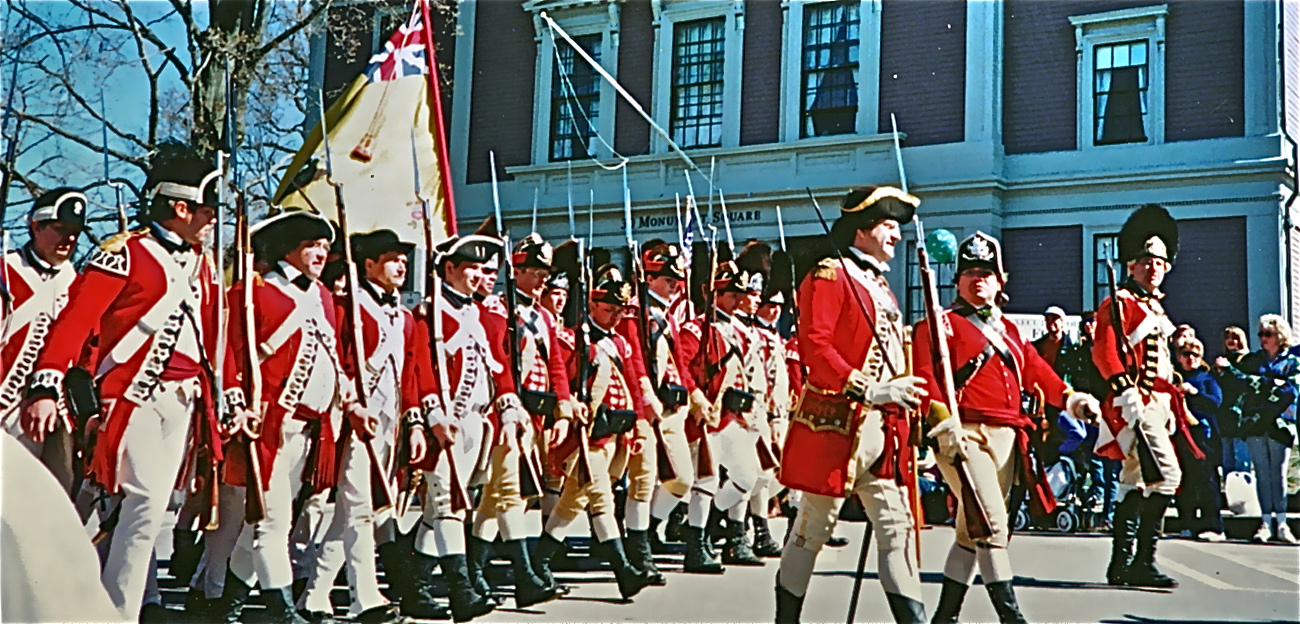
In Massachusetts and Maine (once part of Massachusetts) Patriot’s Day is observed on the third Monday in April. Providing many with a three-day weekend, it commemorates the Battles of Lexington and Concord, the start of the American Revolution, which took place on 19 April 1775.

You’ll forgive my obvious bias, but though there was a British barrage on Lexington Green (its catalyst unknown) at around 5:00 a.m. resulting in the deaths of eight colonists, the actual shot immortalized by Emerson took place in Concord later that morning when (for the first time) colonial militiamen fought back, routing the King’s troops  “…by the rude bridge that arched the flood, their flag to April’s breeze unfurled, here once the embattled farmers stood, and fired the shot heard round the world.”

Today, Patriots Day features reenactments of the call to arms by Paul Revere and William Dawes, along with an early morning parade and reenactment in Lexington and a (more traditional) parade and reenactment in Concord that starts at 09:00.  At 11:00 the Red Sox throw the first pitch in a game at Fenway Park and (until recently) the Boston Marathon began at noon.  As a matter of fact one year (1999) Giles and I caught the parade in Concord, made it to Fenway in time to watch the Sox beat the Tampa Bay Devil Rays, and then managed to make it out to Kenmore Square in time to watch the winners of the Boston Marathon run down Commonwealth Avenue.

In our house Patriots Day also occurs at around the same time as Linda’s birthday (18 April) and Giles’ birthday (17 April). It seems like only a year or two ago that I made a CD of songs for Giles on his 15th birthday, that included today’s selection and the lines: I’m fifteen for a moment, caught between ten and twenty…etc.”  Please highlight that “for a moment” reference.

Today’s song was written and recorded by John Ondrasik, aka Five for Fighting.  Born in 1965 in Los Angeles, Ondrasik learned the piano as a child and later the guitar.  As a teen he began to write music and, after graduating from UCLA with a degree in Applied Science and Mathematics adopted a stage name that’s familiar to every hockey fan, “five for fighting” i.e. the five-minute penalty a player receives for fighting.

Most famous for “Superman (It’s Not Easy)” which became an unofficial anthem after the September 11 attacks, today’s song, was included on Five for Fighting’s 2003 album, The Battle for Everything and held the Number One position on the Billboard Adult Contemporary Tracks chart for 12 non-consecutive weeks in 2004.

It may feel like a year or two ago that Giles turned 15, but (“another blink of an eye?”) tomorrow he turns 21.  To paraphrase Five for Fighting (fitting name for a Patriot’s Day), the sun certainly seems to be getting a little higher ‘round here…and like these “British Regulars” time itself sees to be moving on….

LISTEN TO TODAY’S SELECTION – Patriot’s Day 16 April

 100 Years Lyrics

I’m fifteen for a moment

Caught in between ten and twenty

And I’m just dreaming

Counting the ways to where you are

I’m twenty two for a moment

She feels better than ever

And we’re on fire

Making our way back from Mars

Fifteen there’s still time for you

Time to buy and time to lose

Fifteen, there’s never a wish better than this

When you only got hundred years to live

I’m thirty three for a moment

Still the man, but you see I’m of age

A kid on the way

A family on my mind

I’m forty five for a moment

The sea is high

And I’m heading into a crisis

Chasing the years of my life

Fifteen there’s still time for you

Time to buy, time to lose yourself

Within a morning star

Fifteen I’m all right with you

Fifteen, there’s never a wish better than this

When you only got hundred years to live

Half time goes by

Suddenly you’re wise

Another blink of an eye

Sixty seven is gone

The sun is getting high

We’re moving on

I’m ninety nine for a moment

Dying for just another moment

And I’m just dreaming

Counting the ways to where you are

Fifteen there’s still time for you

Twenty two I feel her too

Thirty three you’re on your way

Every day’s a new day

Fifteen there’s still time for you

Time to buy and time to choose

Hey fifteen, there’s never a wish better than this

When you only got hundred years to live

“…leider nicht von Johannes Brahms”

I was out doing yard work while listening to some music on my iPhone when today’s selection came around, and immediately I was transported to another place and another, very nearly forgotten, Sunday morning. Ever have that happen?

It was 1981 and I’m pretty sure that it was May 25, the Sunday before Memorial Day, which provided a much cherished “two day weekend” away from the Negev Airbase Constructors and especially away from the QC Lab. A friend and I had slept out under the stars in a meadow near Tiberius, overlooking the Sea of Galilee and were making the two-hour journey back to her home in Ramat Aviv, a suburb of Tel Aviv.

I had to dig through a few old photo albums to figure out exactly what kind of car we rented that day and as best I can figure it was a boxy Peugeot 305 “four door saloon” known to clutch grinders everywhere for its “durable gearbox.”  Unfortunately the photos also testify to a ridiculous look sported by yours truly, which included a scraggly beard and a khaki tembel (bucket) hat. Add in a pair of teardrop sunglasses and a pipe (these were pipe smoking days) and you have a general idea of what drew the attention of those in the “deuce and a half” army truck ahead of us.

You see, while my friend slept in the passenger seat I became entranced by a cassette of Strauss waltzes. Perhaps it was the music, perhaps the nicotine from the pipe tobacco, most likely it was simply because it was a beautiful morning in that bucolic, green, northern countryside and I was happy to be alive.

But I distinctly recall “grooving” to the music, slightly swaying along with the steering wheel…back and forth…and taking great pleasure in the moment…and then slowly becoming aware of the truckload of laughing Israeli soldiers lifting up the back canvas to get a good look at…me, the silly swaying driver with a pipe in his mouth.

Chalk it up to An der schönen blauen Donau, Op. 314 (aka The Blue Danube), composed in 1866 by Johann Strauss II, a paean to Europe’s second longest river (after the Volga) that flows majestically for nearly 1,800 miles through ten countries (and four capital cities: Vienna, Bratislava, Budapest and Belgrade).

Recognized as one of the great classical pieces it was only marginally successful when first performed at an 1867 concert of the Vienna Men’s Choral Association. But by the time Strauss’s stepdaughter asked Johannes Brahms for his autograph a number of years later the great composer wrote down the first few bars of The Blue Danube and added “Leider nicht von Johannes Brahms” (“Alas! Not by Johannes Brahms”). The world had caught up.

As for my friend and me, we made it. I’d ordered some (lace-up) roller skates through the Spiegel Catalogue and once back in Ramat Aviv we went roller-skating.  It was a great time, and a great time of life… goofy hat, shadow and all.

LISTEN TO TODAY’S SELECTION – Sunday 15 April

…when her robe is unfurled, she will show you the world

In 1950 Groucho Marx halted trading on the New York Stock Exchange for 15 minutes when traders all stopped to watch him sing Lydia the Tattooed Lady and tell a few jokes. Inspired by the work of Gilbert and Sullivan, Harold Arlen and Yip Harburg wrote the song in 1939 for the Marx Brothers’ ninth film At the Circus. For the remainder of his life, today’s selection would be one of Groucho’s signature tunes.

So let’s see what Lydia has to offer: On one side of her back is the Battle of Waterloo (the 1815 battle in which the Duke of Wellington reigned victorious and Napoleon’s rule came to an end) and beside it The Wreck of the Hesperus (a Longfellow narrative poem about a supercilious sea captain who ignores the appeals of his men in the face of a pending storm and loses his ship on the reef of Norman’s Woe near Gloucester).  And proudly above?  Why, it’s the red, white and blue!

Then for a dime you can see Kankakee (a city in Kankakee County, Illinois) and we all know about “Paree” the City of Light, and Washington Crossing the Delaware (the famous 1851 painting by Emanuel Leutze). Next we have ‘Ol Hickory himself, Andrew Jackson, riding up that hill, and the spectacular view of Niagara Falls, not to mention Alcatraz Island (aka “The Rock”) in San Francisco Bay.

Buffalo Bill Cody and his Wild West Show lasso make an appearance, followed by Mendel Picasso, whom no one seems to know (he was not an historic figure) and Captain Spaulding exploring the Amazon.  Of course, the Brazilian Amazon (the second longest river in the world) is real. As for Captain Spaulding: that was Groucho’s character in the 1930 film, Animal Crackers which led to another of Groucho’s signature songs: “Hooray for Captain Spaulding, the African explorer…. Hooray, Hooray, Hooray!”

Moving on we have that 11th Century noblewoman of legend, Lady Godiva, who rode through the streets of Coventry naked so as to gain remission for the oppressive taxation imposed by her husband (this time with her pajamas on) and Grover Aloysius Whalen, the New York politician who opened the 1939 New York World’s Fair and unveiled the Trylon, one of two modernist structures at the center of the fairgrounds. Connected to the (180 foot in diameter) Perisphere, the 700 foot spired Trylon was the world’s longest escalator.

On the West Coast we have Treasure Island, which is a man-made island in San Francisco Bay (named after the Robert Louis Stevenson novel) that was created for the 1939 Golden Gate International Exposition, with peace and Pacific unity among its themes.  When that didn’t work out it served as a Naval Base and since being decommissioned is a popular destination for visitors. And then there’s Vaslav Nijinsky, the greatest male dancer of the early 20th century, as well as a fleet of ships on her hips and Lydia’s Social Security Number (the Social Security Administration was established as part of Roosevelt’s New Deal in 1935).

One interesting aside, in a posting of mainly asides, is that Yip Harburg, the lyricist actually wrote different lyrics for the final stanza, which were “When she stands, the world gets lit’ler. When she sits, she sits on Hitler.” But the lines were changed because the studio feared the song would sound dated. Instead they went with “Grover Whalen unveilin’ the Trylon,” which is now much more outdated than any reference to Hitler.

Regarding the intro, Thaïs was an ancient Greek courtesan, Madame du Barry was a French countess known for her beauty and we’ve all seen the “Swedish Sphinx” Greta Lovisa Gustafsson (aka Garbo) on the silver screen…. Ole!

LISTEN TO TODAY’S SELECTION – Saturday 14 April

Yes there’s a YouTube Clip too:

http://www.youtube.com/watch?v=n4zRe_wvJw8

Lydia, The Tattooed Lady

 My life was wrapped around the circus

Her name was Lydia

I met her at the World’s Fair in 1900

Marked down from 1940

 Ah, Lydia

She was the most glorious creature

Under the su-un.

Thaïs, du Barry, Garbo

Rolled into one

 Lydia, oh Lydia, say, have you met Lydia?

Lydia the tattooed lady

She has eyes that men adore so

And a torso even more so

Lydia, oh Lydia, that encyclopedia

Lydia, the queen of tattoo

On her back is the Battle of Waterloo

Beside it the Wreck of the Hesperus, too

And proudly above waves the red, white and blue

You can learn a lot from Lydia

 (la la la la la la)

(la la la la la la)

 When her robe is unfurled, she will show you the world

If you step up and tell her where

For a dime you can see Kankakee or Paree

Or Washington crossing the Delaware

 (la la la la la la)

(la la la la la la)

 Lydia, oh Lydia, say, have you met Lydia?

Lydia the tattooed lady

When her muscles start relaxin’

Up the hill comes Andrew Jackson

Lydia, oh Lydia, that encyclopedia

Oh Lydia, the queen of them all

For two bits she will do a mazurka in jazz

With a view of Niagara that nobody has

And on a clear day, you can see Alcatraz

You can learn a lot from Lydia

(la la la la la la)

(la la la la la la)

 Come along and see Buffalo Bill with his lasso

Just a little classic by Mendel Picasso

Here is Captain Spaulding exploring the Amazon

Here’s Godiva but with her pajamas on

(la la la la la la)

(la la la la la la)

 Here is Grover Whalen unveilin’ the Trilon.

Over on the West Coast we have Treaure Island.

Here’s Najinsky a-doin’ the rhumba.

Here’s her social security numba’.

 (la la la la la la)

(la la la la la la)

Lydia, oh Lydia, that encyclopedia

Lydia, the queen of them all

She once swept an admiral clean off his feet

The ships on her hips made her heart skip a beat

And now the old boy’s in command of the fleet

For he went and married Lydia

 I said Lydia

He said Lydia

I said Lydia

He said Lydia

Ole!

…you’ve got a reason to live

Marilyn Manson says he wasn’t upset when the guy sang that “he’d kick my ass, I just don’t want to be used in the same sentence as Courtney Love.  I’ll crack his skull open if I see him.”  And yet You Get What You Give, which has received well over a million radio plays, has such a life-affirming message.

The guy in question is singer/songwriter Gregg Alexander, who was the one constant member of the Иew Radicals. His song reached Number 30 on the U.S. Billboard Hot 100 Chart and Number 5 on the U.K. Chart in 1999. A short lived band, Иew Radicals released only one album, 1998’s (tantalizingly titled) Maybe You’ve Been Brainwashed Too, which contained  “radio-friendly” tracks intermixed with refreshingly strong criticism of corporate America.

According to Alexander, the section of today’s selection (sorry) that “enraged” Marilyn Manson was actually a test to see whether the media would focus on the major political issues of some of the earlier lines (Health insurance rip off lying/FDA big bankers buying, etc.), or the petty celebrity insults. As expected, while the more significant lines were largely ignored, the press focused mainly on the name-dropping.

The singer, Beck once said that Alexander actually apologized to him for the reference during a chance meeting in a supermarket.  “He came running up to me…saying,  ‘I hope you weren’t offended. It wasn’t supposed to be personal.’ I was kind of pleased, because he’s a big guy.”  Nothing reported about what kind of guy Courtney Love thought him to be, but the band, Hanson said they just figured it was a pop-culture reference and Alexander actually went on to work with them a few years later. “It was cool working with Gregg,” said drummer Zac Hanson, “…definitely a character but he’s a cool guy.”

LISTEN TO TODAY’S SELECTION – Friday 13 April

You Get What You Give

Wake up kids

We’ve got the dreamers disease

Age 14 we got you down on your knees

So polite, we’re busy still saying please

Frien-emies, who when you’re down ain’t your friend

Every night I smash a Mercedes-Benz

First we run and then we laugh till we cry

But when the night is falling

You cannot find the light, light

If you feel your dream is dying

Hold tight

You’ve got the music in you

Don’t let go

You’ve got the music in you

One dance left

This world is gonna pull through

Don’t give up

You’ve got a reason to live

Can’t forget

We only get what we give

 I’m coming home baby

You’re the tops

Give it to me now

 Four a. m. we ran a miracle mile

Were flat broke but hey we do it in style

The bad rich

God’s flying in for your trial

But when the night is falling

You cannot find a friend, friend

You feel your tree is breaking

Just bend

 You’ve got the music in you

Don’t let go

You’ve got the music in you

One dance left

This world is gonna pull through

Don’t give up

You’ve got a reason to live

Can’t forget

We only get what we give

This whole damn world can fall apart

You’ll be okay, follow your heart

You’re in harm’s way

I’m right behind

Now say you’re mine

 You’ve got the music in you

Don’t let go

You’ve got the music in you

One dance left

This world is gonna’ pull through

Don’t give up

We’ve got a reason to live

Can’t forget

We only get what we give

Don’t let go

I feel the music in you

Fly high

What’s real can’t die

You only get what you give

You’re gonna’ get what you give

Just don’t be afraid to live

Health insurance, rip off lying

FDA, big bankers buying

Fake computer crashes dining

Cloning while they’re multiplying

Fashion shoots

With Beck and Hanson

Courtney Love and Marilyn Manson

You’re all fakes

Run to your mansions

Come around

We’ll kick your ass in!

Don’t let go

One dance left

Don’t give up

Can’t forget….

{unsung lyrics from liner}

Championed by a soulless media misleading

People unaware they’re bleeding

No one with a brain’s believing

It’s so sad you lost the meaning

Never knew it anyway

Human natures so predictable

I’m a fool to do your dirty work

Whoa, whoa

…you’re not to blame

She was a real girl.  And her name really was Renée.  Described as a tall and free-spirited blonde, Renée Fladen-Kamm was the girlfriend of Left Banke bassist Tom Finn and the object of unrequited affection for the group’s 16-year-old keyboard player, Michael Brown (nee Michael Lookofsky).

A “baroque pop” band, formed in New York in 1965, The Left Banke borrowed its harmony ideas from (then near ubiquitous) British Invasion groups and greatly benefited by access to a recording studio run by Brown’s father, a popular session violinist who also served as the group’s manager, producer and publisher.

Released in 1966 “Walk Away Renée” spent 13 weeks on the Billboard charts, peaking at Number 5.  By far The Left Banke’s biggest hit, it was actually recorded while Fladen-Kamm looked on. “My hands were shaking when I tried to play,” Brown later recalled, “she was right there in the control room. There was no way I could do it with her around, so I came back and did it later…I was just sort of mythologically in love, if you know what I mean, without having evidence in fact or in deed (but) I was as close as anybody could be to the real thing”

Clearly Fladen-Kamm radiated some serious pheromones, because the infatuated teen actually wrote a series of love songs with her in mind, including the band’s second hit “Pretty Ballerina” followed by “She May Call You Up Tonight.” As for the real Renée, she and the bassist soon broke it off and after decades of obscurity, she was eventually identified as a classical singer and vocal teacher living in the Bay Area.

“Walk Away Renée” would also become a big hit for the Four Tops in 1968, reaching Number 13 on the Billboard charts and Number 3 on the UK Singles Chart, and has since been performed by countless artists as varied as: Frankie Vallie, the Cowsills, Rickie Lee Jones, Southside Johnny, Billy Bragg, Tori Amos, David Cassidy, Eric Carmen, Bon Jovi and Linda Ronstadt.  Today’s selection is a version recorded in 1998 by California based singer/songwriter, Vonda Shepard.

LISTEN TO TODAY’S SELECTION – Wednesday 12 April

 Walk Away Renée

 And when I see the sign that points one way

The lot we used to pass by every day

Just walk away Renee

You won’t see me follow you back home

The empty sidewalks on my block are not the same

You’re not to blame

From deep inside the tears I’m forced to cry

From deep inside the pain I chose to hide

Just walk away Renee

You won’t see me follow you back home

Now as the rain beats down upon my weary eyes

For me it cries

Your name and mine inside a heart upon a wall

Still find a way to haunt me though they’re so small

Just walk away Renee

You won’t see me follow you back home

Now as the rain beats down upon my weary eyes

For me it cries

Just walk away Renee

You won’t see me follow you back home

The empty sidewalks on my block are not the same

You’re not to blame

…here she comes now

Born in London in 1948, Steven Demetre Georgiou was the youngest of three kids living above their divorced parent’s restaurant on Shaftsbury Avenue, where the entire family worked. After teaching himself to play piano on the restaurant’s baby grand he acquired his first guitar and would escape to the rooftop to write songs and listen to the musical numbers emanating from some of the nearby West End theatres.

At the age of seventeen Georgiou began to perform in local coffee houses and pubs and soon concluded that he preferred performing solo. As the stage name he’d then adopted (Steve Adams) didn’t seem to be cutting it, he decided to come up with something a little more memorable. The British love their animals and since his girlfriend especially liked cats, Steven Demetre Georgiou thought he might be able to gain a few fans by calling himself Cat Stevens.  The following year (1966) he got his big break when a producer was impressed enough with his songs to help him to land a record deal. The title song for that first album, Matthew and Son hit Number 2 on the British charts and Cat Stevens was on his way.

In 1967 he sold one of his songs to P. P. Arnold for £30, and although her rendition of The First Cut is the Deepest managed to reach Number 18 on the U.K. Chart, its durability would become the real surprise with major hit covers by Keith Hampshire in 1973, Rod Stewart in 1977 and Sheryl Crow in 2003.  It would go on to earn Stevens back-to-back ASCAP “Songwriter of the Year” awards in 2005 and 2006, forty years after it was written.

After he nearly died from tuberculosis and discovered newfound faith while convalescing, the course of Cat Stevens’ music changed dramatically, making him an international superstar in the ’70s.  Ultimately he changed his name as well, this time after nearly drowning off the coast of Malibu, when he decided to devote himself completely to God.  But lest we forget, before that ‘70s superstardom, today’s Mr. Ysuf Islam was once the epitome of a ’60s pop idol.

First recorded in 1967 for his debut album Matthew and Son, today’s selection (minus the final verse) became a huge hit for the Tremeloes whose version peaked at Number 4 on the UK Singles Chart and reached Number 13 on the U.S. Billboard Hot 100 chart that very same year.

 LISTEN TO TODAY’S SELECTION – Wednesday 11 April

Here Comes My Baby

In the midnight moonlight, I’ll…

Be walking a long and lonely mile

And every time I do

I keep seeing this picture of you

Here’s comes my baby

Here she comes now

And it comes as no surprise to me

With another guy

Here’s comes my baby

Here she comes now

Walking with a love

With a love that’s all so fine

Never to be mine

No matter how I try

 You never walk alone

And you’re forever talking on the phone

I’ve tried to call you names

But every time it comes out the same

 Here’s comes my baby

Here she comes now

And it comes as no surprise to me

With another guy

Here’s comes my baby

Here she comes now

Walking with a love

With a love that’s all so fine

Never to be mine

No matter how I try

I’m still waiting for your heart

‘Cause I’m sure that some day it’s gonna’ start

You’ll be mine to hold each day

But ’til then this is all that I can say

 Here’s comes my baby

Here she comes now

And it comes as no surprise to me

With another guy

Here’s comes my baby

Here she comes now

Walking with a love

With a love that’s all so fine

Never to be mine

No matter how I try

…It takes lots of strength to run and play

Born on a cotton-farm near Kosse, Texas in 1905, his father was a statewide fiddle champion and so Robert “Bob” Wills gained some impressive skills at a very young age, namely how to pick cotton and how to play fiddle and mandolin. As part of a large family he, his parents and several siblings frequently played at “kitchen” dances, either in their home or at other ranches around West Texas and eastern New Mexico.

In addition to traditional country music Wills was also deeply immersed in the world of Negro spirituals while working in the cotton fields. “I don’t know whether they made them up as they moved down the cotton rows or not,” Wills once said, “but they sang blues you never heard before.”

Other than his siblings, his playmates were all children of African American cotton pickers and his father, in particular, enjoyed watching him dance the jig with the other kids. However, by the age of 16, with his family struggling to make ends meet, Wills ventured out on his own and drifted for several years by hopping freight trains (he was nearly killed more than once). In his early 20s he attended barber school and got married, alternating between barbering and performing at minstrel shows where he played his violin, cracked jokes and entertained the audience with his amazing jigs.

By 1934 he had formed the basis of the band that would make him famous and moved his family to Tulsa, Oklahoma where Bob Wills and his Texas Playboys became a local institution with live (Monday through Friday) noontime broadcasts and evening dances at Cain’s Ballroom (still in existence).

While the band’s front line consisted of fiddles and/or guitars, Wills accidentally added a trumpet when he hired an announcer who happened to have played with the New Orleans symphony and thought he’d been hired as a trumpeter and simply began to play with the band. Then a struggling young sax player was allowed to play and Wills realized he now needed a drummer to balance things out.  In 1935 a steel guitar player who could serve as a second vocalist was added and by 1938 Texas Playboy recordings included lead, rhythm, steel and electric guitars.  Inductees in the Rock and Roll Hall of Fame (in the Early Influence category) their recording of Ida Red was tellingly re-worked by Chuck Berry as Maybelline decades later.

By now a new genre had been developed, incorporating jazz, blues, popular music and improvised scats, and with an orchestra that sometimes contained as many as 23 members, Bob Wills was (and is) known by all as the King of Western Swing.  Written by (Evansville, Indian born) Fred Rose, today’s selection was first recorded by Bob Wills and His Texas Playboys in 1946.

LISTEN TO TODAY’S SELECTION – Tuesday 10 April 

Roly Poly

 Roly Poly, eatin’ corn and taters

Hungry every minute of the day

Roly Poly, gnawin’ on a biscuit

Long as he can chew it it’s ok

He can eat an apple pie

And never even bat an eye

He likes everything from soup to hay

Roly Poly, daddy’s little fatty

Bet he’s gonna be a man someday

 Roly Poly, scrambled eggs for breakfast

Bread and jelly 20 times a day

Roly Poly eats a hearty dinner

It takes lots of strength to run and play

Pulls up weeds and does the chores

Runs both ways to all the stores

He works up an appetite that way

Roly Poly, daddy’s little fatty

Bet he’s gonna be a man someday

…少年ナイフ

First formed in 1981 perhaps you’re familiar with 少年ナイフ, aka Shonen Knife (literally “Boy Knife”), an all-female trio from Osaka, Japan, which describes itself as the “oo-oo-ultra-eccentric-super-cult-punk-pop-band-shonen-knife!”

With influences that include the Beach Boys, the Ramones and all those girl groups from the ‘60s, Shonen Knife has long had a worldwide cult following including Curt Colbain, who was one of their most ardent fans. After attending one of their concerts he asked them to open for his group, Nirvana.  It was only later that lead singer, Naoko Yamano admitted that they had no idea what Nirvana was.

“So I went to a record store, and I bought their CD,” she said. “And when I saw their photograph, I thought they might be scary persons, because their hairstyles and their clothes were very grunge. But once the tour had started, I noticed that all the members were nice, good persons.”

Long a favorite in our family when we’re in the mood to dance, today’s selection is the  少年ナイフ rendition of a number that was written by Richard Carpenter and John Bettis and featured on the Carpenter’s 1972 album, A Song for You.  First released as a single by Lynn Anderson the following year (reaching Number 2 on the U.S. Country Singles charts) the Carpenters quickly released their own version as a single, which topped the U.S. pop singles charts for two weeks in 1973.

Along with other unconventional covers of Carpenter songs by such artists as Sonic Youth, the Cranberries, Sheryl Crow, Dishwalla and Cracker, today’s selection was the second track on the winningly peculiar 1994 tribute album If I Were a Carpenter.

 LISTEN TO TODAY’S SELECTION – Monday 9 April

On Top of the World

Such a feeling coming over me

There is wonder in the things I see

Not a cloud in the sky, got the sun in my eyes

And I won’t be surprised if it’s a dream

 Everything I want the world to be

Is coming true especially for me

And the reason is clear, it’s because you are here

You’re the nearest thing to heaven that I’ve seen

 I’m on the top of the world looking down on creation

And the only explanation I can find

Is the love that I’ve found ever since you’ve been around

Your love put me on the top of the world

Top of the world

Top of the world

Top of the world

Top of the world

 Something in the wind has learned my name

Telling me that things are not the same

In the leaves on the trees and the touch of the breeze

There’s a pleasant sense of happiness for me

 There is only one wish on my mind

When this day is through I hope I’ll find

Tomorrow will be the same for you and me

All I need will be mine if you are here

 I’m on the top of the world looking down on creation

And the only explanation I can find

Is the love that I’ve found ever since you’ve been around

Your love put me on the top of the world

Top of the world

Top of the world

Top of the world

Top of the world

Top of the world

Top of the world

 Top of the world

Such a feeling coming over me now

 Top of the world

Everything I want the world to be now

Top of the world

On top, on top, on top of the world

I’m on the top now, I’m on the top now

Top of the world

I’m on top, top, top

Top of the world


…It’s not a cry you can hear at night

Written and first performed by Leonard Cohen on his 1984 album Various Positions it took a long time for today’s selection to become an instant hit.  First it took someone who liked Cohen’s lyricism enough to release a tribute album, and that was Welsh singer-songwriter John Cale, who performed a cover version of Hallelujah on his 1991 album, I’m Your Fan.

Cale had watched Cohen perform the song in his typical dispassionate manner and asked if he wouldn’t mind sending the lyrics. Cohen then faxed Cale fifteen pages of lyrics, many of them evoking stories from the Old Testament.  In the end Cale’s melodious version featured vocals, piano and lyrics that Cohen had only performed live, with just a few of the biblical references remaining, including Samson and Delilah (“she broke your throne and she cut your hair”) and King David and Bathsheba (“you saw her bathing on the roof, her beauty in the moonlight overthrew you”)

Since Cale first covered the song it has been performed by approximately 200 artists in various languages. During a CBC Radio interview, Cohen said that he found this amusing given that when he wrote it his record company refused to release it as a single.   However he added, “I was just reading a review of a movie that uses it and the reviewer said – ‘Can we please have a moratorium on Hallelujah in movies and television shows?’ And I kind of feel the same way…I think it’s a good song, but I think too many people sing it.”

It’s Cale’s version that forms the basis of most of these subsequent performances, including Cohen’s during his 2008–2009 world tour, as well as the famous version used in the 2001 film Shrek (although Rufus Wainwright’s version appears on film’s soundtrack album. Cale’s version is also the source for today’s selection, the most critically celebrated rendition, by Jeff Buckley.

Included on Grace, Buckley’s only complete album, in 1994, years later a Q Magazine poll of 50 songwriters, listed it among the all-time “Top 10 Greatest Tracks”. Unfortunately Buckley drowned in 1997 while swimming in a slackwater channel in Memphis and didn’t live to hear the ultimate acclaim his version would receive. Like Cohen’s original, the Buckley version was never officially released as a single and took a looooooong time to garner appreciation.

It wasn’t until 2006 that his cover first hit the charts… in Norway. It was then a hit in Sweden in 2007, and then in March 2008 it was Number One in France before finally topping the U.S. Billboard’s Hot Digital Songs in April 2008, finally propelling it into Platinum status.

Time Magazine called Buckley’s version “exquisitely sung,” observing “Cohen murmured the original like a dirge, but … Buckley treated the … song like a tiny capsule of humanity, using his voice to careen between glory and sadness, beauty and pain… It’s one of the great songs.”

 LISTEN TO TODAY’S SELECTION – Easter Sunday 8 April

Hallelujah

I’ve heard there was a secret chord

That David played, and it pleased the Lord

But you don’t really care for music, do you?

It goes like this

The fourth, the fifth

The minor fall, the major lift

The baffled king composing Hallelujah

Hallelujah, Hallelujah

Hallelujah, Hallelujah

Your faith was strong but you needed proof

You saw her bathing on the roof

Her beauty and the moonlight overthrew you

She tied you to a kitchen chair

She broke your throne, and she cut your hair

And from your lips she drew the Hallelujah

 Baby I have been here before

I’ve seen this room, I’ve walked this floor

I used to live alone before I knew you

I’ve seen your flag on the marble arch

Love is not a victory march

It’s a cold and it’s a broken Hallelujah

Hallelujah, Hallelujah

Hallelujah, Hallelujah

There was a time you let me know

What’s really going on below

But now you never show it to me, do you?

And remember when I moved in with you

The holy dove was moving too

And every breath we drew was Hallelujah

Hallelujah, Hallelujah

Hallelujah, Hallelujah

Maybe there’s a God above

But all I’ve ever learned from love

Was how to shoot somebody who outdrew you

It’s not a cry you can hear at night

It’s not somebody who has seen the light

It’s a cold and it’s a broken Hallelujah

Hallelujah, Hallelujah

Hallelujah, Hallelujah

Hallelujah, Hallelujah

Hallelujah, Hallelujah

Hallelujah, Hallelujah

Hallelujah, Hallelujah

Hallelujah, Hallelujah

Hallelujah, Hallelujah

Hallelujah

OTHER VERSES INCLUDE:

You say I took the name in vain

I don’t even know the name

But if I did, well really, what’s it to you?

There’s a blaze of light in every word

It doesn’t matter which you heard

The holy or the broken Hallelujah

Hallelujah, Hallelujah

Hallelujah, Hallelujah

I did my best, it wasn’t much

I couldn’t feel, so I tried to touch

I’ve told the truth, I didn’t come to fool you

And even though it all went wrong

I’ll stand before the Lord of Song

With nothing on my tongue but Hallelujah

Hallelujah, Hallelujah

Hallelujah, Hallelujah

Hallelujah, Hallelujah

Hallelujah, Hallelujah

Hallelujah, Hallelujah

Hallelujah, Hallelujah

Hallelujah, Hallelujah

Hallelujah, Hallelujah

Hallelujah