Partly it’s because a day finally came when I could restack my woodpile and the “wealdy” subject of this song appealed to me. Partly it’s because it’s Easter time and the song touches on resurrection. Mainly it’s because it’s nice to listen to a new singer and song and instantly like them both – something that seems to happen less and less. Pandora, that reliable venue for discovering new recording artists, came through once again.
And so here you have Elliott Park, whose father (Ernie Park) was an offensive lineman for the Oakland Raiders, and who was raised in Clyde, Texas (population 3,345). While in college he taught himself to play piano and began to write songs, naming Willie Nelson, Simon and Garfunkel, Roger Miller, the Eagles, and Glen Campbell as influences.
For the next ten years his music career proceeded less than apace … until, he was introduced to Nashville songwriter, Walt Aldridge, with whom he co-wrote “I Loved Her First.” Recorded by the band, Heartland it reached Number One on the Billboard Hot Country Songs chart in 2006. Four years later he released “Flyboy,” his first album, which I downloaded as soon as the shed door was locked.
Now working on his second album, Park is the father of four and seems to have the rather endearing quality of regularly singing to/for/about his wife and kids. As one critic notes, “His lyrics draw you down a pleasant road – into an unpretentious world of honest smiles, open hearts, and a few tears along the way.”
Eclectic and fun, there are half a dozen songs on “Flyboy” that I could have put forth here, and I must concur with his five (!?) Amazon reviewers and 925 Facebook “likes.” As another critic puts it, “His music is a seamless blend of genres presented in an honest and endearing way. Elliott Park’s vocals are weathered and truthful as someone at the end of a pilgrimage. His lyrics are colorful and sometimes odd, but always approachable. His genre is life.”
Nice genre if you can get it.
The Soldier and the Oak
This is a story that began long, long ago
I was a young oak tree in dark Missouri soil
And like all other saplings I had dreams of growing
Strong and tall
But one day a rebel with a bullet in his chest
Hung his rifle on my limbs and laid to rest
And there beside me as the blood soaked to my roots
The soldier sang
A song of grace
The heavy rifle bowed me over to the ground
Two years I stayed this way until the rifle fell
And in this manner for a hundred years I grew
All my dreams
Not meant to be
And then one day two men came with a cross cut saw
They spoke of how my arch would hold a weight so strong
And I feared not the blade for such a worthy cause
And so I fell
I gladly fell
Three winter days aboard a northbound train
Three more beneath the hewer’s careful blade
And while he worked he praised my rich red grain
Perhaps it was the soldier’s blood that day
Now I’m the wooden arch that holds a mighty bell
Three stocks before me cracked but I shall never fail
Up in a tall cathedral high above my dreams
Of long ago
And on Sunday mornings when I hear that sweet refrain
I see the soldier’s face like it was yesterday
Calling angels down from heaven with that hymn he softly sang
He appears to have been a man who never quite shook the insecurities of his youth, and the soaring trajectory of his career looks remarkably like the flight of Icarus, who as legend has it … “got crazy once and tried to touch the sun.”
If, like me, you were rather fond of his music back in the day, it meant bucking the tide to embrace a wildly popular singer/song-writer who, no matter their genre, was looked upon with scorn by many of the music industry’s more “authentic” troubadours.
Sometimes such derision was displayed in a big way, as when Charlie Rich, the presenter of 1975’s Country Music Entertainer of the Year Award set fire to the envelope after reading his name. Then there was the time in 1985 when he was “disinvited” to participate in the “We Are the World” music video, for fear that his image would hurt the song’s credibility.
Granted, his visage in those years was rather Muppet-centric, but the USA for Africa crowd’s gesture remains breathtakingly ironic. Not only was he already an outspoken proponent for AIDS relief in Africa, he was also a key supporter of Save the Children, a spokesman for UNICEF, and a co-founder of the World Hunger Project who’d personally been appointed by Jimmy Cater to a Presidential Commission on World and Domestic Hunger. In fact, before 1985 was over he’d also been presented with the Presidential World Without Hunger Award by Ronald Reagan.
A spirited environmental activist, he was a major supporter of Friends of the Earth, the Cousteau Society, and was co-founder of the Windstar Foundation for wildlife preservation. All of which led to his becoming one of only ten recipients – ever – of the Albert Schweitzer Music Award for Humanitarianism. The other nine being: violinist, Isaac Stern; dancer/choreographer, Katherine Dunham; pianist, Van Cliburn; opera singers José Carreras, Placido Domingo, Luciano Pavarotti, and Anna Moffo; and Maestros Mstislav Rostropovich and Leonard Bernstein. Not bad for a man with an image problem.
Born Henry John Deutschendorf, Jr. on New Year’s Eve, 1943 in Roswell, New Mexico, his no-nonsense father was an acclaimed Air Force pilot whose name is now enshrined in the National Aviation Hall of Fame.
As noted in a previous posting: Shy, rather introverted and ever the “new kid” (as a military brat) Henry, Jr had a difficult time making friends. Recognizing this, his grandmother presented the (then) eleven year old with a well-worn guitar, to help him to focus his attention on something he might enjoy, and just maybe to help him to fit in … https://thisrightbrain.com/2012/03/20/i-guess-it-broke-her-heart/
Clearly it helped. By the time he was a Fort Worth high school student it was his fervent desire to make it as a musician, which led him to take his father’s car and drive to L.A. to begin his career. This in turn led Henry, Sr. to fly in on borrowed a jet to convince his son to come home and finish school.
Back in L.A. a few years later, and performing as John Denver (in honor of his favorite state), he began to land gigs on the folk circuit. His first big break came in 1965, when he joined the popular Chad Mitchell Trio, who performed on university campuses throughout the country. This included Gustavaus Adolphus College in Minnesota, where he met sophomore, Annie Martell. Married the following year, they bought a house in Aspen.
By the time he’d written “Annie’s Song” (composed for his wife in 10 minutes, while on an Aspen ski lift) in 1974, John Denver was one of the most successful and recognizable recording artists on the planet, whom the Governor of Colorado had officially proclaimed as the state’s poet laureate. And in the years that followed he seemed to be everywhere, starring in TV specials, hosting the Grammy Awards (five times), acting in films, and even standing in for Johnny Carson on the Tonight Show (15 times).
An avid skier, he served as a skiing commentator for ABC at the 1984 Winter Olympic games in Sarajevo, for which he also composed the theme song. And after a rigorous selection process he was a finalist for NASA’s first citizen trip on the Space Shuttle, a seat ominously taken by schoolteacher, Christa McAuliffe.
Although deeply affected by the Challenger disaster, aviation remained an abiding passion. Echoing his father, he too became an accomplished pilot with ratings that ranged from jets to bi-planes to gliders The man whose first hit song (as sung by Peter, Paul & Mary) was “Leaving on a Jet Plane” preferred to fly his own.
Yet now approaching his 50s, his career was in free fall. While the humanitarian work continued, the music was melting away, and his personal life unraveling.
There were bouts of depression, tales of infidelity and domestic discord. He and Annie parted ways. He remarried. It didn’t last. “Before our short-lived marriage ended in divorce, she managed to make a fool of me from one end of the valley to the other,” he said of his second wife.
There was a DUI charge, then another, which involved wrapping his Porsche around a tree. And so it went until that fateful day in ’97 when John Denver plummeted into the sea and perished.
“A lot of people write him off as lightweight, but he articulated a kind of optimism, and he brought acoustic music to the forefront, bridging folk, pop, and country in a fresh way… People forget how huge he was worldwide,” said country/blue grass performer Kathy Mattea in an Entertainment Weekly interview.
All tolled John Denver recorded and released nearly 300 songs, having written around 200 of them himself. While some have fallen by the wayside, others have stood the test of time – and they’re not necessarily his biggest hits. Take this one, for instance. When it was released as a duet with Placid Domingo (on Domingo’s album of the same title in 1981) there were many among us who found it pretentious, overblown and unlistenable.
But then, to mark the 10th anniversary of his death, in 2007, Denver’s family released Live in the USSR, a set of “unplugged” recordings from a number of 1985 concert performances in the Soviet Union (he would return a few years later to perform in aid – of couse – of the victims of the Chernobyl disaster).
Written for his wife, Annie after their separation, she later reflected that while she “felt blessed by ‘Annie’s Song,’” this was her favorite song of all.
There are fibs and little white lies, and there are big lies and half-truths. There is lying to oneself. There’s confabulation caused by faulty recollection and there’s perjury under oath. There are polite lies and noble lies, untruths and exaggerated puffery. There’s tactical bluffing, hyperbole, and rhetorical bullshit.
There’s equivocation and misrepresentation, propaganda and political spin, dissemblance and disinformation. There is speaking with forked tongue, being economical with the truth, making false and misleading statements, and there’s bald-faced lying… I could go on.
The capacity to lie convincingly is an essential part of our human development which, as every parent learns, generally occurs somewhere between the ages of four and five. By then the average child will have accrued enough experience to know that lying is a way to avoid punishment. In varying degrees, moral comprehension comes later.
In matters of mistruth there are those who subscribe to the beliefs of Aristotle (anyone who advocates lying can never be believed) or St. Augustine (there are no circumstances in which one may ethically lie … lying is a perversion of the natural faculty of speech), who simply could not countenance willing deception.
While others lean toward Machiavelli (appearances can be deceiving, and they should be deceiving … sometimes words must serve to veil the facts) or Nietzsche (some tell the truth only out of weakness … because it’s difficult to maintain a lie), who my have countenanced it a bit too much.
And yet we humans aren’t the only ones to verbally deceive. Perhaps you’ve heard of Koko the gorilla, who is said to understand nearly 2,000 words of spoken English and can communicate with her caretakers in American Sign Language. A number of years ago Koko was given a kitten as a pet to help sooth her nurturing instinct, which was very much in evidence except for the time when she somehow ripped a sink out of the wall. When asked what happened Koko’s response was unequivocally more Nature than Nurture. In crisp, clear signage she affirmed, “The cat did it.”
Cabaret fans will surely recognize the name, David Frishberg. Once a Journalism Major at University of Minnesota, he landed in Greenwich Village as a jazz pianist after a stint in the Air Force, and played for the likes of Carmen McRae, Gene Krupa and Zoot Sims.
Frishberg’s songs have since been performed by such luminaries as Rosemary Clooney, Mel Torme, Diana Krall, and Susannah McCorkle – who actually covered this one. Still, his most popular number was memorably featured in an animated episode of Schoolhouse Rock in which he cleverly un-spun the legislative process with, I’m Just a Bill.
Blizzard of Lies
We must have lunch real soon. Your luggage is checked through.
We’ve got inflation licked. I’ll get right back to you.
It’s just a standard form. Tomorrow without fail.
Pleased to meet you. Thanks a lot. Your check is in the mail.
Marooned, marooned, marooned in a blizzard of lies.
Marooned, marooned, marooned in a blizzard of lies.
Your toes and knees aren’t all you’ll freeze
When you’re in it up to your thighs.
It looks like snow, but you never know
When you’re marooned in a blizzard of lies.
You may have won a prize. Won’t wrinkle, shrink or peel.
Your secret’s safe with me. This is a real good deal.
It’s finger lickin’ good. Strictly by the book.
What’s fair is fair. I’ll be right there. I am not a crook.
Marooned, marooned, marooned in a blizzard of lies.
Marooned, marooned, marooned in a blizzard of lies.
Better watch your step when your old dog Shep
Can’t even look you in the eyes.
You’re cold and lost and you’re double crossed
When you’re marooned in a blizzard of lies.
We’ll send someone right out. Now this won’t hurt a bit.
He’s in a meeting now. The coat’s a perfect fit.
It’s strictly fresh today. Service with a smile.
I’ll love you darling ’till I die. We’ll keep your name on file.
Marooned, marooned, marooned in a blizzard of lies.
Marooned, marooned, marooned in a blizzard of lies.
Walk on, walk on, with hope in your heart.
And you’re in for a big surprise.
When you’re marooned, marooned, marooned
marooned, marooned, marooned,
marooned, marooned, marooned in a blizzard of lies.
His name was John Shaw Torrington, a Royal Navy Petty Officer, and a member of Sir John Franklin’s “lost expedition” sent to gather magnetic data in the Canadian Arctic and navigate the Northwest Passage. At the age of 22, he was the first to perish.
Buried on Nunavut’s Beechey Island for 138 years, the last thing startled forensic scientists expected when they dug down into the permafrost and peered into his grave, was for John Shaw Torrington to be staring back at them! With eyes and facial features completely preserved, and his thawed limbs fully flexible, anthropologist Owen Beattie later reported that lifting the diminutive engine-stoker from his coffin was like moving someone who was unconscious rather than dead.
Setting out from England (far from any permafrost) in May of 1845, it had been a promising start for the 129-member crew. Provisions were ample, including 33,000 pounds of tinned meat and vegetables, while the expedition’s two sturdy ships, HMS Terror and HMS Erebus featured such cutting-edge technology as steam engines, screw propellers, reinforced beams, and internal steam heating. Yet within months all would be lost.
After the Admiralty posted a £20,000 reward, a massive search began, both by sea and land, and in 1850 a stone hut, tins of food and three graves were discovered on Beechey Island, containing the remains of Torrington and two others who had died early in the voyage.
But that was pretty much it, and it wasn’t until the 1980s, when Beattie and his team were dispatched, that one of modern history’s great anthropological cold cases would be resolved. The culprit? A lack of quality control.
Awarded the contract a few weeks before departure, the food provisioner was known to have cut corners during the rudimentary canning process and haphazard lead soldering contaminated everything with the tins as a result, as evidenced by those near the graves. Although an autopsy revealed that Torrington had died from pneumonia, the severe physical and mental symptoms of lead poisoning proved to be a significant contributing factor.
Pressed for time, Beattie’s team was only able to briefly examine another of the bodies, but combined with other evidence it was firmly concluded that although the expedition continued on, lead poisoning – and eventually tuberculosis, starvation, and hypothermia – ultimately spelled the demise of all.
Hailed as heroes in Victorian times, the Franklin Expedition inspired a multitude of artistic, musical, and literary works (for example, Terror and Erebus are referenced in both Jules Verne’s Twenty Thousand Leagues Under the Sea and Joseph Conrad’s Heart of Darkness), a trend that would be reborn after pictures of Torrington’s remarkably preserved remains were widely circulated in the 1980s.
Sheenagh Pugh’s Envying Owen Beattie, Margaret Atwood’s The Age of Lead, and Mordecai Richler’s Solomon Gursky Was Here, all find there genesis with the story as does Iron Maiden’s Stranger in a Strange Land … and this whimsical track for a cold winter’s day, as featured on James Taylor 13th album, New Moon Shine in 1991.
The Frozen Man
Last thing I remember is the freezing cold
Water reaching up just to swallow me whole
Ice in the rigging and howling wind
Shock to my body as we tumbled in
Then my brothers and the others are lost at sea
I alone am returned to tell thee
Hidden in ice for a century
To walk the world again
Lord have mercy on the frozen man
Next words that were spoken to me
Nurse asked me what my name might be
She was all in white at the foot of my bed
I said Angel of Mercy, I’m alive! Or am I dead?
My name is William James McPhee
I was born in 1843
Raised in Liverpool by the sea
But that ain’t who I am
Lord have mercy I’m the frozen man
It took a lot of money to start my heart
To peg my leg and buy my eyes
The newspapers call me “state of the art”
And the children, when they see me, cry
I thought it would be nice just to visit my grave
See what kind of tombstone I might have
I saw my wife and my daughter and it seemed so strange
Both of them dead and gone from extreme old age
See here, when I die make sure I’m gone
Don’t leave ‘em nothin’ to work on
You can raise your arm, you can wiggle your hand (not unlike myself)
Arthur Fiedler, Laurence Olivier, Muddy Waters … there are certain celestial-types whose soaring careers were so enduring that a youthful countenance isn’t what comes to mind when their names are mentioned. And to these you can add an artist who, like Fiedler, rather amazingly began as a violinist.
Born in Mississippi in 1928, Ellas Otha Bates was raised by his mother’s cousin, Gussie McDaniel (Ellas McDaniel would be his songwriting name) in the South Side of Chicago. As a teen he not only studied the violin, he actually learned how to make them at a local vocational school.
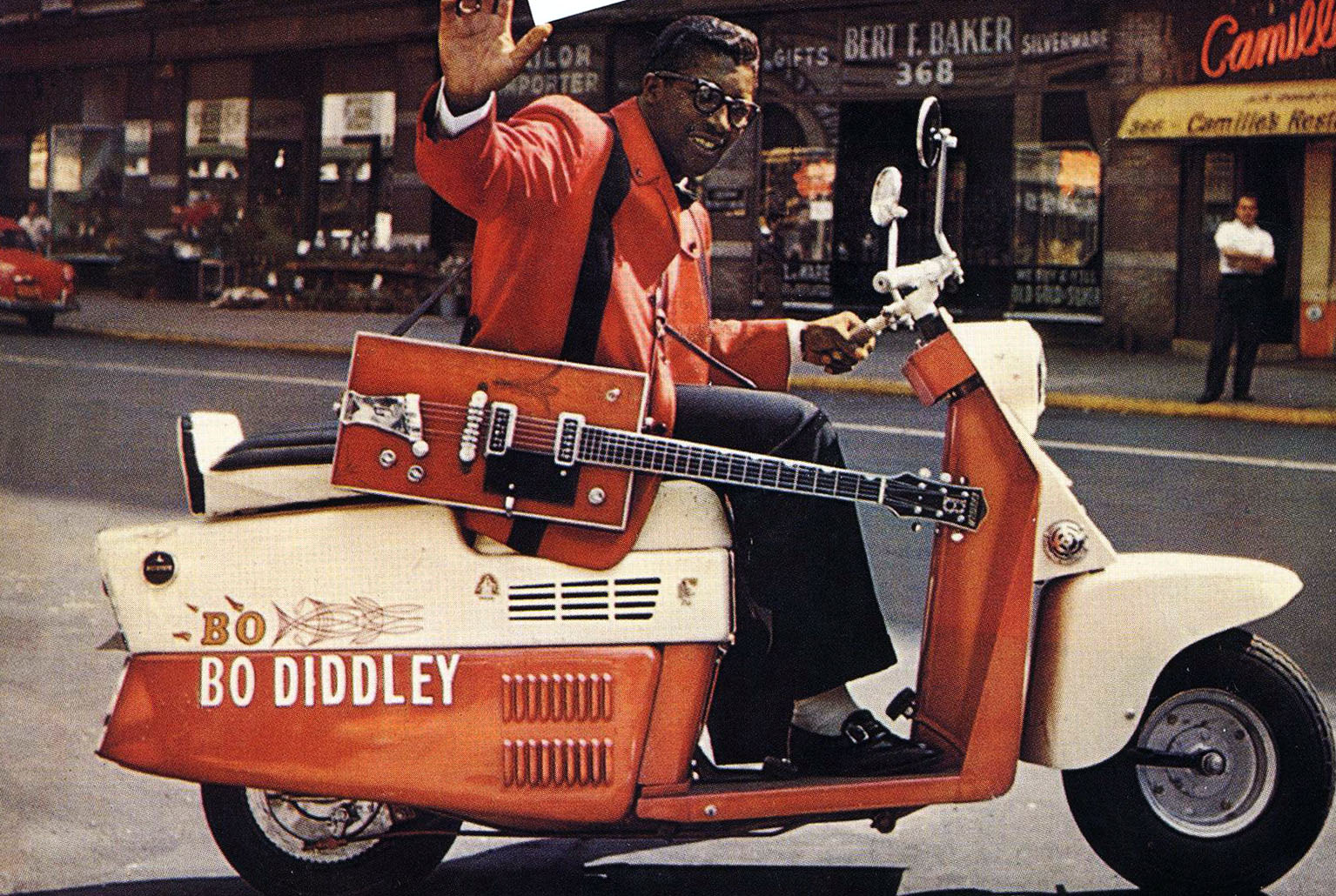
Then he saw John Lee Hooker perform and the aspiring musician put down his bow and, with a voc-made guitar in hand, joined some friends in a street-corner band. It took a few years, but by 1951 young Ellas had developed a signature playing style and was offered a regular gig at a nearby club. All he needed was a solid stage name, which he found in a colloquial phrase (whose literal meaning is ‘absolutely nothing’), “Bo Diddley.”
Revered for the powerful, rhythmic, “jingle-jangle” beat that remains a Hip-Hop staple to this day, the inventive Blues/Rockabilly guitarist would come to cast a powerful influence over legions of music legends in the years ahead, among them: Elvis Presley, Buddy Holly, Dick Dale, Jimi Hendrix, Eric Clapton, the Rolling Stones (and the Beatles for that matter), Pink Floyd, Velvet Underground, and Parliament Funkadelic.
Bo Diddley’s trademark instrument was the cigar-box shaped “Twang Machine” that he designed after a memorable performance early in his career. While leaping around the stage with a traditional Gibson guitar he injured himself in the groin and quickly decided to come up with something a little “less restrictive” to keep the good-time acrobatics alive.
Paired with “I’m a Man” as its B-side, this song (named for the performer, not the writer) impressively became a Two-Sided Number One (!) R&B hit in 1955 … which led to a much coveted appearance on The Ed Sullivan Show.
Unfortunately the short-fused Sullivan was expecting a rendition of (the Tennessee Ernie Ford hit) “Sixteen Tons” and was so furious when Bo Diddley played “Bo Diddley” that he never invited him back again. “Ed Sullivan said that I was the first black boy to ever double-cross him on the show,” Diddley later recalled. “ He said I wouldn’t last six months.”
Fortunately, for those of us who took a while to discover him, that prediction fell slightly shy of the mark and the great Bo Diddley’s career lasted for another 52 years, with tracks that would be covered by the likes of: Bruce Springsteen, CCR, Aerosmith, The Clash, The Kinks, The Who, Tom Petty, The Zombies, The Animals, Bob Seger, The Yardbirds, The Grateful Dead, The Doors…
“I used to get mad about people recording my things,” said Diddley late in his career. “But now I got a new thing going. I don’t get mad about them recording my material because they keep me alive.”
“As a folk duo, how much could recording costs be?” asked the record producer who had been brought in to help Paul Simon get back into the studio during a bout of writer’s block. Unfortunately for Columbia Records the recording costs for Simon & Garfunkel could be memorable.
It was the summer of ’67, the Beatles had just released Sgt. Pepper, and the “duo” were working on a concept album of their own (exploring the cycle of life) called Bookends.
The first session was for this track and after percussionists, brass and viola players had been brought in, everyone worked through the night to find just the right sound. Greatly influenced by Strawberry Fields Forever and Tomorrow Never Knows, the outcome is said to lyrically reflect Simon’s tenuous working relationship with his lifelong “frenemy,” Art Garfunkel.
The woman “entering” the tailor shop was folk singer Beverley Martyn, an associate of Simon’s who was good friends with (“the Scottish Dylan”) Donovan, whose last name is Leitch, hence the tailor’s name. Apparently Simon had wondered what his vocation might have been had he lived a century earlier and concluded that he surely would have been a tailor in Vienna or Budapest. Only later did he learn that his grandfather, whose name was also Paul Simon, actually was a tailor who’d lived in Vienna a century earlier.
Released as a single in June 1967 (the album itself was released the following year) the song’s running time is 3 minutes and 14 seconds, but since AM stations resisted anything that ran longer than 3 minutes, Simon slyly faked the time printed on the label to read 2:74.
“Life is not linear, it’s organic,” affirms education revisionist Sir Kenneth Robinson and although it was linear thinking that made me think of this song on a balmy autumn Sunday (after listening to one of Robinson’s popular TED talks), its actual genesis is about as meanderingly organic as you can get … much as this posting.
In the early years of the last century a new genre of dance music that blended military marches, African rhythms, and field hollers (among other influences) with spirituals and syncopated jazz took hold in the red light district of Memphis. The musicians were of the medicine show/street corner variety and their home-crafted instruments regularly featured: banjos made with metal pie-plates and discarded guitar necks, washboards, stovepipe or washtub basses, guitars fashioned from flattened gourds, spoons, comb and tissue kazoos, and the stoneware “instruments” that gave the genre its name, Jug band music.
Roundly recorded in the early 1920s, many a future Jazz and Swing great began in a Jug band, including: Louis Armstrong, King Oliver, Jimmy Dorsey, Gene Krupa, Jack Teagarden, and Glen Miller.
Although it fell out of favor during the Depression, new life was blown into the genre during the Folk era of the mid-to-late ’50s at the same time that a strikingly similar resurgence, minus the jug, took place in Britain. There it was called Skiffle and many a future rock star cobbled together his own instrument and joined a Skiffle band: Van Morrison, Mick Jagger, Roger Daltrey, Ronnie Wood, Jimmy Page, Robin Trower, David Gilmour, and Graham Nash.
Back in the States, the Jug band resurgence hit its peak in the early ’60s, with the Rooftop Singers’ Number 1 hit, Walk Right In, and, yes, many a well-known act would evolve from its homespun origins: The Grateful Dead, Country Joe and the Fish, The Mommas and the Papas, and after she married Geoff Muldaur of the Jim Kweskin Jug Band, Maria Muldaur of the Even Jug Band.
This song, so well suited for a balmy Sunday morning, was one of many written by Maria’s former Even Jug bandmate, John Sebastian, after he’d formed the Lovin’ Spoonful in 1964. Released on the group’s second album of the same name, it reached Number 2 on the Billboard Charts in 1966.
It is very much an organic chain of events that, later that year, led to the first track of the second side of the most famous ex-Skiffle band of them all’s seminal album, Revolver … “(This) was our favourite record of theirs,” says Paul McCartney about the Lovin’ Spoonful song. “Good Day Sunshine was me trying to write something similar to Daydream.”
Daydream
What a day for a daydream
What a day for a day dreamin’ boy.
And I’m lost in a daydream
Dreamin’ ’bout my bundle of joy.
And even if time ain’t really on my side
It’s one of those days for taking a walk outside
I’m blowing the day to take a walk in the sun
And fall on my face on somebody’s new-mown lawn
I’ve been having a sweet dream
I’ve been dreaming since I woke up today.
It’s starring me and my sweet thing
‘Cause she’s the one makes me feel this way.
And even if time is passing me by a lot
I couldn’t care less about the dues you say I got.
With her blond bouffant and panda eyes she was a veritable “Swingin’ ’60s” icon, at the very forefront of the British Invasion, having hit the American Billboard’s Hot 100 a mere week after the Beatles’ I Want to Hold Your Hand. She was also one of the finest white soul singers of her (or any) era.
But by 1968 the invasion was over. Popular music had changed. Though long accustomed to recording (and often self-producing) in England, she made the bold move of crossing over to American-based Atlantic Records, and headed down to Memphis with something different in mind. Now enshrined in the Grammy Hall of Fame as one of the greatest albums of all time, Dusty in Memphis was all that and more … Then again, this wasn’t the first time Dusty Springfield had been to Tennessee.
Born into a musically-inclined family in 1939, Mary Isobel Catherine Bernadette O’Brien earned her nickname early, while playing football with the boys in her North London neighborhood. By the time she was 18 “Dusty” and her brother, Tom had become folk club regulars, eventually forming a trio with fellow singer, Tim Feild, and using a name they’d come up with while rehearsing in a Somerset field one spring day: the Springfields.
Looking for an “authentic” Appalachian sound, they soon travelled to Nashville, only to become deeply influenced by the R&B scene instead. The result was a pop-folk style that helped to make them Britain’s top vocal group until the Springfields’ disbandment in 1963. Then, while Tom continued to produce and write songs (including “Georgy Girl”) and Tim became a renowned Sufi mystic (really), Dusty Springfield came into her own with “I Only Want to Be With You,” one of the first singles to be played on BBC-TV’s legendary Top of the Pops.
An uncompromising perfectionist who deplored the quality of her record company’s London studios, she preferred to record in the ladies room where the acoustics were better. Nor would she compromise on her sense of justice, and was famously deported from South Africa after performing for an integrated audience near Cape Town.
Voted Britain’s top female singer throughout the ‘60s, Springfield loved to sing backup for other performers too, using the pseudonym, Glady’s Thong on recordings by Elton John, Kikki Dee, Anne Murray, and (her own one-time backup singer) Madeline Bell.
It was Elton John, in fact, who helped to induct Dusty Springfield into the Rock and Roll Hall of Fame, two weeks after her death from breast cancer in 1999, saying, “I’m biased but I just think she was the greatest white singer there ever has been … Every song she sang, she claimed as her own.”
That would include this, the third track on Dusty in Memphis, written by John Hurley and Ronnie Wilkins. A top ten hit in both the US and UK, it was originally offered to Aretha Franklin, who eventually recorded it after hearing this version.
Post Scriptus: During her Memphis sessions Springfield urged Atlantic producer Jerry Wexler to sign on a newly formed group that included one of her favorite session musicians, John Paul Jones. The group was Led Zeppelin, whom the label signed to an historic contract – sight unseen, according to Wexler – based largely on the recommendation of Dusty Springfield.
‘Though many of us lost interest in “the Game” a few weeks ago, there’s always “The” game to burn a candle over. And although it was a game played long before the discovery of fire, this particular wick was first lit in 1911.
It’s also the only Number One pop single with music written by either a U.S. Vice President or a Nobel Peace Prize winner…or for that matter, an Ambassador to the Court of St. James.
With lyrics written by songwriter, Carl Sigman in 1951 the tune reaches back to a composition written by a Chicago bank president named Charles Gates Dawes, who would later become Vice President of the United States under Calvin Coolidge.
An amateur pianist, Dawes composed the tune (which he entitled “Melody in A Major”) in a single sitting at his lakeshore home in Evanston, Ill. After listening to it a friend took the sheet music to a publisher. Weeks later Dawes was dumbfounded to discover a picture of himself in a State Street music shop window where they were selling “Dawes Melody”.
“I know that I will be the target of my punster friends,” he said. “They will say that if all the notes in my bank are as bad as my musical ones, they are not worth the paper they were written on.”
Dawes would share the Nobel Peace Prize in 1925 for his plan to stabilize Germany’s economy after the First World War and after serving as VP, the man whose face was on the 14 December 1925 cover of Time Magazine, went on to serve as US Ambassador to Britain prior to returning to the banking business. But throughout his political career he would regret that day in 1911 that he came up with his “melody” as it was played whenever and wherever he made a political appearance.
Then “Dawes Melody” took on a life of its own, becoming a favorite of popular violinist Fritz Kreisler, who used it as his closing number throughout the ‘30s and then a Big Band standard after Tommy Dorsey picked it up in the ‘40s.
In 1951, the year Charles Dawes died, songwriter Carl Sigman wrote his lyrics to the song, which was now called “It’s All in the Game” and it was soon recorded by Dinah Shore, Sammy Kaye, Louis Armstrong and Nat King Cole among others, including Tommy Edwards, whose version reached Number 18 on the Billboard Charts.
Stepping forward to 1958, Edwards, who had been bumping along since his 1951 hit, had only a single session left on his record contract. As stereo recording had recently become viable Edwards chose to “go for the gusto” with a stereo version of “Game” using the same studio orchestra as his original but with a Rock n’ Roll arrangement.
The resulting single owned the Billboard charts for six straight weeks and soon topped the British charts as well, reviving Edwards career for another few years, and guaranteeing the continued reappearance of “that sweet bouquet” for years to come as performed by the likes of: Cliff Richard, Robert Goulet, Andy Williams, The Lettermen, The Four Tops, Jackie DeShannon, Cass Elliott, George Bensen, Neil Sedaka, Merle Haggard, John Mathis, Barry Manilow, Glen Campbell and Keith Jarrett.
Born in Waukesha, Wisconsin in 1915 (his mother was related to both the makers of the Stutz automobile and the founders of the Valentin Blatz Brewing Company), Lester William Polsfuss began playing the harmonica at age eight. After learning to play the guitar (having failed at banjo) as an adolescent, he invented the neck-worn harmonica holder, which is still broadly used and manufactured to this day using his basic design.
By the age of 13 he was playing semi-professionally at area roadhouses and before dropping out of high school to join a Western Swing band he had figured out a way to amplify his acoustic guitar by wiring a phonograph needle to a radio speaker. By the age of 19 Les Paul, as he now billed himself, had moved to Chicago and begun to play jazz and blues.
Over time his guitar style became so strongly influenced by Django Reinhardt that he traveled abroad to befriend the “Gypsy virtuoso” after the war and (by then a household name) furnished his headstone when Reinhardt died from a brain hemorrhage in 1953. An incredibly innovative player, with trills, licks, fretting techniques and chording sequences, Les Paul stood out amongst his contemporaries (Time magazine named him one of the ten best electric guitar players of all-time in 2009) and, he too became a huge influence…on countless guitarists that followed. As the manager of the Andrews Sisters (with whom Paul worked in the 1940s) once observed, “Watching his fingers work was like watching a locomotive go.”
In 1948 that “locomotive” was derailed for well over a year on icy Route 66 near Davenport, Oklahoma. His wife and singing partner Mary Ford was driving their Buick convertible when it skidded and rolled over and over, down into a creek bed. Lucky to be alive, Paul had shattered his right elbow and arm so severely that the doctors gave him the choice of amputation or having it all fused in one position. His choice was to have the arm set at an angle of just under 90 degrees, which would eventually allow him to pick and cradle his guitar.
Of course, Les Paul is also remembered for his numerous inventions and innovations, such as overdubbing, delay effects and multi-track recording…and especially as the man who pioneered the solid-body electric guitar, making that Rock n Roll sound possible.
Back in the 1930s Paul had become frustrated with acoustic-electric guitars, which hindered his improvisation. The main impediments were “feedback” as the acoustic body didn’t resonate very well with amplified sound and “sustain” as there was little dissipation from the instrument’s strings, which meant that not much sound generated through the guitar’s body.
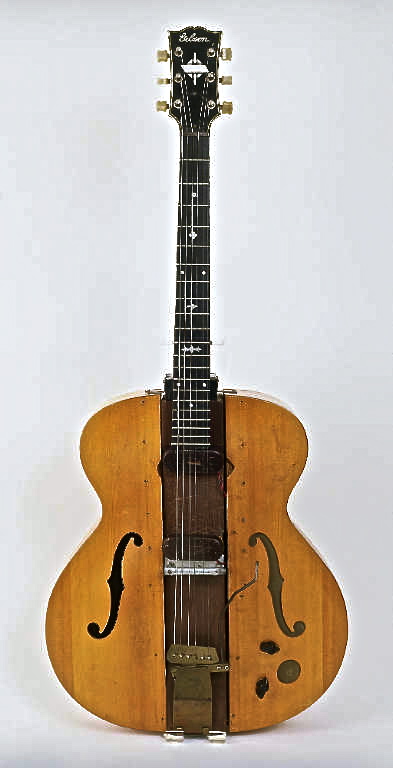
Experimenting in his Queens, NY apartment, his first attempt at a solid-body instrument was an actual 4” X 4” pine log, taken from a train rail, with an attached guitar neck, a simple hard-tail bridge and pickups. Immediately dubbed “The Log” Paul later installed sawn-off body parts from an Epiphone semi-accoustic guitar solely for the sake of a more convincing appearance.
As was confirmed when it was recently displayed in the Smithsonian “The Log” was an ugly instrument, but despite it’s clunky appearance (Paul’s next prototype was called “the clunker” by the way) audiences were hugely impressed with its volume and the never-before-heard sounds that could be created with it.
In 1946 Paul took his prototype to the Gibson Guitar Corporation and although the company didn’t use his exact design it was very happy to work with him and especially to use his well-known name to promote the first ever line of solid-body guitars in the 1950s. “Les Paul” guitars have long been a sought after brand ever since, especially for legions of popular musicians, many of them playing their own customized models. While “The Log” is now priceless, an original run-of-the mill ’52 Gibson Les Paul STD Gold Top can still be had for a mere $25,000.
Recognized as an “architect” and “key inductee” to the Rock and Roll Hall of Fame, along with Sam Phillips and Alan Freed, among his many honors Les Paul is also one of a handful of artists with his own permanent, stand-alone exhibit.
Written by Morgan Lewis and Nancy Hamilton and first featured in the 1940 Broadway revue, “Two for the Show” today’s selection has been a standard ever since. However, the most popular version of them all remains this one by Les and Mary Ford (the couple had 16 top-ten hits between 1950 and 1954) recorded on 4 January 1951.
As an aside, I took the photo above of the Les Paul trio playing this song, one autumn evening in 1991, at Fat Tuesday’s in New York, where he reliably played every Monday for years.

 thisrightbrain