…we just walk on by, we just keep on dreaming

Founded in New York’s Bowery in 1973, the awning read: CBGB and beneath that, OMFUG, acronyms of the kind of music that club owner Hilly Kristal meant to feature: “Country Bluegrass Blues” and “Other Music For Uplifting Gormandizers.” Affectionately referred to as CB’s, Kristol also intended to feature poetry readings.

Instead CBGB became world-famous as the birthplace of America’s Punk and New Wave movements. This was in an era when there were very few locations in New York where unknown bands could play their original songs. Purely by coincidence (at least in the beginning) and as a way to avoid having to pay ASCAP royalties, the otherwise open-minded Kristal had but one rule that a group must follow if they were to play in his venue, they must play mainly original music….

Throughout the 1970s the club helped to foster such fledgling groups as: the Ramones, The B-52’s, Joan Jett & The Blackhearts, Talking Heads, Television, the Patti Smith Group, Mink Deville and (in more than one variation), Blondie.

Born in Miami in 1945, Deborah Ann Harry graduated from Centenary College in Hackettstown, New Jersey before moving to New York and finding work, variously, as a secretary (at BBC Radio), a Playboy Bunny and a go-go dancer. She had musical aspirations throughout, of course, and recorded an album with the folk rock group, The Wind in the Willows in the late ‘60s.

In the early ‘70s she sang with The Stilettos, which performed at CBGB.  Eventually Harry and the group’s guitarist (and her subsequent life partner) Chris Stein formed a group called Angel and the Snake, a name that was shortly changed in honor of the frequent catcalls the stunning singer would receive whenever she walked down the street, “Hey Blondie!”

Continual regulars at CBGB, Blondie released its eponymous debut album in 1976 to decent reviews but tepid sales, and it wasn’t until 1978, with the release of their second and third albums (“Plastic Letters” and “Parallel Lines”) that they met with mainstream success. Today’s selection was featured on the group’s fourth album “Eat to the Beat” in 1979, reaching Number 27 on the U.S. Billboard charts and Number 2 on the UK Charts.

Sadly CBGB was forced to close over a rent dispute in 2005 (a high-end men’s fashion designer is now in the location) and Hilly Kristal died a few years later.  As for (“they’re a group, not a girl”) Blondie, after a few hiatuses they’re back on tour and at the age of 66, Debbie Harry still owns the stage, as she did a few months ago at the New Orleans Jazz Fest, while working through the group’s exceptional playlist, including… not “Dream” or “Dreams” but… “Dreaming”.

LISTEN TO TODAY’S SELECTION – Friday 29 June 

Dreaming

 When I met you in the restaurant

You could tell I was no debutante

You asked me what’s my pleasure

A movie or a measure?

I’ll have a cup of tea and tell you of my dreaming

Dreaming is free

I don’t want to live on charity

Pleasure’s real or is it fantasy?

Reel to reel is living rarity

People stop and stare at me

We just walk on by, we just keep on dreaming

 Feet, feet, walking a two mile

Meet, meet, meet me at the turnstile

I never met him, I’ll never forget him

Dream, dream, even for a little while

Dream, dream, filling up an idle hour

Fade away, radiate

 I sit by and watch the river flow

I sit by and watch the traffic go

Imagine something of your very own

Something you can have and hold

I’d build a road in gold

Just to have some dreaming

 Dreaming is free

Dreaming

Dreaming is free

Dreaming

Dreaming is free

Dreaming

Dreaming is free…
…a different way to be

Long utilized by Northeastern Woodlands tribes as a food ingredient (especially for on-the-go pemmican), as well as a dye and a wound medicine, they called the red berries “sassamanash” and showed the famished Plymouth Pilgrims how best to eat them.  Noting how the acidic fruit’s evergreen plant resembled the neck, head and bill of a crane when it was in bloom, the English settlers referred to the shrub as a “craneberry” bush. Within a generation or two it was “cranberry”.

Henry Hall, a Revolutionary War veteran living in Dennis, Massachusetts is believed to have been the first to actually farm the berries, which were soon being shipped to Europe.  By the 1820s cranberry bushes were being planted in Russia and the Nordic countries, while in North America they were eventually grown as far west as British Columbia and Washington State.

While Massachusetts remains the second largest producer of the antioxidant-rich “superfruit”, more than half of all cranberries harvested in America now come from Wisconsin.  However, due to their bitter/sour/sharp flavor only five percent of these are actually purchased fresh. As a matter of fact the leading cranberry product today is cranberry juice cocktail, which (though pleasingly tart) contains a tablespoon of sugar per ounce.

So perhaps it was a glucose spike that led Mike and Noel Hogan, a couple of brothers in Limerick, Ireland, (home of that kind of verse that …”packs laughs anatomical…in a space that is quite economical”) to name their newly formed band, The Cranberry Saw Us (a pun, as in “cranberry sauce”) in 1989.  After losing their lead singer a year or so later they advertised for a new one and auditioned Dolores O’Riordan, who had taken one of the band’s demos and arrived at the session with re-written lyrics and a new melody.

She was hired on the spot and asked to re-craft another demo. Eventually the resulting songs, “Linger” and today’s selection, would turn out to be the (sensibly renamed) Cranberries biggest hits after being featured on the group’s debut album, “Everybody Else is Doing it, So Why Can’t We?”

Unlike this week’s Monday, Tuesday and Wednesday’s selections, each entitled “Dream,” you will be pleased to know that we have finally progressed, and today’s selection is entitled “Dreams”.

LISTEN TO TODAY’S SELECTION – Thursday 28 June 

Dreams

 Oh, my life is changing everyday

In every possible way

And my dreams it’s never quiet as it seems

Never quiet as it seems

 I know I’ve felt like this before

But now I’m feeling it even more

Because it came from you

And then I open up and see

The person falling here is me

A different way to be

 I want more, impossible to ignore

Impossible to ignore

And they’ll come true, impossible not to do

Impossible not to do

 And now I tell you openly

You have my heart so don’t hurt me

You’re what I couldn’t find

A totally amazing mind

So understanding and so kind

You’re everything to me

 Oh, my life is changing every day

In every possible way

And my dreams it’s never quiet as it seems

‘Cause you’re a dream to me, dream to me

…when rest has embraced your soul, then you’ll be free to dream

A diminutive Pākehā (a Māori of European descent), now in her twenties, Hollie Smith is one of New Zealand’s most prominent female singer/songwriter/musicians.  Her voice has been described (locally, and perhaps with no concern for political correctness) as that of “a big mama from a Southern Baptist choir.”

Born in 1982, Smith won the award for Best Female Vocalist at the National Jazz Festival of New Zealand at the age of 16, and in the same year released her debut album, “Light From a Distant Shore” featuring traditional Celtic Scottish songs. Today’s selection, unsurprisingly entitled “Dream” (three days running with that title), is a lullaby written by Smith herself.

LISTEN TO TODAY’S SELECTION – Wednesday 27 June

Dream

 Sleep, sleep, go to sleep

Go to sleep my baby

Sweet dreams

Beautiful seas

Close your eyes and sleep

Close your eyes and sleep

Stay calm all through the night

Stay calm my baby

Dream your dreams

All’s what it seems

When you’re fast asleep

Close your eyes and sleep

 Far within the world of rest

Lies the land of dreams

All who journey to her shores

Must play out their schemes

And dream

Dream, dream, dream

Dream, dream, dream

Dream

 Go to sleep my little one

Go to sleep my baby

And when rest has embraced your soul

Then you’ll be free to dream

 Dream, dream, dream

Dream, dream, dream

Dream

 Go to sleep and dream

Go to sleep and dream

Go to sleep and dream

Dream, dream, dream…

…I lived it full and I lived it well

Born in 1984 as Priscilla Natalie Hartranft in Fort Stewart, Georgia, Priscilla Ahn (her mother’s maiden name) split her childhood between the States and her mother’s native Korea.  A singer songwriter, who plays guitar, piano, harmonica, ukulele and banjo, she is now  based in Los Angeles and, as is often the case with up and coming artists these days, many of her songs are most recognizable as featured music for Hollywood movies, television programs and commercials.

Today’s selection was released on her 2008 debut album, “A Good Day”. Once again we have a song entitled, “Dream” but this one comes accompanied by two YouTube videos.

The first, entitled “A Dream” is accompanied by the song’s studio version –          it has a thumb’s up button that says “Thumbs up if you cried”:

The second – and there are those of us who think the song bears repeating –        is Ahn’s compelling live version:

 LISTEN TO TODAY’S SELECTION – Tuesday 26 June 

Dream

 I was a little girl alone in my little world

who dreamed of a little home for me.

I played pretend between the trees,

and fed my houseguests bark and leaves,

and laughed in my pretty bed of green.

I had a dream

That I could fly from the highest swing.

I had a dream.

Long walks in the dark through woods grown behind the park,

I asked God who I’m supposed to be.

The stars smiled down on me, God answered in silent reverie.

I said a prayer and fell asleep.

I had a dream

That I could fly from the highest tree.

I had a dream.

Now I’m old and feeling grey.

I don’t know what’s left to say about this life I’m willing to leave.

I lived it full and I lived it well,

there’s many tales I’ve lived to tell.

I’m ready now, I’m ready now,

I’m ready now to fly from the highest wing.

 I had a dream

…watch the smoke rings rise in the air, you’ll find your share of memories there

Holy Moly, by the time he was my age he’d been dead for two years.  Born in Vernon, Texas in 1936 (he succumbed to a heart attack in 1988, at his mom’s house in Tennessee), Roy Kelton Orbison was six when his father gave him a guitar and as he later recalled, by age  seven, “I was finished, you know, for anything else.”

With a sallow complexion (after a bout of childhood jaundice), thick glasses and protruding ears, Orbison’s looks were’t nearly of teen-idol caliber, especially after his hair turned prematurely white, inducing him to dye it at a very young age. Yet with no PR to speak of and despite (or perhaps with the help) of early record sleeves that didn’t include his picture, he began to reach a listening audience.

Orbison was wearing prescription sunglasses while traveling to to one of his earlier performances, when he realized he’d forgotten his regular glasses, so by necessity, he wore the sunglasses onstage.   A shy man, who suffered from severe stage fright, he found the dark glasses helped him to “hide” a little, and so he continued to perform in them.

“I wasn’t trying to be weird you know,” he once said.  “I didn’t have a manager who told me to dress or how to present myself or anything. But the image developed of a man of mystery and a quiet man in black somewhat of a recluse, although I never was, really.”

As a matter of fact, although quiet and self-effacing, the remarkably polite Orbison was known to have a fine sense of humor.  All of which mattered little when he began to sing.   A natural baritone, musical scholars have noted that he had a “three-of-four octave range” that, when combined with complex musical arrangements led some to refer to him as “the Caruso of Rock”…as even the Beatles would discover.

With his star rising in 1963, Orbison was given top billing on a tour of the UK with the Fab Four (whom he’d never heard of) just as they were beginning to build their own enormous fan base. After his arrival in England, it became clear that he was no longer the main draw and he commented out loud, “What’s a Beatle anyway?”

He then felt a tap on his shoulder and John Lennon replied, “I am.”

On the first night of the tour Orbison took the stage first with his usual, sedate manner. This was completely alien to the raucous Beatles who were dumbfounded when he was called back for fourteen encores.  Apparently lifelong friendships were formed during that tour, with Orbison feeling a particular kinship with Lennon and years later, with George Harrison, but first a little adjustment was required, as Ringo Starr recalled, “We were all backstage listening to the tremendous applause he was getting. He was just standing there, not moving or anything.”

No doubt some of that applause came as a result of today’s selection, from Orbison’s 1963 album, “In Dreams”. Written by Johnny Mercer in 1944 and first recorded by June Hutton and the Pied Pipers, other notable versions of “Dream” include the Skylarks, Betty Johnson, Frank Sinatra (who had two hit versions, one in 1945 and one in 1960), Etta James, Ella Fitzgerald, Michael Buble… and in 1970 on his album, “Sentimental Journey” none other than Ringo Starr himself.

But I ask you, if you had but one version of “Dream” to play, which would yours be?  I thought so….

LISTEN TO TODAY’S SELECTION – Monday 25 June

 Dream

 Dream, when you’re feeling blue

Dream, that’s the thing to do

Just watch the smoke rings rise in the air

You’ll find your share of memories there

So dream when the day is through

Dream, and they might come true

Things never are as bad as they seem

So dream, dream, dream

Dream when the day is through

Dream, and they might come true

Things never are as bad as they seem

So dream, dream, dream

…Dr. MacPhail’s Trance

Formed in Argyll, western Scotland with the notion of adapting traditional Gaelic songs with modern production techniques, and named after the Western Capercaillie, a bird native to the Argyll region, Capercaillie, the band, recorded its first album in 1984.

Today’s selection was included on “Get Out” the group’s sixth album, released in 1992, with many of its tracks focusing on the notorious Highland Clearances.

Ranging from the 18th Century to well into the next one, the clearances came about as a result of an agricultural transformation by hereditary aristocratic landowners, who forced crofters (farmers) and their families off their lands in droves (at a rate that reached 2,000 families a day), sometimes brutally.

Tacitly abetted by the government, financial aid for new infrastructure was provided to strengthen trade and support the new sheep-fueled economy.  The great expulsion also hastened the end of Scotland’s age-old clan system. Displaced to the seacoast and the Lowlands, many were forced into emigrating to Australia and Canada where today there are now significantly more highland descendants than in Scotland itself.

That said, today’s selection, an instrumental, is one of the album’s few tracks that has nothing to do with the clearances.  Rather, Dr. MacPhail’s Trance comes to you as a precursor to another “Dream Week” with each selection focusing on Dreams.

LISTEN TO TODAY’S SELECTION – Sunday 24 June

…so if you like to party, get on and move your body

Time again for this song, stolen off one of the kid’s I-Pods a few years back.  Laugh if you must, especially if you live anywhere near a Six Flags, but it happens to be a track from the best selling music album of all time in the UK, where enough copies have been sold for each household in the land to have six of them.

First released in the Netherlands as “Up & Down – The Party Album!” in 1997, “The Party Album” was the Vengaboys’ debut release.  A  Eurodance group, based in Amsterdam, “Vengaboys” was originally the nickname of a couple of young “party animal” Dutch producers (“Venga” is Spanish for “come on”) who had an old school bus.  The “boys” enjoyed a great deal of success in the mid-90s, cruising around to various Spanish beaches with their DJ gear and holding illegal beach parties, which usually ended when the Civil Guard showed up.

In the summer of ’96 they’d just been discussing ways to expand their parties, world-wide if possible, when they met soon to be front-woman, Kim Sasabone (from Salvador, Brazil) at one of their beach parties and she introduced them to some of her friends.  Within months Kim and her friends were touring in the “Vengabus” as “The Vengaboys” and by the following spring “The Party Album” was beginning its worldwide spin.

Known in the UK for their Number One singles, “Boom, Boom, Boom, Boom!!” and “We’re Going to Ibiza” the “Eurohouse” group (with an estimated 15 million records sold worldwide) is best known in the U.S. for “We Like to Party” which peaked at Number 26 on the Billboard Hot 100 Chart. …Damn right I can still dance to it!

So there really was a Vengabus and today is my birthday, and here I’ll freely admit that when I blow out those candles my wish will be (along with health and happiness for my friends and family) that, if ever those “wheels of steel” churn this way…they allow me to sit in for that driver.

LISTEN TO TODAY’S SELECTION – Saturday 23 June

 We Like to Party

 I’ve got somethin’ to tell ya,

I’ve got news for you,

Gonna’ put some wheels in motion,

Get ready cause we’re comin’ through.

Hey now Hey now Hear what I say now

Happiness is just around the corner

Hey now Hey now Hear what I say now

We’ll be there for you

The Venga bus is comin’ & everybody’s jumpin’,

New York through San Francisco,

An Interstate free disco,

The wheels of steel are turnin’ & traffic lights are burnin’,

So if you like to party,

Get on and move your body

 We like to party

We like we like to party

We like to party

We like we like to party

Hey now hey now hear what I say now

Happiness is just around the corner

Hey now hey now hear what I say now

We’ll be there for you

The Venga bus is comin’ & everybody’s jumpin’,

New York through San Francisco,

An Interstate free disco,

The wheels of steel are turnin’ & traffic lights are burnin’,

So if you like to party,

Get on and move your body

…Just remember I laughed twice as hard as I cried

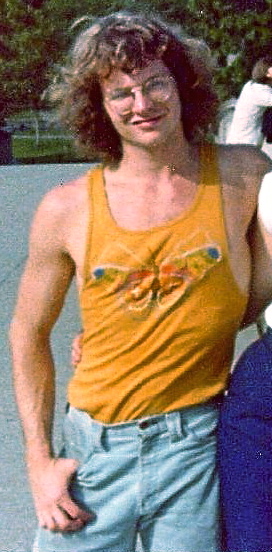
Since it keeps on showing up on Facebook I may as well address it. I’m on the eve of my 54th birthday. Now there are some who consider 54 to be positively antediluvian, while many others I know, view it as an age when the bloom has yet to even meet the rose.  Me, I’d say that 54 is just about right…be foolish not to…and at least I can have a little fun with that fact.

So let me ask those who have lived through at least four or five decades, if you could be 20 again, would you do it?

This picture was taken on the John Weeks Footbridge, (connecting Cambridge with the Allston section of Boston) around about this time of year in 1978 and it’s diverting to consider, as any actuary will agree, that the odds are downright bankable that there will be a far greater age difference between this 54 year old and that 20 year old, than there will be between this 54 year old and the fellow who hears the sound of that final horn.

Time is fleet and for the most part life has been grand, but there is no…way…in…Hell that I’d want to go back, even to that remarkably delightful moment on the bridge and the halcyon times that surrounded it. Would you?

Admittedly, from a physical standpoint it would be nice not having to contend with some of the grievances Father Time and Mother Nature have thrown my way, and I’m not about to include a current picture as a means of comparison (ouch!) but when you consider all that life has brought to most of us since the age of 20, or 30, or even 40, I’ll take today…any day.

Right, and where do we go from here?  Just recently we saw one of our favorites in concert, Loudon Wainwright III, and he didn’t disappoint, especially when he sang today’s selection.  High, Wide and Handsome: in a literal sense, well, at least I can claim to be wide, but when taken figuratively (as in jovial, carefree and…jaunty) it’s truly something to aspire to.

A genuine All-American phrase that conjures images of openness and freedom (and maybe a cowboy or two), High, Wide and Handsome has been in use since at least the 1880s; eventually even making the leap across the pond in the 1930s, when it was used in a British newspaper advert for an ocean liner, described as: “A trim ship built high, wide and handsome, a ship with ‘decks appeal’.”

By decade’s end P.G. Wodehouse had placed his own spin on the phrase in “Uncle Fred in Springtime”.  Although… “He has a nasty way of lugging Pongo out into the open and proceeding to step high, wide and plentiful.” …certainly lacks the punch of today’s song, which was included on Wainwright’s 20th studio (and first Grammy winning) album, “High Wide & Handsome: The Charlie Poole Project”

Released in 2009 as a tribute to singer and musician Charlie Poole (1892–1931), the album features original songs (such as this one) as well as numerous versions of songs made popular by Poole, a “rambling, hard-drinking, crazy Southern showman,” much like Wainwright himself (raised in New York but born in Chapel Hill).

Admittedly, the notion of promiscuity and abject carousing belongs back on a bridge somewhere, at least for this particular 54 year old, but there’s still something rather wonderful in the realization that it “isn’t that long a stay” …and we may as well tackle what’s left in a high, wide and handsome way.

LISTEN TO TODAY’S SELECTION – Friday 22 June 

High Wide and Handsome

 High, wide and handsome

That’s how I like living

High, wide and handsome

That’s how life should be

Low skinny and ugly that’s for other people

High, wide and handsome suits me to a tee

 Song, wine and women – they’re my three favorites

Beer, gin and whisky – that’s 5, 6 and 4

Saturday night I like eating and dancing

Then I sleep all day Sunday

So’s I’m ready for more

 High, wide and handsome

You can’t take it with you

High, wide and handsome

That’s one way to go

Let’s live it up – might as well, we’re all dying

High, wide and handsome

Let’s put on a show

 Can’t quit what will kill me

So why even bother?

I love this hard living

So why even try?

I’ll be high, wide and handsome when I kick the bucket

I’ll be high, wide and handsome on the day I die

High, wide and handsome

You can call it my motto

High, wide and handsome

Call it my creed

Money’s just paper

Liquor’s thicker than water

High, wide and handsome

In thought word and deed

 Have “high, wide and handsome” carved on my headstone

With the date I was born plus the date that I died

Take one from the other

All that’s left is a number

Just remember I laughed twice as hard as I cried

 High, wide and handsome

That’s how I like living

High, wide and handsome

That’s how life should be

Low, skinny and ugly that’s for other people

High, wide and handsome suits me to a tee

… and still I’d like to tell her that I miss her so, in North Ontario

And now it’s summer. And here I feel like a regular blackguard and a heretic too, having “ripped” out the first half of an artist’s song to get to what, in my opinion, is the far better second half.  Ah yes, right at the point where, with a pffffttttt, he opens a beer and takes a satisfying gulp…

Born in Orillia, Ontario in 1938, with hundreds of recordings released over a career that has spanned five decades, Gordon Meredith Lightfoot, Jr. has been called a Canadian National Treasure by no less a Canadian treasure himself than Robbie Robertson. Then there’s Bob Dylan, who refers to him as one of his favorite songwriters, further noting that when he hears a Lightfoot song he often wishes that it would last forever.

So who am I to question the artistic vision of such a man when it comes to the final track of his seventh album, 1971’s “Summer Side of Life”?  Entitled “Cabaret” it starts out with a lilting (some may say tedious) dewy-eyed reminiscence about the sea and the sky and “sounds of laughter on ladies gay….” Sorry but riiiiiiip…because at 2:53, when you’re about to drift away that initial song, which really must have started life as a different track, evolves into the highly resonating account of a drifter (so maybe that’s it) on the road.

And here we are, huddled in some west coast roadside diner while the big rigs roll by. Anyone who has spent a few days “cold on the shoulder” will immediately identify.  Then comes the chorus, which always makes me think of my wife, Linda (now decades ago), back in Toronto when she was roundly pregnant with our first-born.

My job would regularly have me venturing to Ottawa or Hamilton or maybe to Winnipeg, all within 150 kilometers of the great southern border (which is where four-fifths of the Canadian population resides).  But in the icy vortex of January, Linda’s company would send her to the wilds (and I mean that) of Timmins on the frozen Mattagami, or to Kapuskasing, where GM operates its “Cold Weather Development Center.”

Well into her third trimester, well before mobile GPS devices or practical cell phones for that matter, she’d fly through the frigid northern darkness, rent a Jeep Cherokee at the air field and drive for an hour and a half down a plowed but barren highway, and then…according to the desultory directions she’d received…”take a left.”

It’s summer time now, but this song transports me back to a tiny Beaches (neighbourhood) apartment, when on more than one cold, dark winter’s evening I’d sit close to the telephone on the kitchen wall and await my wife’s call, thinking all along how much…”I’d like to tell her that I miss her so, in North Ontario.”

 LISTEN TO TODAY’S SELECTION – Thursday 21 June

From the coast of California

Up to the Oregon border

I’ve thumbed a thousand miles I guess

Sitting in a roadside diner

The big trucks rollin’ by

I don’t seem to know at times what’s best

And still I’d like to tell her

That I miss her so

In North Ontario

 If you’re drivin’ east to Reno

Or north to Mendocino

I hope you find your rainbow’s end

This highway is my rainbow

And though I might regret it

I’m so glad I said it way back when.


…stranger on the shore

Ever have one of those days that starts out on an even keel, but continuously picks up tumult so that, for reasons out of your control, you’re feeling downright harried by day’s end?  Well that explains the brevity of this write-up along with the mellow nature of today’s selection performed by “Mr. Acker Bilk” …yes, that’s exactly what was on the record label.

A bowler-wearing clarinetist, also known for his goatee and striped-waistcoat, he was born Bernard Stanley Bilk in Somerset, England in 1929.  “Acker” is local slang for “mate” (as in friend), ‘though it must have been a hard earned appellation as he lost his two front teeth in a school fight that forever-after affected his jazz clarinet style.

Although he had a number of light jazz recording hits in the UK, Bilk was far from an international star when he wrote today’s selection for his newborn daughter, Jennifer (and initially named it for her) in 1961.  When a BBC television producer happened to hear the song he asked Bilk for permission to use it as the theme song for a new television series, called, “Stranger on the Shore”

Wise choice, “Stranger on the Shore” as the song itself was soon called, was the biggest selling UK single of 1962, becoming the first British recording to reach Number One on the U.S. Billboard Hot 100.

In May of 1969 it accompanied the crew of Apollo 10 in lunar orbit, as lunar module pilot, Gene Cernan selected it as one of his choices on a cassette tape used in the spacecraft’s command module.  “To the moon, Acker…to the moon.”

LISTEN TO TODAY’S SELECTION – Wednesday 19 June