…I want to shoot the whole day down

In Old English it’s “Mōnandæg” (similar to the name used in other Germanic languages) and by the time we reach Middle English it’s more recognizable as ‘Monenday” …that’s right, “moon day” or as many love to grumble, “Monday” that goldmine of antipathy for generations of songwriters wishing to dive right in to the start of the work week, oft-noted for its melancholia, anxiety and (sigh) depression.

For example, there’s today’s selection, written in 1979 after Robert Frederick Zenon Geldof (or just “Sir Bob” in light of the honorary knighthood for his later Band-Aid work), happened to read a telex report about a shooting spree involving 16-year-old, Brenda Ann Spencer in San Diego, California.

On the first school day after Christmas Vacation, Spencer took a Ruger 10/22 semi-automatic rifle, pushed open a window in her home and began shooting at the elementary schoolyard across the street.  After firing thirty rounds, Spencer barricaded herself for nearly seven hours before finally surrendering to police. In the end the school’s principal and custodian were killed, and eight kids and a policeman were seriously wounded

When later asked why she showed no remorse, she replied, “I just did it for the fun of it. I don’t like Mondays. This livens up the day.”

Geldof, the lead singer of the Irish punk rock band, The Boomtown Rats, included the resulting song, “I Don’t Like Mondays” on the group’s third album, “The Fine Art of Surfacing” later in ’79 and it led the UK charts for four straight weeks.  However, it only reached Number 73 on the US Billboard Hot 100. Perhaps a bit too close to home, or perhaps like the day itself, not everyone likes “I Don’t Like Mondays”

 LISTEN TO TODAY’S SELECTION – Monday 7 May

I Don’t Like Mondays

 The silicon chip inside her head gets switched to overload

And nobody’s gonna’ go to school today

She’s going to make them stay at home

And daddy doesn’t understand it

He always said she was good as gold

And he can see no reasons, ’cause there are no reasons

What reason do you need to be shown?

Tell me why?

I don’t like Mondays

Tell me why?

I don’t like Mondays

Tell me why?

I don’t like Mondays

I want to shoot the whole day down

The telex machine is kept so clean and it types to a waiting world

And mother feels so shocked

Father’s world is rocked

And their thoughts turn to their own little girl

Sweet 16 ain’t that peachy keen

No, it ain’t so neat to admit defeat

They can see no reasons ’cause there are no reasons

What reasons do you need

Tell me why?

I don’t like Mondays

Tell me why?

I don’t like Mondays

Tell me why?

I don’t like Mondays

I want to shoot the whole day down, down, down, shoot it all down

And all the playing has stopped in the playground now

She wants to play with the toys of war

And school’s out early and soon we’ll be learning

That the lesson today is how to die

And then the bullhorn crackles

And the captain cackles with the problems and the hows and whys

And he can see no reasons ’cause there are no reasons

What reason do you need to die, die?

And the silicon chip inside her head gets switched to overload

And nobody’s gonna’ go to school today

She’s going to make them stay at home

Her daddy doesn’t understand it

He always said she was good as gold

And he can see no reasons ’cause there are no reasons

What reason do you need to be shown?

Tell me why?

I don’t like Mondays

Tell me why?

I don’t like Mondays

Tell me why?

I don’t like, I don’t like, (Tell me why?) I don’t like Mondays

Tell me why?

I don’t like, I don’t like, (Tell me why?) I don’t like Mondays

Tell me why?

I don’t like Mondays

I want to shoot the whole day down
…that’s the way God planned it

”Music is my life and every day I live it, and it’s a good life to everything I want to say through music it gets to you. I may not be the best around but I’m surely not the worst. I learned to play and sing since the age of three, you don’t know how glad I am God laid his hands on me.” ~ Billy Preston, from the liner notes of That’s The Way God Planned It

Well, “He” certainly did lay his hands on William Everett Preston, who was born in Houston, Texas in 1946 and raised mainly in Los Angeles.  Little Billy began playing piano while sitting on his mother’s lap and was a noted child prodigy by the age of ten, when he was onstage backing Mahalia Jackson and several other noted gospel singers.  At eleven he appeared on Nat King Cole’s national TV show and by age twelve he played the young W.C. Handy in the biopic, St. Louis Blues.

In the years that followed he would play with a wide array of incredible acts including: Eric Clapton, Johnny Cash, Ray Charles, Sam Cooke, Little Richard, Fats Domino, The Band, Sly and the Family Stone, Neil Diamond, Red Hot Chili Peppers, Joe Cocker, Herb Alpert…among others.  But Preston left his mark on two bands in particular.

He first met the Beatles, while playing organ for Little Richard in Hamburg in 1962 and first met the Rolling Stones years later, while performing with Ray Charles.  Not only did he join the Stones on a number of their tours, but his keyboard playing can be heard on a number of their albums, including: Sticky Fingers, Exile on Main Street, Goats Head Soup, It’s Only Rock ‘n Roll and Black and Blue.

In 1969, when the Beatles, on the verge of breakup, were working on their album, Let It Be, George Harrison walked out during one of the sessions and ended up at a Ray Charles where Preston was playing organ. The following day Harrison showed up back at the Abbey Road Studios with Preston in tow, and Preston’s sociable personality helped to calm the tension.  So did his keyboard playing.

Billy Preston played for several of the Let It Be sessions (he was there for the rooftop concert) and is the only person ever to be officially credited (i.e. “The Beatles with Billy Preston”) on a Beatles single, reflecting his prominence on “Get Back”.  Sometimes referred to as the ‘Fifth Beatle” as others have been, in this case John Lennon actually proposed the idea (to which McCartney countered, “It’s bad enough with four”).

Later on Preston would compose Joe Cocker’s biggest hit, “You Are So Beautiful” and, along with Janis Ian, would serve as musical guest on Saturday Night Live’s first episode,    but in 1969 he signed to Apple Records to record his his fourth studio album, “That’s the Way God Planned It”  (today’s selection is a live version of the title song) with George Harrison serving as producer.

Preston and Harrison would remain close friends for the rest of Harrison’s life and in addition to playing on several of Harrison’s solo albums, Billy Preston made a most notable appearance at Harrison’s Concert for Bangladesh. Here’s a YouTube version of today’s selection.  No matter your religious leanings, it’s well worth sticking around for the finale:

  http://www.youtube.com/watch?v=UYxzPdv67yA

 LISTEN TO TODAY’S SELECTION – Sunday 6 MAY

That’s the Way God Planned It

 Why can’t we be humble

Like the good lord said

He promised to exault us

And show us the way.

Why are we so greedy

When there’s so much left?

All things are God given

And they all have been blessed

That’s the way God planned it

That’s the way God wants it to be, be

That’s the way God planned it

That’s the way God wants it to be, be

Let not your heart be troubled

Let all your suffering cease

Just learn how to help one another

And live in perfect peace

If we’d just be humbler

Like the good lord said

He promised to exault us

And show us the way

That’s the way God planned it

That’s the way God wants it to be, be

You better believe me

That’s the way God planned it

That’s the way God wants it to be, be

I hope you get this message

Where you won’t others will

You don’t understand me

But I’ll love you still

That’s the way God planned it

That’s the way God wants it to be, be

…oh will you never let me be?

I am convinced. Even now.  If you’re artistically inclined and spend a little time in Paris with the “right” person, your muse will come a’ calling. Penned by English writer, entertainer and Head of Variety at the BBC, Eric Maschwitz (using the ambitious nom de plume, Holt Marvell), today’s selection came to light after a fine romance with Hollywood actress Anna May Wong, who had recently departed for America.

Along with “A Nightingale Sang in Berkeley Square” (another Holt Marvell wonder) “These Foolish Things” is known as a “Mayfair Song” although many of the lyrics clearly evoke the City of Light.

Written one Sunday morning in Maschwitz’s London flat, with three choruses and a verse, the lyrics were dictated over the telephone to composer Jack Strachey, who quickly wrote the music.  The song was first used in a 1936 late-evening “live review” broadcast, and seemed like such a clunker that Maschwitz’s agent refused to publish it, allowing Maschwitz to keep the copyright. A stroke of luck because soon-after, popular pianist Leslie Hutchinson discovered the sheet music on a piano in Maschwitz’s office and asked if he could record it.

This time it was a huge success and Maschwitz later claimed to have earned in excess of £40,000 (a tidy sum in the ‘30s and ‘40s) from the soon-to-be standard, which has since been covered by the likes of Billie Holiday, Bing Crosby (who omitted the line, “The song that Crosby sings”), Frank Sinatra, Nat King Cole, Ella Fitzgerald, Sarah Vaughn, James Brown, Aaron Neville, Sammy Davis Jr and many others, with instrumental jazz arrangements covered by Stan Getz, Benny Goodman, Lionel Hampton, Thelonious Monk, Dave Brubeck, Chet Baker, Count Basie and Lester Young.

Today’s version (with lyrics that vary slightly from the original) was the title track for a debut solo album in 1973, although the singer was already a well-known recording artist.  Born and raised on a farm in County Durham, Bryan Ferry was a pottery teacher by day and a musician by night when he and some friends (including the eccentric, talented Brian Eno) formed the art-rock group, Roxy Music in 1971.

Remembered today for its musical sophistication and fascinating experimentation, as well as for its racy album covers, Ferry, who had gained renown for his sartorial elegance, managed to become involved with a heroic number of those racy cover models (most famously, Jerry Hall).  Yes, he looked good, but anyone who begins his solo career singing about the ‘sigh of midnight trains in empty stations’ has a few of the (not so foolish but) fundamental things…figured out

 LISTEN TO TODAY’S SELECTION – Saturday 5 May

 These Foolish Things

 Oh will you never let me be?

Oh will you never set me free?

The ties that bound us are still around us

There’s no escape that I can see.

And still those little things remain

That bring me happiness or pain.

 A cigarette that bears a lipstick’s traces

An airline ticket to romantic places,

And still my heart has wings

These foolish things

Remind me of you.

 A tinkling piano in the next apartment

Those stumbling words that told you what my heart meant,

A fairground’s painted swings,

These foolish things

Remind me of you.

 You came, you saw, you conquered me,

When you did that to me, I somehow knew that this had to be.

 The winds of March that make my heart a dancer.

A telephone that rings – but who’s to answer?

Oh, how the ghost of you clings

These foolish things

Remind me of you

 Gardenia perfume lingering on a pillow,

Wild strawberries only seven francs a kilo.

And still my heart has wings

These foolish things

Remind me of you.

The park at evening when the bell has sounded,

The Isle de France with all the girls around it.

The beauty that is spring

These foolish things

Remind me of you.

I know that this was bound to be

These things have haunted me

For you’ve entirely enchanted me

 The sigh of midnight trains in empty stations

Silk stockings thrown aside, dance invitations.

Oh, how the ghost of you clings

These foolish things

Remind me of you.

 First daffodils and long excited cables

And candlelight on little corner tables,

And still my heart has wings

These foolish things

Remind me of you.

 The smile of Garbo and the scent of roses

The waiters whistling as the last bar closes,

The song that Crosby sings,

These foolish things

Remind me of you.

How strange, how sweet to find you still

These things are dear to me

That seem to bring you so near to me

 The scent of smouldering leaves, the wail of steamers,

Two lovers on the street who walk like dreamers,

Oh, how the ghost of you clings

These foolish things

Remind me of you, just you.

…the world survives into another day

“I have a relative who is involved in one of those kinds of government jobs where they can’t say what they do,” Bruce Cockburn once explained.  “The part you can say involves monitoring other people’s radio transmissions and breaking codes. At that time China and the Soviet Union were almost at war on their mutual border. And both of them had nuclear capabilities. (My relative) said, ‘We could wake up tomorrow to a nuclear war.’ Coming from him, it was a serious statement.”

“So I woke up the next morning and it wasn’t a nuclear war. It was a real nice day and there was all this good stuff going on and I had a dream that night which is the dream that is referred to in the first verse of the song, where there were lions at the door, but they weren’t threatening, it was kind of a peaceful thing.”

Born in 1945 in Ottawa, Ontario, Bruce Douglas Cockburn’s first guitar was one he found in his grandmother’s attic, which he adorned with golden stars and used to play along to radio hits….”Hopes to become a musician,” stated the caption under his high school photo. “He has a guitar.”

After graduation Cockburn became a busker in Paris for a while, then he enrolled at Boston’s Berklee College of Music. But as occasionally happens, his passion to create and perform conflicted with the rigors of academia. He returned to Ottawa and eventually signed with a small, local record label. Wondering Where the Lions Are from his 1979 album, Dancing in the Dragon’s Jaws gained wide exposure outside of Canada and ushered in an international career for Cockburn.

Beyond its messages of hope and spiritually there has long been speculation about references made in the song, many of them ostensibly specific to Vancouver (“The Lions” are a pair of pointed peaks overlooking the city for example and there are always “freighters on the nod” in Vancouver Harbor and English Bay) as well as Vancouver Island (where orange Mars Water Bombers, used to fight forest fires, float on Sproat Lake). In the end, however Cockburn is more than happy to allow them to remain slightly oblique.

Today’s selection was Bruce Cockburn’s only Top 40 hit in the United States, peaking at Number 21 on the Billboard charts.  While also a significant hit in Canada, seven of his subsequent singles were far bigger hits there.  Still, Wondering Where the Lions Are was named the “29th Greatest Canadian Song of All Time” by CBC Radio… “All time” …we’re talking about eternity here.

 LISTEN TO TODAY’S SELECTION – Friday 4 May

Wondering Where the Lions Are

 Sun’s up, uuh huh, looks okay

The world survives into another day

And I’m thinking about eternity

Some kind of ecstasy got a hold on me.

 I had another dream about lions at the door

They weren’t half as frightening as they were before

But I’m thinking about eternity

Some kind of ecstasy got a hold on me.

Walls, windows, trees, waves coming through

You be in me and I’ll be in you

Together in eternity

Some kind of ecstasy got a hold on me

Up among the firs where it smells so sweet

Or down in the valley where the river used to be

I got my mind on eternity

Some kind of ecstasy got a hold on me

And I’m wondering where the lions are…

I’m wondering where the lions are…

Huge orange flying boat rises off a lake,

Thousand-year-old petroglyphs doing a double take,

Pointing a finger at eternity

I’m sitting in the middle of this ecstasy

Young men marching, helmets shining in the sun,

Polished and precise like the brain behind the gun

(Should be!) They got me thinking about eternity

Some kind of ecstasy got a hold on me

 And I’m wondering where the lions are…

I’m wondering where the lions are…

 Freighters on the nod on the surface of the bay

One of these days we’re going to sail away,

Going to sail into eternity

Some kind of ecstasy got a hold on me

 And I’m wondering where the lions are…

I’m wondering where the lions are

…there to see my savior

Here’s a case where “what you see” is not necessarily “what you get.”  A few months ago (6 March) we featured the song, Fields of Gold, sung by one of the most mellifluous folk voices ever recorded, that of Eva Cassidy.

If you knew nothing about today’s selection beyond the fact that it’s a traditional American folk/spiritual that has been covered by the likes of Dolly Parton; Tennessee Ernie Ford; Alison Krauss; Peter, Paul and Mary; Emmylou Harris; Pete Seeger and Johnny Cash (among many others)… you’d no-doubt arrive at certain assumptions about the listening experience you’re in for. The fact that Wayfaring Stranger is especially associated with Burl Ives (so much so that he became known as “The Wayfaring Stranger”) would surely seal it for you.

And having heard her rendition of Fields of Gold you’d be correct in thinking that the shy, waif-like Cassidy could do wonderful things with such a song.  But what might surprise you is the kinds of wonderful things she actually did.  Unfortunately they’re a key reason why she lived her entire life in near obscurity.

Eva Cassidy’s singing had astonishing range and versatility and regardless of genre she could effortlessly out-perform many of the world’s great jazz, folk, soul, gospel, pop, country and blues singers.  But her unwillingness to narrow her stylistic focus to one genre prohibited her from securing any kind of record deal.  Artistically, she was compelled to “sing it” her way, which record executives saw as anathema to immediate marketability.

In the case of today’s selection, Cassidy opted to eschew the tried-and-true folk and country influences and bounce the song into a new “spiritual” universe.  Listen to her splendid vocal phrasing and note how she is able to float that prhasing along the bar lines of the melody. Then compare the second chorus with the first, and notice how she increasingly wears that poor wayfaring stranger’s sentiments on her sleeve.  Lastly, be sure to listen closely to the poignant conclusion, sadly portentous of her own life’s story… “I’m going back to see my savior; oh, I’m going back, no more to roam.”

The fair-skinned/fair-haired Cassidy was dead within a year from malignant melanoma and today’s selection was first released on her posthumous debut album in 1997, ‘Eva by Heart’ and then included on the break-through compilation album, “Songbird,” the following year. Word has it that this track was nearly lost to the cutting room floor (deemed too rough) and that it was only through her father’s intervention that we are able to appreciate what the woman who redefined “Fields of Gold” could do with a “Wayfaring Stranger.”

LISTEN TO TODAY’S SELECTION – Thursday 3 May

Wayfaring Stranger

 I am a poor wayfaring stranger

While journeying through this world of woe

And there’s no sickness, toil nor danger

In that bright land to which I go

 I’m going there to see my Father

I’m going there no more to roam

I’m only going over Jordan

I’m only going over home

I know dark clouds will gather around me

I know my way is rough and steep

And beautiful fields lie just before me

Where God’s redeemed there vigils keep

I’m going there to see my Father

I’m going there no more to roam

I’m only going over Jordan

I’m only going over home

 I’m going there to see my Mother

I’m going there no more to roam

I’m only going over Jordan

I’m only going over home

 I want to wear that crown of glory

When I get home to that good land

Well I want to shout salvation’s story

In concert with the blood-washed band

 I’m going there to see my Savior

I’m going there no more to roam

I’m only going over Jordan

I’m only going over home

…she was only a girl

Born in Dallas and raised in San Antonio, Bette Claire McMurray married Warren Audrey Nesmith just before he shipped off to War in the Spring of ’42. Nine months later their son was born in Houston.  Unfortunately the Nesmiths divorced soon after Warren’s return and Bette and her son, Robert Michael returned to Dallas where she still had family.

To support herself, Bette took on a number of temp jobs, learning invaluable skills along the way, including shorthand, graphic design and touch-typing.  Finally she was offered a permanent secretarial position at Texas Bank and Trust and such was her proficiency that she eventually became an executive secretary, pretty much the top rung of the ladder for a woman in that time and that place.

In the 1960s IBM’s Selecectric typewriter, with its groundbreaking typeball design, would prove to be a typing pool marvel, but here in the ‘50s electric typewriters featured key-baskets and typing ribbons that were notorious for their typographical errors.  With her graphics experience it occurred to Bette that artists don’t erase their mistakes, they simply paint over them.  “So,” she once recounted, “I decided to use what artists use. I put some tempera water-based paint in a bottle and took my watercolor brush to the office.  I used that to correct my mistakes.”

For the next few years she used it in secrecy and continued to improve upon this white correction paint, even incorporating the help of her son’s high school chemistry teacher.  While some executives admonished her when they discovered that she’d been using it, Bette’s “paint out” was in high demand among her co-workers.  In 1956 she began to market the correction fluid as “Mistake Out” and when it started to catch on, she changed the product’s name to “Liquid Paper” and launched her own company.

Over the next quarter century Bette Graham (she remarried in 1962) built the company into an international, multimillion-dollar business and by the time she sold the Liquid Paper Corporation to Gillette in 1979 (for $48 million), it employed 200 people and made 25 million bottles of correction fluid per year.  When Bette died at the age of 56, just a few months after selling her company, a considerable portion of her estate went to the Gihon Foundation so that it could establish its Council of Ideas, a think tank (active between 1990 and 2000) that was devoted to exploring world problems.

The remainder of Graham’s estate went to her son, Michael, who had already made somewhat of a name for himself as an actor and musician, and would go on to become a music video pioneer (winning the first Grammy Award ever given for a Video of the Year,in 1982) and with the $25 million he inherited, an eminent philanthropist.

To many, of course, Michael Nesmith will best be remembered for the wool hat he wore as Mike in the NBC comedy, The Monkees, which ran from 1966 to 1968. But Nesmith was also a celebrated songwriter who, prior to joining The Monkees, had written the hit, “Different Drum” made famous by Linda Ronstadt and the Stone Poneys.

In 1969 he formed the collaborative First National Band, writing much of the group’s music himself, including today’s selection. Released in 1970 on his debut album, “Magnetic South” it rose to Number 21 on the Billboard Charts.  And although it would be Michael Nesmith’s only “solo” top 40 single, when it hit the charts Bette Graham herself was still years away from topping her 40s, and as any proud mother would be, she was surely very pleased with “Joanne”.

LISTEN TO TODAY’S SELECTION – 2 May 2012

 Joanne

 Her name was Joanne

And she lived near a meadow

By a pond

And she touched me for a moment

With a look that spoke to me

Of her sweet long

 Then the woman that she was

Drove her on with desperation

And I saw, as she went

A most hopeless situation

For Joanne and the man

And the time that made them both run

 She was only a girl

I know that well, but still I could not see

That the hold that she had

Was much stronger than the love

She felt for me

But staying with her

And my little bit of wisdom

Broke down her desires

Like a light through a prism

Into yellows and blues

And the tune that I could not have sung

Though the essence is gone

I have no tears to cry for her

And my only thoughts of her

Are kind

 Her name was Joanne

And she lived near a meadow by a pond

And she touched me for a moment

With a look that spoke to me

Of her sweet long

Then the woman that she was

Drove her on with desperation

And I saw as she went

A most hopeless situation

For Joanne and the man

And the time that made them both run

 For Joanne and the man

And the time that made them both run

…he’s a false, deluded young man

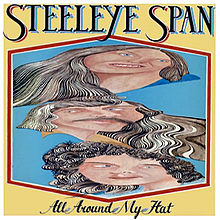
Remember when album covers were fun? Take this one for example. Designed by an artist named, John Connor who used an “anamorphic projection” of the band members’ features.  It looked distorted until you held up the accompanying lyric sheet, which had special pinholes through which the picture (when viewed at an angle) looked perfectly correct.

Formed in 1969, when Fairport Convention bassist, Ashley Hutchings left that seminal band with the idea for a new group that combined traditional folk songs with rock and blues, Steeleye Span (the name comes from a character in the Lincolnshire song, “Horkstow Grange”) is still in business and remains at the vanguard of the longstanding British folk revival. Not that it didn’t take a while to get there.

It wasn’t until 1973, when they were opening for Jethro Tull in concert and had released their fifth album, Parcel of Rogues, that they finally had a hit. Sung a cappella in Latin, “Gaudete” reached Number 14 on the UK Singles Chart at Christmas time and provided Steeleye Span with its first Top of the Pops performance. And it wasn’t until the group’s eighth album, “All Around My Hat” in 1975 (with the really cool cover) that they began to gain a solid international following after reaching Number 143 on the American Billboard charts.  With English origins that stretch back at least to the 1820s, the album’s rollicking title track is Steeleye Span’s highest charting single (reaching Number 5 in the UK).

Like many such traditional songs there are numerous versions with perhaps the earliest featuring a Cockney costermonger (street vendor who sold fruit and vegetables) whose fiancée has been sentenced to seven years in Australia for theft.  He vows to remain true to her by wearing willow sprigs in his hatband  (a symbol of mourning) for “twelve-month and a day.” Other versions can be found in Canada, Scotland and in Ireland, where the protagonist is a Republican girl who swears to wear the Irish tricolor in her hat in remembrance of her lover who died in the Easter Rising.

Steeleye Span’s version features lyrics that are interpolated from at least two other songs, “Farewell He” offering a sermon-like warning to young girls on the faithlessness of young men; and “She Wore a Yellow Ribbon” which is an old U.S. military song (still used to keep cadence in marching) that was used in the John Ford film of the same name and includes the recognizable refrain “Far away! Far away! She wore it for her soldier who was far, far away.”

LISTEN TO TODAY’S SELECTION – Tuesday 1 May

All Around My Hat

All around my hat

I will wear the green willow

And all around my hat

For a twelve month and a day

And if anyone should ask me

The reason why I’m wearing it

It’s all for my true love

Who’s far, far away

 Fare thee well cold winter

And fare thee well cold frost

Nothing have I gained

But my own true love I’ve lost

I’ll sing and I’ll be merry

When on occasion I do see

He’s a false deluded young man

Let him go farewell he

 The other night he brought me

A fine diamond ring but,

He thought to have deprived me

Of a far better thing

But I being careful

As lovers ought to be

He’s a false deluded young man

Let her go farewell he

And all around my hat

I will wear the green willow

And all around my hat

For a twelve month and a day

And if anyone should ask me

The reason why I’m wearing it

It’s all for my true love

Who’s far, far away

With a quarter pound of reason

And a half a pound of sense

A small spring of time

And as much of prudence

You mix them all together

And you will plainly see

He’s a false deluded young man

Let him go, farewell he

And all around my hat

I will wear the green willow

And all around my hat

For a twelve month and a day

And if anyone should ask me

The reason why I’m wearing it

It’s all for my true love

Who’s far, far away

 All around my hat

I will wear the green willow

And all around my hat

For a twelve month and a day

And if anyone should ask me

The reason why I’m wearing it

It’s all for my true love

Who’s far, far away

 All around my hat

I will wear the green willow

And all around my hat

For a twelve month and a day

And if anyone should ask me

The reason why I’m wearing it

It’s all for my true love

Who’s far, far away

…some fools fool themselves, I guess, but they’re not foolin’ me

It’s hard to imagine a popular song that the following artists (among others) have in common: The Who, Cher, Emmylou Harris & Gram Parsons, Jimmy Webb, Jennifer Warnes, Journey, Don McLean, Joan Jett, Roy Orbison, Bad Romance, Kim Carne, Heart, Pat Boone, Keith Richards & Norah Jones, Juice Newton, Sinead O’Conner, The Everly Brother, Robin Gibb, Rod Stewart, Leo Sayer, Nazareth and Jim Capaldi.

Written and composed by Boudleaux Bryant in 1960 and first recorded by The Everly Brothers (although not as a single), “Love Hurts” became a hit for Roy Orbison the following year…in Australia (hitting Number 5 on the charts). In 1973 a cover of the song by Emmylou Harris and Gram Parsons was included on Parson’s posthumously released album, “Grievous Angel” and Emmylou has included it as part  of her live repertoire ever since.

The most popular recording of the song, and perhaps the one you most remember, was by Scottish metal band, Nazareth whose version reached Number 10 on the U.S. Billboard Singles Charts in 1975; at nearly the same time that today’s selection by Jim Capaldi, hit Number Four on the UK Charts.

Born in Evesham, Worcestershire in 1944, Capaldi was yet another of those seminal rock artists.  With a musical career that lasted more than four decades he was a founding member of Traffic (Mr. Fantasy was one of his songs), and performed as drummer and percussionist for the likes Hendrix, Clapton, Harrison and Santana.

After his death from stomach cancer in 2005, the Dear Mr. Fantasy concert was held in London to celebrate his life, with artists as varied as Pete Townshend, Cat Stevens, Bill Wyman and (of course) Steve Winwood and all profits going to The Jubilee Action Street Children Appeal.  Which goes to show that although there are times when love hurts, there are other times when belovedness relieves.

 LISTEN TO TODAY’S SELECTION – Monday 30 April

Love Hurts

Love hurts, love scars, love wounds and mars

Any heart, it’s not tough or strong enough

To take a lot of pain, take a lot of pain

Love is like a flower, holds a lot of rain

Love hurts

 I’m young, I know, but even so

I know a thing or two I’ve learned from you

I really learned a lot, really learned a lot

Love is like a stove, burns you when it’s hot

Love hurts, oo love hurts

 Some fools dream of happiness, blissfulness, togetherness

Some fools fool themselves, I guess, but they’re not foolin’ me

I know it isn’t true, I know it isn’t true

Love is just a lie, made to make you blue

Love hurts, oo love hurts

 Some fools dream of happiness, blissfulness, togetherness

Some fools fool themselves, I guess, but they’re not foolin’ me

I know it isn’t true, I know it isn’t true

Love is just a lie, made to make you blue

Love hurts, love hurts, oo love hurts

Oo love hurts, yeah love hurts ….

…Heaven knows where we are going

He’s an interesting guy, a true bibliophile, who has gone so far as to read the Random House Dictionary cover to cover.  His website contains a year-by-year listing of every book he has read since 1968.  Both the first and thousandth listings are Rousseau’s Confessions.

A left-handed multi-instrumentalist who plays violin, piano and guitar, he has walked across the United States (in increments) on several occasions, writing poetry along the way.  He has also walked across Japan and has been incrementally working on Europe since 1998.

In the early ‘60s, prior to his incredible musical success, he earned a BA in Art History followed by a Masters in Mathematics, both from Columbia University.  Then at the very peak of that commercial success he received his doctorate in Mathematics Education, also at Columbia. And yet he is best known for his voice.

Arthur Ira “Art” Garfunkel was born in Forest Hills, Queens, New York in 1941.  When bar mitzvahed he performed as cantor, singing for his family for over four hours. By this time he had already met his future singing partner, Paul Simon after they’d both been cast in the same PS 164 production of “Alice in Wonderland” as sixth graders.  As legend has it, Simon first became interested in singing after hearing Garfunkel sing “Too Young” in a school talent show and in time the two began performing together as “Tom & Jerry” at high school dances.

Eventually they would take their rocky ride as one of popular music’s great acts (Simon & Garfunkel are ranked as #40 on Rolling Stone’s list of the 100 greatest artists of all time) and although there would be numerous reunions their final album would be 1970’s Bridge Over Troubled Water. Then Garfunkel would turn to acting, starring in Catch-22 and Carnal Knowledge, for which he was nominated for a Golden Globe.  He would also turn to teaching, serving as a mathematics teacher at a private school in Connecticut.

And in 1973 he would return to singing, releasing his debut solo album Angel Clare (named after a character from Thomas Hardy’s Tess of the d’Urbervilles) which reached Number Five on the Billboard Album charts. Written and first recorded by the British Afro-pop band, Osbisa in 1971, today’s World Music selection is the eighth track on the album.

LISTEN TO TODAY’S SELECTION – Sunday 29 April 

Woyaya

 We are going, heaven knows where we are going,

We’ll know we’re there.

We will get there; heaven knows how we will get there,

We know we will.

 It will be hard we know

And the road will be muddy and rough,

But we’ll get there; heaven knows how we will get there,

We know we will.

 We are going, heaven knows where we are going,

We’ll know we’re there.

…and life gets more exciting with each passing day

If this were “What’s My Line” you’d no doubt guess the name of this individual after the first hint: Each year on his birthday the Empire State Building lights up with blue lights in reference to his nickname.

Of course you know who we’re talking about, but just for fun I’ll drop in a few of the awards he garnered in his lifetime:  Presidential Medal of Freedom awarded by President Ronald Reagan; three stars on the Hollywood Walk of Fame, for his contributions to:  Motion Pictures, Recording and Television;  named the “Greatest Voice of the Twentieth Century” by the BBC and in case your name is Arlene Francis and you still haven’t figured it out, he was inducted into the New Jersey Hall of Fame a decade after his death in 1998 – when the lights of the Las Vegas Strip were dimmed for ten minutes in his honor. “Ring a Ding, Ding!”

Born in Hoboken, New Jersey in 1915, Francis Albert “Frank” Sinatra was the only child of a Genoese mother and a Sicilian father. Much has been written, of course about how he began his musical career with Harry James and Tommy Dorsey and was soon following in the footsteps of his crooner-hero, Bing Crosby, becoming a ‘40s idol to bobby soxers everywhere and establishing himself as the first modern pop superstar by creating an intimate, sensual new-style of singing.

When his career began to falter in the early ‘50s he turned to acting, winning an Academy Award (as Best Supporting Actor) for his performance as Maggio in “From Here to Eternity” and with his mojo firmly back Sinatra lead a swing revival that took popular music to new levels of sophistication. After signing with Capitol Records in 1953 (the start of “the Capitol years”) there are many among us who believe that Frank Sinatra was at his peak with  albums that included “Songs for Swingin’ Lovers”, “In the Wee Small Hours”, “Only the Lonely” and (our favorite) “Come Fly With Me”.

Today’s selection is the comeback single that started it all.  Written and published in 1953 with music by Johnny Richards and lyrics by Carolyn Leigh, Sinatra was the first to record the song and it became such a major hit (selling well over a million copies) that they renamed the movie he was filming with Doris Day to “Young at Heart” and featured the song in both the opening and closing credits.

As an interesting aside, this was the film that helped to establish Sinatra’s ‘50s persona (as seen on many of his album covers), in which he played a romantic loner, in front of a piano with his tilted hat and dangling cigarette, or at the bar with a shot glass within reach and a countenance displaying anything but the ability to laugh at dreams falling apart at the seams…“better set ‘em up Joe.”

 LISTEN TO TODAY’S SELECTION – Saturday 28 April

Young at Heart

  Fairy tales can come true

It can happen to you

If you’re young at heart

For it’s hard, you will find

To be narrow of mind

If you’re young at heart

 You can go to extremes with impossible schemes

You can laugh when your dreams fall apart at the seams

And life gets more exciting with each passing day

And love is either in your heart or on its way

Don’t you know that it’s worth every treasure on earth

To be young at heart

For as rich as you are it’s much better by far

To be young at heart

 And if you should survive to 105

Look at all you’ll derive out of being alive

And here is the best part

You have a head start

If you are among the very young at heart

 And if you should survive to 105

Look at all you’ll derive out of being alive

And here is the best part

You have a head start

If you are among the very young at heart