
…it’s a fool’s game

As Gaynor Hopkins can well attest, sometimes a dispiriting heartache can pave the way to incalculable gladness.  Born in Skewen, Neath, Wales in 1951, her father was a coal miner and her mother an opera lover whose musical affinity was shared with her children.

Coming of age in the ‘60s Gaynor, who worked as a supermarket cashier upon leaving school, was especially moved by Janis Joplin, Tina Turner and (fellow Welsh woman) Mary Hopkin. Blessed with a fine singing voice herself, it was her rendition of the Hopkin hit “Those Were the Days” that won her a £1 prize in a local talent contest and led to a series of pub and club appearances with a local band.

Although those who know her personally still call her Gaynor, it was clear that she needed to adopt a stage name.  So after forming a band of her own she incorporated the names of a few relatives and came up with…Sherene Davis.

Eventually the young singer was “discovered” by Swansea-based songwriter/producers Ronnie Scott and Steve Wolfe.  But the resulting record contract came with the stipulation that she select a different stage name, and Sherene Davis became Bonnie Tyler.

Within months the newly named Tyler had her first Top Ten UK hit with “Lost in France” (perhaps you too remember… “I was lost…in France…in love”).  Next came a successful debut album. And then came the heartache.

Diagnosed with nodules on her vocal cords that were severe enough to warrant immediate surgery, Tyler was ordered not to speak for six weeks. But after only a few days she accidentally screamed out in frustration, causing her voice to take on a permanent raspy quality that would forever alter the way she sounded.

Having already written her next single, Scott and Wolfe convinced the despondent singer to record the aptly named “It’s a Heartache” nonetheless. Surprisingly, her performance resonated in the UK, peaking at Number 4 on the charts.  But before its scheduled U.S. release a nearly concurrent version by Juice Newton became a huge hit in Mexico.  With dueling versions about to hit the American airwaves, each of them exemplary, the down home American clearly had a huge advantage over the little-known Welsh miners’ daughter.

To everyone’s astonishment, particularly her own, it was Tyler’s convincingly husky rendition that reached Number 3 on the Billboard Charts while topping pop charts around the globe.  Not only was it one of the most memorable songs of 1978 (Newton’s version peaked at Number 86) but, with over six million copies sold, it remains one of the best selling singles of all time.

In more ways than one, Bonnie Tyler’s “Heartache” enabled her to become an international star.

LISTEN TO TODAY’S SELECTION – Thursday 6 September

It’s a Heartache

 It’s a heartache

Nothing but a heartache

Hits you when it’s too late

Hits you when you’re down

It’s a fool’s game

Nothing but a fools game

Standing in the cold rain

Feeling like a clown

It’s a heartache

Nothing but a heartache

Love him till your arms break

Then he lets you down

It ain’t right with love to share

When you find he doesn’t care for you

It ain’t wise to need someone

As much as I depended on you

It’s a heartache

Nothing but a heartache

Hits you when it’s too late

Hits you when you’re down

It’s a fool’s game

Nothing but a fools game

Standing in the cold rain

Feeling like a clown

It ain’t right with love to share

When you find he doesn’t care for you

It ain’t wise to need someone

As much as I depended on you

 Oh, it’s a heartache

Nothing but a heartache

Love him till your arms break

Then he lets you down

It’s a fool’s game

Standing in the cold rain

Feeling like a clown

It’s a heartache

Love him till your arms break

Then he lets you down

It’s a fool’s game

Standing in the cold rain…
Ah, summer is over…

Got the white sundresses and seersucker suits back in the closet yet?  Yes, summer is over, at least symbolically here in the States, and with any luck our attention is now focused on a return to normalcy.  Of course, being of a certain age I am ever reminded of today’s selection, written and performed by a ’60s Tin Pan Alley legend whose star rose infinitely higher as a ’70s singer-songwriter.

Carol Klein was born in Manhattan in 1942. Having learned to play the piano as a girl, she joined a singing quartet in high school and hit upon her stage name after a brief consultation with the phone book.  Next came Queens College where Carole King, as she was now known, befriended fellow students Paul Simon and Gerry Goffin.  While at Queens she also met a boy named Neil Sedaka, who was so smitten that the song he wrote in her honor reached Number 9 on the Billboard Charts, “Oh Carol.”

King’s initial response, “Oh Neil”, failed to chart, but with the help of Goffin she tried again with “Will You Love Me Tomorrow” which eventually became the first-ever Billboard Number One song by an all girl group when the Shirelles released it in 1960.  By then King and Goffin were married and working as a songwriting team at the Brill Building, cranking out such standards as: “Take Good Care of My Baby”, “One Fine Day” and “Up on the Roof”.

Although she served as a backup vocal on Little Eva’s “The Loco-Motion” (which she co-wrote) in 1962, it would be nearly a decade before King, who suffered from stage fright had any further success as a performer.  Meanwhile she and Goffin extended their successful Brill Building streak (e.g. “You Make Me Feel”, “I’m into Something Good”, “Pleasant Valley Sunday”) before the marriage (and partnership) ended in divorce and, in 1968, King headed to L.A. to serve as songwriter for Strawberry Alarm Clock among other assignments.   Her new residence, of course, was in Laurel Canyon.

As you may remember, by the late 1960s Laurel Canyon had become a haven for such newly trending folk-rock singer-songwriters as Joni Mitchell, David Crosby (along with Stills, Nash & Young), Glenn Frey (and the Eagles) and Jackson Browne.  But it was, James Taylor, an old friend who she’d first met in New York, who encouraged King to overcome her inhibitions and reinvent herself as a full-blown singer-songwriter by releasing a solo album in 1970.

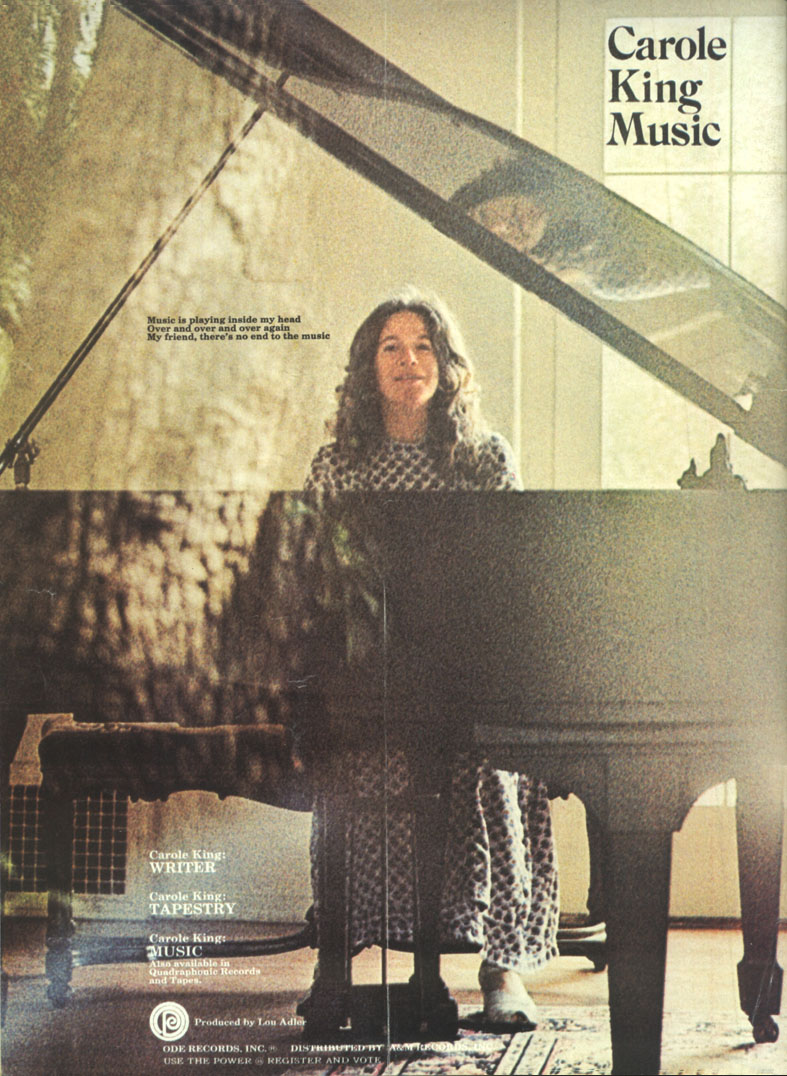
Although it received positive reviews, “Writer” was initially a commercial flop and it wasn’t until the following year that King finally returned to the Top 40 charts with her second effort as a singer-songwriter.  Actually “return” is an understatement. “Obliterated” is a more suitable term because “Tapestry” hit the airwaves like a howitzer and Carole King was suddenly an iconic 1970s singer-songwriting superstar.

“Tapestry” owned the Number One Billboard Album spot for an unprecedented 15 consecutive weeks, the most ever by a female solo artist, and it took over 40 years (this year to be exact) before the work of another female artist finally surpassed its total number of weeks at the top, albeit non-consecutively. That album, Adele’s “21” still has a long way to go, however, before ousting “Tapestry” from its standing as the longest charting album by a female solo artist…with over 300 weeks logged between 1971 and 2011.

Certified Gold only days after its release later that year and reflecting the mood of its predecesor, King’s third album, “Music” (officially “Carole King: Music”) immediately joined “Tapestry” as a Top Ten Album on the Billboard Charts, where it would sit at Number One for three consecutive weeks in 1972, while remaining on the charts for over  40 more.

Yes summer is over but, so long as the music keeps playing, perhaps a little seasonal reinvention is a very good thing indeed.

  LISTEN TO TODAY’S SELECTION – Wednesday 5 September

Music

 Music is playing inside my head

Over and over and over again

My friend, there’s no end to the music…

Ah, summer is over

But the music keeps playing

And won’t let the cold get me down

Pictures are forming inside my brain

Soon with the colors they’ll rain together and grow

Then don’t you know, don’t you know there’ll be music…

Ah, it’s not always easy

But the music keeps playing

And won’t let the world get me down.