…been waiting for the sun to rise and shine

Moments before sunrise and my son and I were speeding down New Hampshire Route 101, with today’s selection as our musical accompaniment.  There are a myriad of ways to see in your 50th birthday and I’d decided to see in mine by watching day break over the Atlantic at Hampton Beach.

Why Hampton Beach?  Well, it’s within easy reach of our Boston-area home, and in the early morning you can find hundreds of parking spaces along the competently manicured strand.  Hampton also holds schoolboy memories of a time long lost…gone. And although I never could vouch for its honky-tonk surrounds, any dawn in decent weather brings that enchanted moment, when the world holds its breath and the sun cracks the cerulean horizon before blending into the day.  Over in an instant, it’s the “grand commencement,” and what happens next is all up to you.

When the baby of our family whooped it up at her own (high school) commencement this past weekend, with her pal, Christian providing “musical accompaniment” on a plastic trumpet (from his impromptu perch near the podium), it reminded me of that moment and this song, featured on Todd Rundgren’s 1973 album, “A Wizard, A True Star.”

Propitiously perhaps, the vinyl album is memorable for pushing the limits of how much music (55:56) could fit on an LP (long-playing record). Acknowledging a slightly diminished sound quality, in the liner notes, Rundgren advised listeners to crank up the volume.

Hmmm, push the limits and crank up the volume.  Sounds like sage advice to me.

LISTEN TO TODAY’S SELECTION – Monday 11 June  

Just One Victory

 We’ve been waiting so long

We’ve been waiting so long

We’ve been waiting for the sun to rise and shine

Shining still to give us the will

 Can you hear me, the sound of my voice?

I am here to tell you I have made my choice

I’ve been listening to what’s been going down

There’s just too much talk and gossip going round

 You may think that I’m a fool, but I know the answer

Words become a tool, anyone can use them

Take the Golden Rule, as the best example

Eyes that have seen will know what I mean

 The time has come to take the bull by the horns

We’ve been so downhearted; we’ve been so forlorn

We get weak and we want to give in

But we still need each other if we want to win

 (Hold that line, baby hold that line

Get up boys and hit ’em one more time

We may be losing now but we can’t stop trying

So hold that line, baby hold that line)

If you don’t know what to do about a world of trouble

You can pull it through if you need to and if

You believe its true, it will surely happen

Shining still, to give us the will

 We’ve been waiting so long

We’ve been waiting so long

We’ve been waiting for the sun to rise and shine

Shining still to give us the will

Bright as the day, to show us the way

Somehow, someday

We need just one victory and we’re on our way

Prayin’ for it all day and fightin’ for it all night

Give us just one victory, it will be all right

We may feel about to fall but we go down fighting

You will hear the call if you only listen

Underneath it all we are here together

Shining still to give us the will

Bright as the day, to show us the way

Somehow, someday

We need just one victory and we’re on our way

Prayin’ for it all day and fightin’ for it all night

Give us just one victory, it will be all right.

 (Hold that line, baby hold that line

Get up boys and hit em one more time

We may be losing now but we can’t stop trying

So hold that line, baby hold that line)


…there’s more to love than boy meets girl

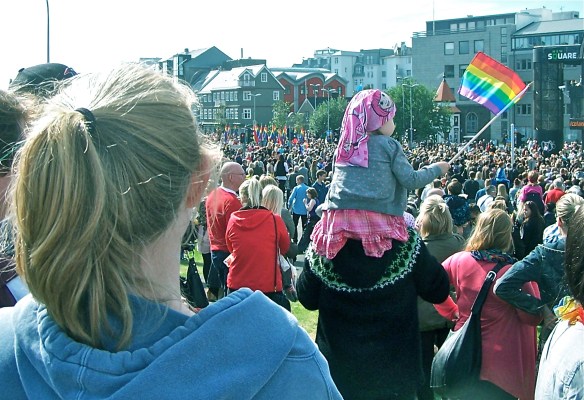
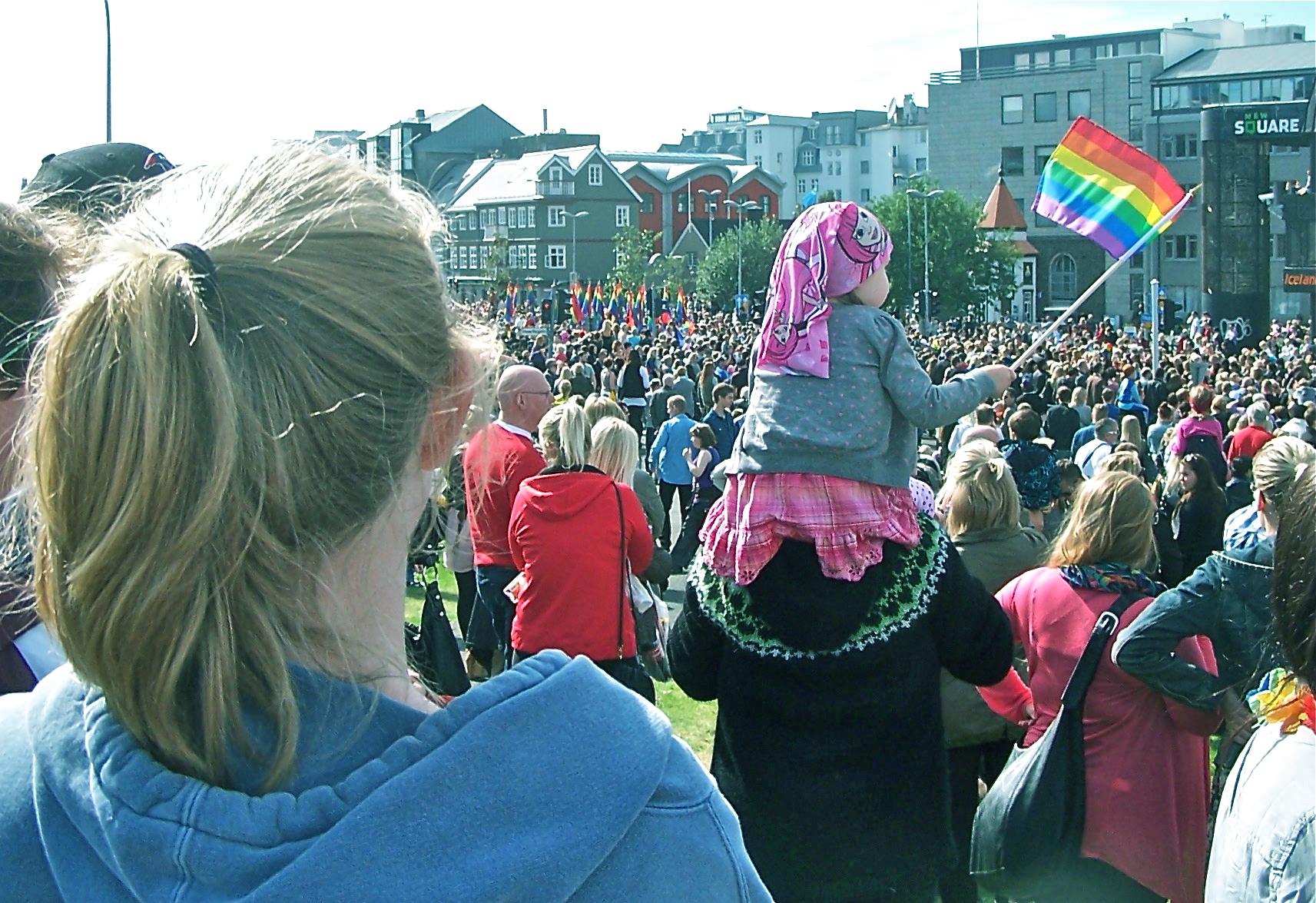
Viewed by many as a way to support human rights for all, there are now Gay Pride celebrations in numerous cities throughout the world.  In Reykjavik, for example, the annual parade attracts some 80,000 people…which is nearly a third of Iceland’s population.

While estimates vary (based upon whichever study/survey you subscribe to), we’re on solid ground when we say that at least 7 percent of women and 8 percent of men, between the ages of 14 and 94, identify themselves as gay, lesbian or bisexual in these United States.  With a sum total in the vicinity of 25 million, that represents a population that’s greater than those of most countries on earth.

Yet well within Baby-boom memory (‘though many of us remained blithely unaware), this considerable segment of society was deemed to be un-American and subversive. Designated as “security risks” (ostensibly for their lack of “emotional stability”), the names of known homosexuals were included on the same U.S. State Department watch lists as anarchists and communists.

Right through the 1960s, the FBI, local police and even the U.S. Post Office also “kept track” while state and local legislators amped the vitriol even further.  Thousands of American citizens were harassed, humiliated, jailed or institutionalized. Gay enclaves (discreetly) remained in major cities like New York, of course, but there were no legal establishments where gays or lesbians could openly congregate without being arrested.

Ever a bohemian magnet, New York’s Greenwich Village, with its rich history of Prohibition speakeasies, seemed to provide a tolerable remedy at least, and right through the ‘60s “private bottle clubs” catered to members of the gay community. With peepholes at the door so that bouncers could examine those wishing to enter, such unlicensed “clubs” were generally owned by mobsters, who overcharged for watered-down drinks and treated their patrons with distain.

The Stonewall Inn at 43 Christopher Street was a prime example of such an establishment, with overrunning toilets, no fire exits and used glasses that were “washed” in tubs of water behind the bar prior to reuse.  However, it was the only gay club in all of New York that allowed dancing, and on Saturday the 28th of June 1969, the place was packed.

That evening a number of undercover police had infiltrated the swarm to gather “visual evidence” while the Sixth Precinct’s Public Morals Squad waited quietly outside. When the signal was given, they commenced with their raid and in typical fashion, the lights were turned on, the music turned off and harried customers were lined up to have their IDs checked and recorded.  Those in full drag, or in the case of women, those who weren’t wearing at least three pieces of “feminine” clothing were arrested, as were those without proper identification.

Two paddy wagons were needed that night and when the first one arrived a crowd began to gather.  But the second wagon was delayed, leaving incarcerated patrons and their police captors in full view of an ever-growing throng.  When a cop shoved one of the drag queens she hit him on the head with her purse and someone shouted “Gay power!” which became a chant.  Meanwhile it was being rumored that people were being beaten up inside and onlookers began to throw coins, then bottles at the police.

Next came an “unknown woman” in handcuffs (described as typically “New York butch”) who’d been struggling with the police and, in plain sight, was bashed in the head with a billy club.  Staggering, she turned to the crowd and shouted, “Why don’t you guys do something!?” And thus began the Stonewall riots.

By dawn a “surreal quiet” is said to have descended over Christopher Street, as the morning’s newspapers all displayed a similar tally: four police officers injured, thirteen people arrested, some of them hospitalized.  There was further rioting that Sunday night (and for a few nights after that) with many more police (including the riot squad) and many more protesters, some of whom would come to form the Gay Liberation Front in the months ahead.

Beat poet (and gay literary icon), Allen Ginsberg, himself a Christopher Street resident, was there as well. “You know, the guys there were so beautiful,” he later commented. “They’ve lost that wounded look that fags all had 10 years ago.”

As another witness put it, “From going to places where you had to knock on a door and speak to someone through a peephole in order to get in. We were just out. We were in the streets.”

“Stonewall” is now recognized as the catalyst for today’s LGBT (Lesbian, Gay, Bi-sexual, Transgender) movement, and in the United States LGBT Pride events are generally held in June as a result.  “Boston Gay Pride” the largest such event here in New England, takes place this weekend (June 8 – 10).  And to commemorate a classic human rights struggle we posit this “weekend” selection.

Known equally for his falsetto voice and his vocal support of gay rights, the diminutive James William Somerville was born in Glasgow in 1961.  In 1983 he co-founded the openly gay, “synth pop” group, Bronksi Beat, which proceeded to have a string of hits on the British charts.

Then, in 1985 he and classically trained pianist, Richard Coles (now of Church of England Vicar) formed the “synth pop” duo, The Communards, which also had a string of hits during its three year run.  Today’s selection, co-written by Somerville and Coles, is the second track from the duo’s second album, “Red” released in 1987.

LISTEN TO THIS WEEKEND’S SELECTION – Friday/Saturday 8/9 June  

There’s more to love than boy meets girl

I would like to shout it from the highest mountain

To tell the world I’ve found love and what it means to me

But all around there’s violence and laws to make me think again

Maybe one day they will understand

There’s more to love than boy meets girl

There’s more to love than boy meets girl

For love is strange and uncontrolled, it can happen to anyone

There’s more to love than boy meets girl
How can one man decide the fate and destiny of innocent lovers

And why is it less of a crime to take the life of another?

Through time they’ve always tried to hide

and cast aside this love denied

In the shadows we held each other tight

There’s more to love than boy meets girl

There’s more to love than boy meets girl

For love is strange and uncontrolled, it can happen to anyone

There’s more to love than boy meets girl

 I saw your face, it caught the light, infatuation swirls inside

My every thought for days was only you

So I’ll climb that mountain and shout it loud

I’ll never let them bring me down

And one day they will have to understand

There’s more to love than boy meets girl

There’s more to love than boy meets girl

For love is strange and uncontrolled, it can happen to anyone

There’s more to love than boy meets girl
There’s more to love than boy meets girl

There’s more to love than boy meets girl

For love is strange and uncontrolled, it can happen to anyone

There’s more to love than boy meets girl
 There’s more to love than boy meets girl

There’s more to love than boy meets girl

For love is strange and uncontrolled, it can happen to anyone

There’s more to love than boy meets girl

….I’ll kiss you for each leaf on every tree

In the 1940s many of his recordings included the following “Copyright Warning”:

“This song is Copyrighted in U.S., under Seal of Copyright # 154085, for a period of 28 years, and anybody caught singin’ it without our permission, will be mighty good friends of ourn, cause we don’t give a dern. Publish it. Write it. Sing it. Swing to it. Yodel it. We wrote it, that’s all we wanted to do.” 

Of course there are many factions who still claim the copyrights to many of these songs  and the obfuscated legalese contained within their warnings is no longer quite so friendly and folksy.

Born in Okemah, Oklahoma in 1912 and named after the Democratic Governor of New Jersey, and soon to be President of the United States, Woodrow Wilson “Woody” Guthrie’s folk compendium includes well over a thousand traditional, political and children’s songs. Cited for his natural ability to play by ear (and never learning to read or write music), Guthrie began to learn old ballads and English and Scottish folks songs as an adolescent. Although he never graduated from high school those who knew him noted how he always seemed to be reading.

With the onset of the Great Depression, Guthrie joined the wave of migrant workers, moving from Oklahoma to California, learning countless folk and blues songs along the way.  After “borrowing” a plethora of styles, he began to write and perform songs about his own experiences, and came to be known as the “Dust Bowl Troubadour.”

Eventually the twice married and twice divorced Guthrie accepted an invitation from his friend Will Geer (that’s right “Grampa Walton”) and moved to New York City where he performed in various venues and on the radio, his guitar displaying the slogan, “This Machine Kills Fascists”.  It was in New York, in 1940, that his most famous song came into being. After growing tired of listening to Irving Berlin’s “God Bless America” (which he considered to be complacent and unrealistic) he wrote “This Land is Your Land” (subtitled: “God Blessed America For Me”).

Although he thought the best use of his talents would be to perform his anti-fascist songs as a USO performer, the US Army disagreed and conscripted him for the draft.  As some of his friends were going into the Merchant Marine he decided to join them, serving as dishwasher and troop entertainer on the long transatlantic voyages.  However, in 1945 some of Guthrie’s “left-leaning” associations came to light (although he never considered himself to be Communist he was accused of being one) and, now barred from the Merchant Marine, he was drafted into the Army.

While on furlough he married his third wife, Marjorie, and after the war they moved to a house on Mermaid Avenue in Coney Island, where they had four children, including Nora and little Arlo (who would follow in his father’s folk footsteps). The years that followed were Woody Guthrie’s most productive as a songwriter and the resulting collection (much of it never recorded) was archived by Marjorie after his death in 1967 (from Huntington’s Chorea) and later by his daughter Nora.

In 1992 Nora, who wanted to introduce her father’s songs to a new generation of musicians, approached (our old friend), English “non-folk” singer, Billy Bragg, after attending his Guthrie tribute concert in Central Park.  As Woody didn’t write music, the lyrics Nora presented to Bragg included only stylistic notations.

Bragg then approached the band, Wilco (none of whom he’d previously met) and asked them to participate in the project, which included writing contemporary music for a selection of Guthrie’s lyrics and then recording the songs. The resulting album, Mermaid Avenue, was Released in 1998.

Hailed as a huge success and nominated for a Grammy Award as Best Contemporary Folk Album, after it’s release two follow-up albums were produced and other artists began to follow suit by recording unpublished material by Woody Guthrie.  Not that the Billy Bragg and Wilco were first at the door. As a matter of fact, as Bob Dylan noted in his autobiography, “Chronicles” Woody Guthrie had offered his unpublished songs to him back in the early 1960s, but he was unable to access them because Arlo Guthrie wouldn’t let him in the house.

Performed by Jeff Tweedy of Wilco, This is track number 13.  Between his mother and his daughter, Guthrie clearly thought a lot of the name, Nora.

LISTEN TO TODAY’S SELECTION – Thursday 7 June  

Hesitating Beauty

 For your sparkling cocky smile I’ve walked a million miles

Begging you to come and wed me in the spring

Why do you my dear delay

What makes you laugh and turn away

You’re a hesitating beauty, Nora Lee

 Well I know that you are itching to get married, Nora Lee

And I know how I’m twitching for the same thing, Nora Lee

By the stars and clouds above we could spend our lives in love

You’re a hesitating beauty, Nora Lee

 We can build a house and home where the flowers come to bloom

Around our yard I’ll nail a fence so high

That the boys with peeping eyes cannot see that angel face

My hesitating beauty Nora Lee

Well I know that you are itching to get married Nora Lee

And I know how I’m twitching for the same thing Nora Lee

By the stars and clouds above we can spend our lives in love

If you quit your hesitating, Nora Lee

 We can ramble hand in hand across the grasses of our land

I’ll kiss you for each leaf on every tree

We can bring our kids to play where the dry leaves blow today

If you quit your hesitating, Nora Lee

 Well I know that you are itching to get married, Nora Lee

And I know how I’m twitching for the same thing, Nora Lee

By the stars and clouds above we could spend our lives in love

If you quit your hesitating, Nora Lee

…she’s really got a magical spell

His is not a household name, especially on these North American shores, but as lead singer he is credited with singing more hit singles (on both sides of the Atlantic) with different groups than any other recording artist in history.  Born in Exeter, Devon in 1942, Anthony “Tony” Burrows’ first started singing professionally in the early 1960s with the vocal harmony group, The Kestrels.

What?  Never heard of them? No matter, because after joining The Ivy League in 1967, he had his first (albeit marginal) hits with “Willow Tree” and “My World Fell Down”.  No?  Well, later that year The Ivy League changed its name (ah ha!) to The Flower Pot Men and it was with The Flower Pot Men that Tony Burrows had his first major hit single, at least in the UK, “Let’s Go to San Francisco” which charted at Number 4.

Still not ring a bell?  No matter, because by 1970 Burrows was firmly established as a “session vocalist” and his next big release (which peaked at Number 5 on the U.S. Billboard Chart) remains the fastest rising Number 1 hit record in UK history, remaining at the top for five straight weeks. The “band” was a studio assemblage that for the sake of the release was dubbed Edison Lighthouse and the song (written by Tony Macaulay and Barry Mason) was none other than “Love Grows (Where My Rosemary Goes).”

But “Love Grows” grew so fast that there wasn’t time to reconnect the disparate session musicians who recorded it, so the studio producer ferreted out a local pub group (called Greenfields) and, along with Burrows, brought them to the BBC studios to mime the song and stand in as Edison Lighthouse for that week’s “Top of the Pops” broadcast.

Tony Burrows, in the mean time, was on an epic roll and (on 26 February 1970) two weeks after that initial “Top of the Pops” appearance he became the only person ever to front three different groups on the same show.  In addition to Edison Lighthouse (still with the Number 1 hit) he sang “My Baby Needs Lovin’” (which hit Number 9 in the UK and Number 13 on the U.S. Charts) for White Plains, a “studio project” that had evolved from The Flowerpot Men; and then peaking at Number 10 in the UK and Number 13 in the U.S, he sang “United We Stand” with the real-live pop group (and future Eurovision Song Contest winner) The Brotherhood of Man.

And yet there’s more.  Later that year (1970) Tony Burrows and Roger Greenway (who most famously wrote “I’d Like to Teach the World to Sing”) had a hit single (Number 6 in the UK and Number 9 on the U.S. Billboard Charts) as the “novelty duo” The Pippins, singing a song that is considered to be the first-ever rap record, “Gimme Dat Ding”.

For the next few years Burrows kept a relatively low profile, serving as session singer for Elton John, Cliff Richard and big band leader, James Last.  Then in the summer of 1974 he was enlisted by a producer friend who needed someone to front yet another studio assemblage using the name, The First Class, and the resulting Beach Boys influenced release peaked at Number 13 in the UK and made it all the way to Number 4 on the U.S Billboard Charts.  But then again, “Beach Baby” is a song for another day.

LISTEN TO TODAY’S SELECTION – Wednesday 6 June

Love Grows Where My Rosemary Goes

She ain’t got no money

Her clothes are kinda funny

Her hair is kinda wild and free

Oh, but Love grows where my Rosemary goes

And nobody knows like me

She talks kinda lazy

And people say she’s crazy

And her life’s a mystery

Oh, but Love grows where my Rosemary goes

And nobody knows like me

 There’s something about her hand holding mine

It’s a feeling that’s fine

And I just gotta say, hey!

She’s really got a magical spell

And it’s working so well

That I can’t get away

I’m a lucky fella’

And I’ve just got to tell her

That I love her endlessly

Because Love grows where my Rosemary goes

And nobody knows like me

There’s something about her hand holding mine

It’s a feeling that’s fine

And I just gotta say, hey!

She’s really got a magical spell

And it’s working so well

That I can’t get away

I’m a lucky fella’

And I’ve just got to tell her

That I love her endlessly

Because Love grows where my Rosemary goes

And nobody knows like me

It keeps growing every place she’s been

And nobody knows like me

If you’ve met her, you’ll never forget her

And nobody knows like me

 La la la- believe it when you’ve seen it

Nobody knows like me

…Life used to be so hard

Before the Spaniards arrived, Laurel Canyon was inhabited by the indigenous Tongva tribe, who enjoyed the use of a spring-fed stream that flowed there throughout the year.  That stream is what eventually attracted Mexican ranchers and when they’d been summarily “moved along” in the mid-19th Century, the Anglo settlers who were next on the scene began to talk in terms of water rights.

Soon after the dawning of the 20th Century an electric (trackless) trolley began to run from Sunset Boulevard to a roadhouse part way up the canyon, which by now was being subdivided into “mountain vacation” properties. Log cabins were especially popular at the time and, until the all-mighty automobile belched its way to the forefront, those that were built beyond the roadhouse were reached either by mule or by foot.  Some of the earliest cabins still exist, including the one owned by Silent film cowboy, Tom Mix (which was later owned by Frank Zappa) and, directly across the street, Harry Houdini’s cabin.

Of course, most of us know Laurel Canyon for the many (often bohemian) celebrities who reside or have resided there, most of them actors and musicians including: Mary Astor, Jim Morrison,David Carradine, Jackson Browne, Werner Herzog, Cass Elliot, Marilyn Manson,  Lead Belly, Eric Burdon, Jennifer Aniston, Timothy Leary, Clara Bow, Louise Brooks,  David Byrne, Canned Heat, Lon Chaney, Jr., George Clooney, Alice Cooper, Micky Dolenz, Fabian, Errol Flynn, Michael J. Fox, Glenn Frey, Greta Garbo, Jimi Hendrix, Boris Karloff, Carole King, k.d. lang, Jerry Lewis, Bela Lugosi,  Dean Martin, Steve Martin, Robert Mitchum,  Patty Duke, Gram Parsons, Iggy Pop, Keith Richards (actually both The Beatles and The Stones spent time in Laurel Canyon), Meg Ryan, Slash, Dusty Springfield, Justin Timberlake, Peter Tork, Orson Wells, Brian Wilson and if you’ve made it this far you get the picture.

Then, of course, there was Crosby, Stills, Nash, Young, Mitchell and Collins.

While Steven Stills had written “Suite: Judy Blue Eyes” about his relationship with Judy Collins, which was featured on Crosby, Stills & Nash’s eponymous debut album in 1969 (hitting Number 29 on the Billboard Charts), Graham Nash wrote today’s selection in reference to his relationship with Joni Mitchell on Crosby, Stills, Nash & Young’s (technically) debut album, “Déjà Vu” in 1970 (hitting Number 30 on the Billboard Charts). This was while Mitchell was releasing her own (third) album, “Ladies of the Canyon.”

As Nash later recounted: “…once you walked into that front door, everything disappeared …and then I started to think, you know, God, that’s an incredibly domestic scene, you know, here we are, Joni Mitchell and Graham Nash, and I’m, you know, put flowers in the vase and light the fire… I love this woman, and this moment is a very grounded moment… I sat down at the piano and, an hour later, ‘Our House’ was done.”

LISTEN TO TODAY’S SELECTION – Tuesday 5 June 

Our House

 I’ll light the fire

You place the flowers in the vase

That you bought today

 Staring at the fire

For hours and hours

While I listen to you

Play your love songs

All night long for me

Only for me

Come to me now

And rest your head for just five minutes

Everything is good

Such a cozy room

The windows are illuminated

By the evening sunshine through them

Fiery gems for you

Only for you

Our house is a very, very, very fine house

With two cats in the yard

Life used to be so hard

Now everything is easy

‘Cause of you

And our la, la, la, la, la, la, la, la, la, la, la…..

Our house is a very, very, very fine house

With two cats in the yard

Life used to be so hard

Now everything is easy

‘Cause of you

And our…

 I’ll light the fire

While you place the flowers in the vase

That you bought today.

…no one knows for certain and so it’s all the same to me

Born in 1961 into a devout Pentecostal family in Paragould, Arkansas, Iris DeMent was the youngest of 14 children. When she was three the family moved to Cypress, California where she grew up, first to the sounds of gospel music and later to the influences of such artists as: Johnny Cash, Loretta Lynn, Joni Mitchell and Bob Dylan.

After college in Kansas City, DeMent remained in Missouri and supported herself as a waitress, while composing songs and honing her guitar and singing skills at open-mic nights around town.  In 1988 she made the leap to Nashville and eventually landed an independent record deal.

Today’s selection was included on her debut album, “Infamous Angel” which was released in 1992 when she was 31 years old. Despite a total lack of support from country radio, the album’s word-of-mouth acclaim landed her a major record deal, with Warner Brothers, which re-issued the album and served as the label for her next two albums as well. Now identifying herself as an “agnostic Christian” DeMent’s themes include religious skepticism, small town life, human frailty and forgiveness.

“Let the Mystery Be” has since been covered by a number of other artists (most notably 10,000 Maniacs) and was one of her numbers during Season One of the BBC Transatlantic Sessions, recorded at Montgreenan Mansion House in Ayrshire, Scotland in 1994. Here’s a YouTube clip, with priceless expressions and a group of musicians who seem to be having way too much fun…

LISTEN TO TODAY’S SELECTION – Sunday 3 June  

Let The Mystery Be

Iris Dement

 Everybody’s wonderin’ what and where they all came from

Everybody’s worryin’ ’bout where they’re gonna go when the whole thing’s done

But no one knows for certain and so it’s all the same to me

I think I’ll just let the mystery be

Some say once you’re gone you’re gone forever and some say you’re gonna come back

Some say you rest in the arms of the Savior if in sinful ways you lack

Some say that they’re comin’ back in a garden, bunch of carrots and little sweet peas

I think I’ll just let the mystery be

 Everybody’s wonderin’ what and where they all came from

Everybody’s worryin’ ’bout where they’re gonna go when the whole thing’s done

But no one knows for certain and so it’s all the same to me

I think I’ll just let the mystery be

Some say they’re goin’ to a place called Glory and I ain’t saying it ain’t a fact

But I’ve heard that I’m on the road to purgatory and I don’t like the sound of that

Well, I believe in love and I live my life accordingly

But I choose to let the mystery be

Everybody’s wonderin’ what and where they all came from

Everybody’s worryin’ ’bout where they’re gonna go when the whole thing’s done

But no one knows for certain and so it’s all the same to me

I think I’ll just let the mystery be

I think I’ll just let the mystery be

…there was a man who lived in a shed

Well, it’s out first Saturday in June and weather permitting, you’re likely to find me in and around my garden shed. Painted and shingled to match the main house, and replete with decorative shutters and flower boxes I use it as the vast majority of North American sheds are used, as a place for a bit of potting and to store a couple of bicycles, a lawn mower and an assorted collection of garden tools.

Here in the States, and despite their exteriors, most sheds are rather utilitarian storage structures, with lingo to match – taking someone to the woodshed,” is a term that generally means, “to mete out punishment” (if only figuratively) and was derived from the once common American practice of disciplining wayward boys away from public view.  Conversely, everyday sheds in the the UK are often viewed as inviting places to actually inhabit for hobbying or tinkering.

Sheds, according to Gordon Thorburn (author of “Men and Sheds”) are a veritable “male necessity,” providing a “place of retreat” for much-needed solace. Right, but whether male or female this notion of solace is certainly one that many artists have cottoned to. I also have a number of friends who run small businesses from their (expanded, sometimes beautifully appointed) sheds.

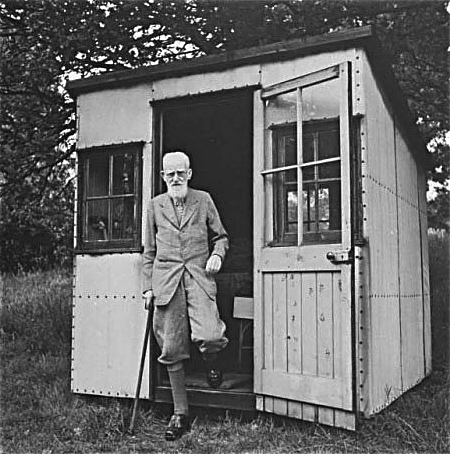
But when it comes to outright shed-creativity, the true champion (in my opinion) has got to be George Bernard Shaw who, for the final decades of his life, worked within the confines of an inredible writer’s shed that he had designed for his Hertfordshire property. To have a rural shed hooked up with electricity, a telephone and a buzzer system in the early half of the 20th Century was remarkable in itself, but what truly made this the Shed of Sheds was the fact that it was built on a turntable, enabling Shaw to push it around to follow the sun.

Man and Supershed – The great man and his writing shed

One way to follow the sun

As an author, a playwright and a progressive voice, Shaw has long been an inspiration, but knowing about his shed-writing habits (e.g. that’s where he wrote “Pygmalion”) was one of the considerations that drove me to accept the offer of some dear friends (whose third floor I was renting) to use the shed at the bottom of their terrace house garden in Tooting (South London) as a “writing hut.”

While it lacked that marvelous turntable, there was ample room for a desk and a case for my books, with windows to steer away the elements and allow me to gaze out at the stars. And while my heating source was a not-very-efficient paraffin heater, there was electricity for my archaic electric typewriter, my battered radio and (certainly not least) my espresso machine. After a year or so I had the entire back wall papered with rejection slips, a cautionary tale to you writers about the futility of unsolicited submissions to publishers through the “slush pile” route.

Although I’ve since come to enjoy the more spacious comforts of attic “garret” offices, there remains something fresh and primal (not to mention cozy) about retreating to the rustic interior of an open-windowed shed. Even if it does let in the rain on occasion, as in today’s selection (…at last) by Gabrielle’s brother, Nick Drake, recorded in 1969 and featured on his debut album, Five Leaves Left.

LISTEN TO TODAY’S SELECTION – Saturday 2 June

Man in a Shed

Well there was a man who lived in a shed

Spent most of his days out of his head

For his shed was rotten let in the rain

Said it was enough to drive any man insane

When it rained

He felt so bad

When it snowed he felt just simply sad.

Well there was a girl who lived nearby

Whenever he saw her he could only simply sigh

But she lived in a house so very big and grand

For him it seemed like some very distant land

So when he called her

His shed to mend,

She said I’m sorry you’ll just have to find a friend.

Well this story is not so very new

But the man is me, yes and the girl is you

So leave your house come into my shed

Please stop my world from raining through my head

Please don’t think

I’m not your sort

You’ll find that sheds are nicer than you thought.


…Hi there, nice to be with you, happy you could stick around

Don’t you hate when that happens?  You wrap yourself around a really cool concept only to find that most of the rest of the world doesn’t “get it.”  It was 25 September 1962 and a couple of students at Central Saint Martins College of Arts and Design (aka CSM) were watching a transatlantic broadcast of the Sonny Liston/Floyd Patterson match (“boom” …third fastest knockout in a world heavyweight title fight).

Somewhere after that first round, tuba player and future lead-vocalist, Vivian Stanshall and saxophonist, Rodney Slater hit it off and started to talk about music.

After pulling in a few of their mates they decided to form a band whose name would be derived from the old “Dada” game of cutting up sentences from a magazine and pulling them out of a hat to re-juxtapose them and form something new. The favorite combination was “Bonzo Dog/Dada” and the band first performed under that name, until they quickly grew tired of having to explain what “Dada” means (most of the rest of the world didn’t “get it”)  And so they became the Bonzo Dog Doo-Dah Band, aka The Bonzos.

Playing mainly as a jazz brass band, they sometimes worked at five pubs a week, gaining a reputation as a band that played “good drinking music” and, in 1966, garnering a record deal.  But the siren call of rock and roll was too hard to ignore and the following year they released their first album, “Gorilla”, featuring today’s selection.

1967 was also the year that Paul McCartney asked them to appear in the Beatles’ Magical Mystery Tour film and preform Stanshall’s song, “Death Cab For Cutie” and it was also the year that they were hired to serve as house band for the ITV program (… I mean, programme) “Do Not Adjust Your Set” which (auspiciously) featured future “Monty Python” alums, Eric Idle, Terry Jones and Michael Palin….

Written by Vivan Stanshall, “The Intro and the Outro” featured every member of the band, credited with their actual instruments, and then moved on to the likes of John Wayne on xylophone and (somewhat) well-known ornithologist, Peter Scott, playing the duck call.  All non-fictional “performers” mentioned were alive at the time with the exception of Casanova and Adolf Hitler.

In 1973, with Stanshell again providing the voiceover, this song provided the framework for Mike Oldfield’s “Tubular Bells”best known as the opening theme for “The Exorcist”

LISTEN TO TODAY’S SELECTION – Friday 1 June

The Intro and the Outro

Hi there, nice to be with you, happy you could stick around

Like to introduce “Legs” Larry Smith, drums

And Sam Spoons, rhythm pole

And Vernon Dudley Bohay-Nowell, bass guitar

And Neil Innes, piano

Come in Rodney Slater on the saxophone

With Roger Ruskin Spear on tenor sax

Hi, Vivian Stanshall, trumpet

Big hello to big John Wayne, xylophone

And Robert Morley, guitar

Billy Butlin, spoons

And looking very relaxed, Adolf Hitler on vibes… Nice!

Princess Anne on sousaphone… Mmmm

Introducing Liberace, clarinet

With Garner “Ted” Armstrong on vocals

Lord Snooty and his pals, tap dancing

In the groove with Harold Wilson, violin

And Franklin McCormack on harmonica

Over there, Eric Clapton, ukulele…. Hi Eric!

On my left Sir Kenneth Clark, bass sax…. A great honour, sir

And specially flown in for us, a session gorilla on vox humana

Nice to see Incredible Shrinking Man on euphonium

Drop out with Peter Scott on duck call

Hearing from you later Casanova, on horn

Yeah! Digging General de Gaulle on accordion….

Really wild, General! Thank you, sir

Roy Rogers on Trigger

Tune in Wild Man of Borneo on bongos

Count Basie Orchestra on triangle…. Thank you

Great to hear the Rawlinsons on trombone

Back from his recent operation, Dan Druff, harp

And representing the flower people, Quasimodo on bells

Wonderful to hear Brainiac on banjo

We welcome Val Doonican as himself (Hullo there)

Very appealing, Max Jaffa…. Mmm, that’s nice, Max!

What a team, Zebra Kid and Horace Batchelor on percussion

And a great favourite, and a wonderful performer, of all of us here

J. Arthur Rank on gong….